Xi’s ‘Thucydides’ Trap’ warning during summit with Trump revives debate over US-China rivalry
The concept, which draws on the ancient Greek historian Thucydides, describes the danger that conflict can erupt when a rising power challenges an established one.
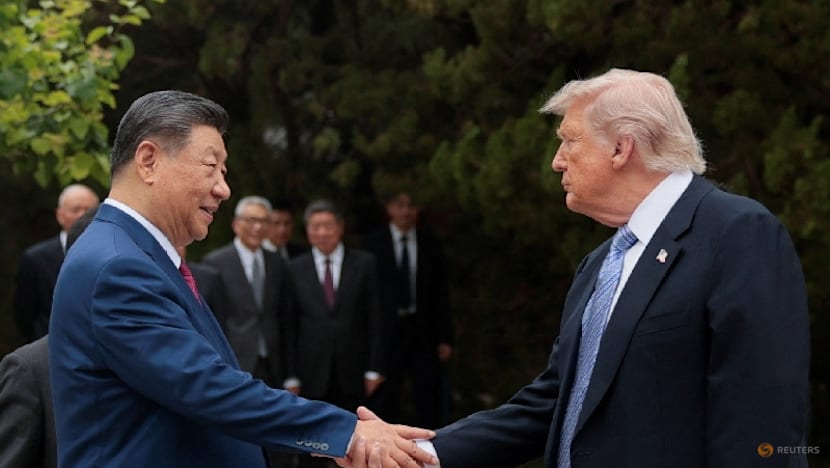
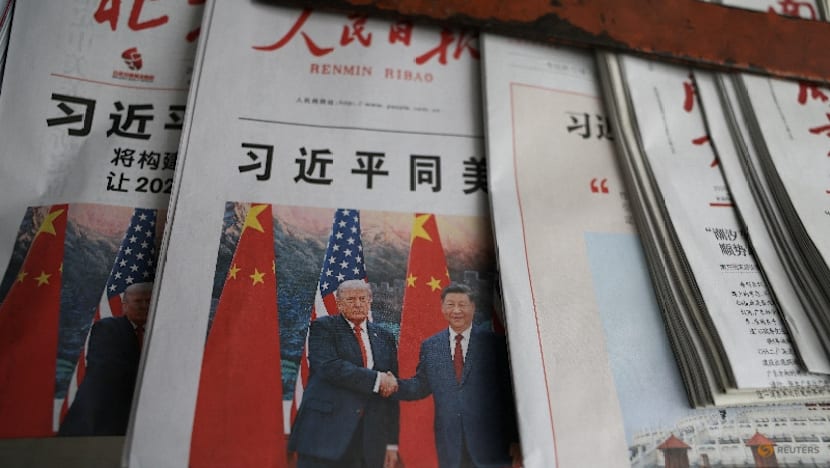
US President Donald Trump shakes hands with Chinese President Xi Jinping after a visit to the Zhongnanhai Garden in Beijing, China, May 15, 2026. (Photo: Reuters/Evan Vucci/Pool)

This audio is generated by an AI tool.


Chinese President Xi Jinping’s mention of the “Thucydides’ Trap” concept during his meeting with his US counterpart Donald Trump on Thursday (May 14) has thrust a centuries-old historical theory into the centre of modern geopolitics.
The term – popularised by American political scientist Graham Allison in his 2017 book Destined for War: Can America and China Escape Thucydides’s Trap? – describes the danger that conflict can erupt when a rising power challenges an established one.
It accurately captures the underlying tensions shaping relations between Washington and Beijing, Allison told CNA.
“Thucydides, the founder and father of history, essentially nailed the issue of China,” said the Douglas Dillon Professor of Government at the Harvard Kennedy School.
“China … is a meteoric rising power. The US is a colossal ruling power, and when a rapidly rising power seriously threatens the position of the established ruling power – typically, the outcome is a catastrophic war.”
NEW FORM OF GREAT POWER RELATIONS
The Chinese president’s remarks on Thursday reflected growing concerns among world leaders that strategic rivalry between the world’s two largest powers could spiral into open conflict.
Xi had asked in his opening remarks: “Can China and the United States overcome the ‘Thucydides’ Trap’ and establish a new paradigm for relations between great powers?”
The term “Thucydides’ Trap” originates from the ancient Greek historian Thucydides, who chronicled the Peloponnesian War between Athens and Sparta more than 2,000 years ago.
Thucydides famously wrote: “It was the rise of Athens and the fear that this instilled in Sparta that made war inevitable.”
Allison said Xi understands the implications of that historical lesson “deeply”, while Trump also appears to appreciate the risks.





“The two of them have determined that they want to not be caught in Thucydides’ trap; (to) not to have this relationship spiral into a war the way it has typically done in other cases,” Allison told CNA’s Asia First.
He noted that instead, both leaders appear to be searching for what Xi has described as a new form of great power relations.
On Thursday, Xi announced he and Trump had agreed to establish a Sino-US relationship based on “constructive strategic stability”. This would guide ties between the two superpowers for the next three years and beyond, Xi said.
Analysts said this indicates how Beijing wants to frame the next phase of US-China relations as long-term competition managed within limits.
“That’s easy to say, hard to do. But I’d say it’s a step in the right direction,” Allison added.
Xi and Trump on Friday wrapped up a two-day summit, in what was the first trip by a US leader to Beijing since 2017 during Trump’s first presidential term.
TIMING OF LATEST WARNING
While Xi has referenced Thucydides’ Trap before, Allison said the timing of this latest warning – delivered directly to Trump during a high-stakes summit – was significant.
He noted that if both countries continue their current trajectory, it will produce “history as usual” – a “catastrophic war” that neither China nor the US would survive.
“This is not just about one meeting. This is not just about one person. This is about international security,” Allison added.
The broader challenge, he argued, lies in balancing two competing realities.
“The US believes that as the world leader, it’s actually created an international security order that’s been to the benefit of all of us,” he added, pointing to the absence of a great-power war over the past 80 years as evidence of that system’s success.
“This is the longest period without great power war since the Roman Empire. It's produced greater well-being for everybody in the world, including Singapore, than previous periods in their history.”
At the same time, China increasingly sees itself as deserving “a bigger place in the world, a bigger place in the sun” as its economic, military and technological power expands, Allison said.
He pointed out that Singapore’s founding prime minister Lee Kuan Yew had long anticipated this strategic dilemma.
The late Lee once stated that the 21st century “will be a contest for supremacy in the Pacific” between the US and China.
“NOT WRONG TO SAY WAR IS LIKELY”
Conflict is not bound to happen, but the risks are substantial, warned Allison.
In his book, he had examined historical cases over the past 500 years in which a rising power challenged a dominant one. Among 16 such cases, 12 ended in war.
“It would obviously be wrong to say war is inevitable. It would not be wrong to say war is likely,” he noted.
Among the examples he cited was the Cold War between the US and the Soviet Union. Despite decades of intense rivalry, ideological competition and nuclear brinkmanship, the two superpowers ultimately avoided direct military conflict.
The key to this was mutual recognition that neither side could survive a nuclear exchange, said Allison.
“The two parties recognised that given that they had equal capabilities for destroying the other, they were going to have to find some way to live together,” he said.
That eventually evolved into a détente – a French term often used to refer to the easing of Cold War tensions from 1967 to 1979.
Allison contrasted that outcome with Europe in 1914, when the rise of Germany challenged British dominance, ultimately leading to World War I.
History shows how “neglect produces bad results” and how “thoughtful policy can do better”, he added.
He suggested that the long-term US-China relationship could resemble the Olympic Games: Intensely competitive, but ultimately peaceful.
Competition itself is not necessarily dangerous, Allison added.
“You and I run faster if we’re running against each other and competing,” he said.
The real test, he added, is whether both systems can coexist without turning rivalry into military confrontation.