‘No boom is forever’: Singapore must seize AI opportunity before correction, says PM Wong
Speaking at the Forbes Global CEO Conference, Prime Minister Lawrence Wong also touched on how countries should deal with the risk of powerful and autonomous artificial intelligence (AI) systems going rogue.
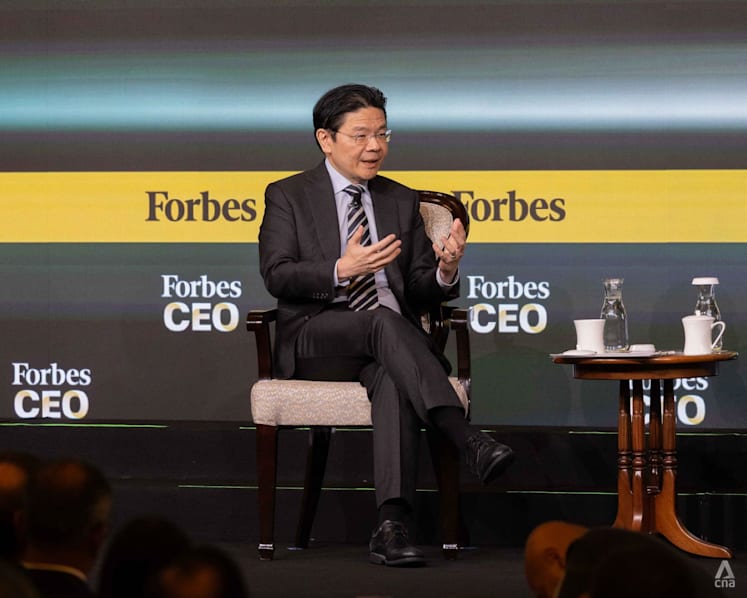
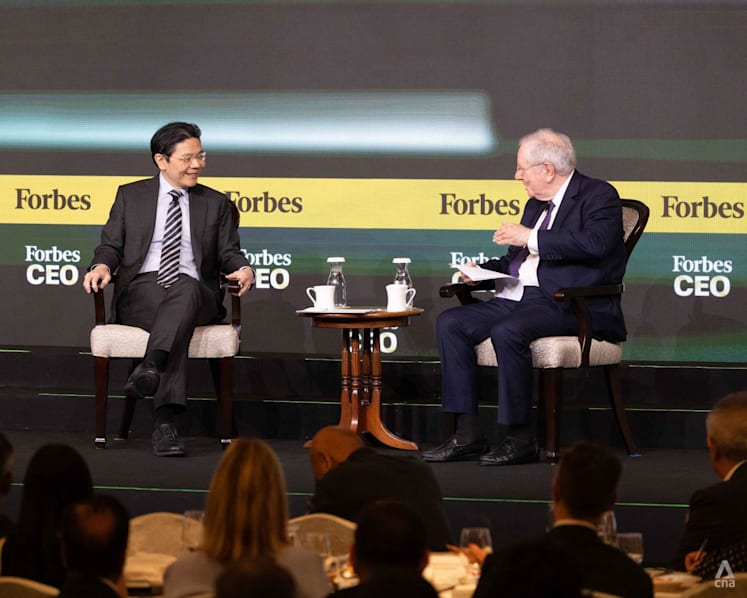
Prime Minister Lawrence Wong, and Forbes Media chairman and editor-in-chief Steve Forbes during the Forbes Global CEO conference at Shangri-La on Oct 8, 2026. (Photo: CNA/Ili Mansor)

This audio is generated by an AI tool.


SINGAPORE: The artificial intelligence (AI) boom that has benefitted Singapore economically will not last forever, and the country's approach is to make good use of this window of opportunity to build new capabilities and create better jobs for Singaporeans, said Prime Minister Lawrence Wong on Thursday (Oct 8).
"No boom is forever. At some point, there will be a correction. And we don't know when it will happen, or how it will happen, we don't know who the casualties will be when it happens,” said Mr Wong, who is also finance minister.
“So our approach is to make good use of this window of opportunity now, where there is external demand, capitalise on it, build new capabilities and create better jobs for Singaporeans.”
He was speaking during a dialogue with Forbes Media chairman and editor-in-chief Steve Forbes at the Forbes Global CEO Conference held at the Shangri-La Singapore.





Mr Wong said the current AI boom has benefited Singapore’s semiconductor industry and related industries, with positive spillovers in sectors such as logistics and professional services.
“We don't make the most advanced AI chips, but we have major firms here like GlobalFoundries, Micron, and they make memory chips and specialty chips, which are in demand now with the AI boom,” he said.
He added that Singapore has also built a semiconductor ecosystem that includes the precision engineering industry and equipment suppliers.
INTERNATIONAL AI SAFEGUARDS
Mr Wong said that no country can deal alone with the risk of powerful and autonomous AI systems going rogue, or by rogue actors misusing AI to cause harm.
While it is good that the United States has appointed a task force to oversee this space, the rules and standards for frontier AI development will eventually have to be international, he said.
“It cannot be just confined to a single country, so ideally international safeguards are put in place, perhaps under the auspices of the United Nations. But that will take time,” he said.
AI safety requirements will also depend on the needs and applications of various sectors, such as healthcare, finance and advanced manufacturing, said Mr Wong.
“I think that the requirements will vary from sector to sector, and the decisions every sector regulator will have to make will be what sort of decisions ought to remain within human control, where is the human in the loop, and what kind of safeguards do you have for your sector,” he said.
Such safeguards are already taking shape in areas such as finance and transport.
Mr Wong cited newly published guidelines by the Monetary Authority of Singapore on the use of AI in finance, and the testing of autonomous cars on Singapore roads – with a pilot by autonomous driving company Waymo letting the authorities test the technology and understand safety requirements before a broader rollout under some regulatory oversight.
Turning to AI’s impact on workers and the jobs market, Mr Wong said Singapore’s approach is “not to protect the job, but to protect every worker”. This is done through close cooperation between the government, employers, and unions over the decades, he said.
NAVIGATING GEOPOLITICS
During the dialogue, Mr Wong also highlighted the impact of tariffs on the economy and called for free trade and freedom of navigation globally.
“We are concerned that what's happening in Hormuz may set a precedent for elsewhere, because if a critical international waterway can be weaponised or arbitrary tolls imposed on shipping through something like Hormuz, then countries may be tempted to do the same elsewhere,” he said.
He drew comparisons with the Strait of Malacca and Strait of Singapore, which he called a “critical maritime chokepoint” in this part of the world.
Mr Wong said he has discussed this issue with his counterparts in the other littoral states – Malaysian Prime Minister Anwar Ibrahim and Indonesian President Prabowo Subianto – and they are fully aligned on the principle that “international waterways must remain open, freedom of navigation and the right of transit passage has to be respected”.
“Even if you may hear rhetoric to the contrary, the leaders are aligned. We will defend these principles strongly, and we will work with partners to uphold these principles,” he said.
Mr Wong said Singapore has “not been able to understand” the tariffs imposed by the US, but that it cannot do anything. “The right tariff should be zero,” he said.
He added that other countries are also putting up more trade barriers, amid increasing concern about competition.
“There's concern that exports from other countries will impact local industries, will impact jobs. So you can see the pendulum shifting,” he said.
While this does not mean trade will stop, the global economy will become more fragmented by regions, he added.
Noting the importance of trade to Singapore, Mr Wong said the country cannot afford to turn inwards, as it “will get poor very quickly” if it does so.
It therefore aims to accelerate the integration in ASEAN, adding that it will have initiatives to do more on that front when it takes the chair of the regional bloc next year, he said.
“We will step up our connections with existing partners, and I think there are also opportunities with new regions like Latin America, Africa and the Middle East, which we hope to do more,” he said, adding that Singapore hopes to be a connector across different regions.

On energy security, Mr Wong said that when the Iran war broke out in February, Singapore was prepared for a “worst-case scenario” akin to the situation during the COVID-19 pandemic when countries scrambled for oil, energy and essential supplies, but fortunately that did not pan out.
“It reflects the adaptive and resilient nature of the global economy. Countries and companies have been able to adapt and adjust, and we see that in Singapore,” he said.
As an energy hub, Singapore has refineries to source for crude oil from outside the Middle East. Though it was a different grade of crude, which resulted in lower output, the refineries were still able to operate and service all their customers in Singapore and beyond.
He added that the risk of a “sudden and severe dislocation” of energy supplies has come down and Singapore is prepared for a prolonged conflict situation where energy prices remain high for longer, along with higher inflationary pressures that also feed into food and other supplies.
Reiterating that Singapore's fiscal position is strong and healthy, he said the country is able to take decisive action if needed and has rolled out support packages to cushion the impact on households and businesses.
"If things get worse, we will be prepared to do more,” he added.
Asked about nuclear power, Mr Wong said Singapore is embarking on Phase 1 of the International Atomic Energy Agency’s Integrated Nuclear Infrastructure Review.
This is a very preliminary stage to examine whether the country has the ability to even consider civilian nuclear power.
“We will go through the due process. We will publish the results of that study, and if there are concerns, then we may not be able to proceed," he said.
But if the study shows that it can be done in Singapore, especially with newer technologies and the small modular reactors that are surfacing now, the country will consider whether to take the next stage.
“So we are doing it in a very deliberate and careful manner, so that we can continue to get public trust and support behind such an initiative. We don't want to rush this. It is a very important and critical undertaking, and we have to get it right,” said Mr Wong.
SECRET TO SUCCESS AND COMPETITIVENESS
During the dialogue, Mr Wong also spoke about Singapore's government, openness and competitiveness.
He noted the importance of a good government and having "a few of the best in every cohort" to be able to serve.
"You have to identify people with the right character and values, and appeal to their sense of purpose and their sense of meaning and calling. So that's what we try very hard to do," he said.
The prime minister announced last month that Singapore’s political office holders will receive a salary increase of up to 9 per cent, taking the sum to about S$1.2 million annually for a minister in the lowest MR4 grade.
The changes will kick in from Oct 15 this year, marking the first time since 2011 that ministerial salaries have been changed.
The matter was debated in parliament, with Nominated Members of Parliament calling for changes to the political salary framework's structure, while MPs from the ruling party relayed residents' questions and concerns about the planned increase.
Mr Wong said on Friday that while the salary framework for ministers will not match their private sector pay, it is "broadly competitive".
"There will still be a discount, but at least the burden and the financial loss and the hurdle of entering politics is not so great,” he added.
"And on that basis, we have been able to attract and retain good people in government these last 60 years."
The government is now in its fourth generation of leadership renewal, with Mr Wong as the nation's fourth prime minister.
"My mission is not only to complete my term as prime minister, but to make sure that I can attract and bring in another generation of leaders whom I can pass the baton to in due course. And that's how we keep Singapore going."
On competitiveness, he drew reference to Hong Kong, which he said is a competitor, but not the only one. He also pointed to London, New York and Dubai, noting that Singapore competes with them on tax, capabilities, institutional quality as well as on being a safe and stable place for doing business.
"I think competition only motivates us to want to do better, and to make sure that Singapore always remains the best place to do business.
"You have to always make sure your incentives are competitive. That's part of staying competitive. But like I said, it's not only about tax incentives. It's a wider range of capabilities as well," said Mr Wong.
As Singapore draws in capital, it is important to ensure the capital is legitimate and used productively, while adding value to the country and its people and creating better jobs, he added.
Increasingly, investors look at where they can put their capital for the long-term; a place where rules are clear and institutions are sound, stable and strong, said Mr Wong.
"We want Singapore to be one of these places. So integrity, trust is uppermost on our considerations. If there's wrongdoing, if there's illicit money, we will take action," he added.
Addressing questions on monetary policy, Mr Wong noted that Singapore is in a "very different position" at a time when many advanced economies are facing record-high levels of debt.
"We have a strong, healthy fiscal position. We have investments from our reserves, which generates investment income that goes into our current revenue.
"We run the economy as well as we can, and so if the fundamentals of the economy are strong, that makes it easier for the central bank to exercise judgment and to have sound, independent monetary policy."
Acknowledging that Singapore is “not at all” a cheap place to live, Mr Wong also outlined the country’s support measures, along with the monetary policies that leaves it well positioned to do so.
“You cannot ask for high incomes and low prices because the services that you consume, what you pay, forms a salary for the people who provide those services,” he said.
“So what's critical is real incomes, incomes after netting of inflation, and so we watch that very carefully and make sure that real incomes continue to rise across all segments of our population, not just at the top level, not even at the median, but especially at the lower end. And we want, of course, income inequalities to continue to come down. And so far, it has been happening.”
Mr Wong said the general approach with cost and affordability, is not to artificially have the government intervene to cap prices as that may lead to a lot of unintended consequences.
“If prices are high, we accept that these are market prices,” he said, adding that targeted support is instead provided to households and groups that need it.
This includes utility rebates and targeted cash support for lower- and middle-income families, said Mr Wong.
Additional reporting by Natasha Ganesan