Healthcare's new challenge is 'living well', but women spend more years in ill health: Ong Ye Kung
Mr Ong, who is Minister for Health and Coordinating Minister for Social Policies, was speaking about women's health in a dialogue with former first lady of the United States Jill Biden at a forum in Singapore.
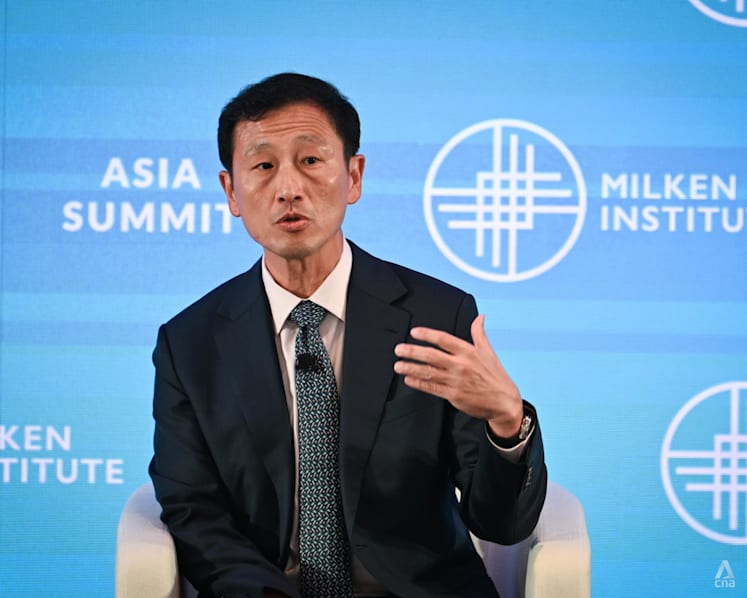
Minister for Health and Coordinating Minister for Social Policies Ong Ye Kung speaking at the Milken Institute Asia Summit on Oct 8, 2026. (Photo: CNA/Syamil Sapari)

This audio is generated by an AI tool.


SINGAPORE: Modern healthcare systems are shifting from fighting infectious diseases to delivering “healthy longevity”, an area where women face more biological hurdles and health vulnerabilities than men, said Minister for Health Ong Ye Kung on Thursday (Oct 8).
Speaking at the Milken Institute Asia Summit in Singapore, Mr Ong, who is also Coordinating Minister for Social Policies, said that as people live longer, it is less about survival and more about living well – bridging the gap between a lifespan and the number of years spent in good health, also known as the morbidity gap.
"What you want is the gap between lifespan and healthspan to be as short as possible. In Singapore, that's about 10 years. For women it is 12 years. For men, it's slightly less than 10 years,” said Mr Ong.
“Although women live four and a half years longer than men on average in Singapore, half of that is spent in ill health."
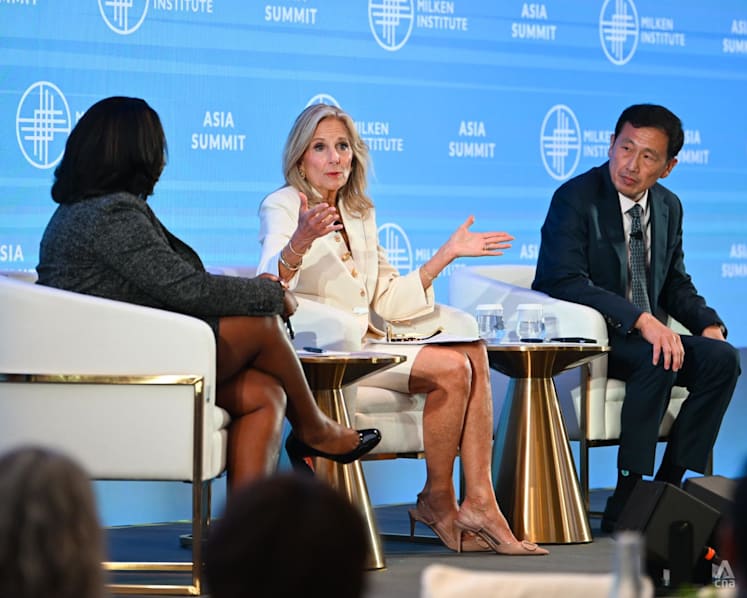
He was speaking to Dr Jill Biden, the former first lady of the United States from 2021 to 2025 and the chair of the Milken Institute Women's Health Network, in a conversation about the future of health. The session was moderated by Ms Esther Krofah, the executive vice president of Health at the Milken Institute.
The Milken Institute is an American non-profit, non-partisan think tank that organises the Milken Institute Asia Summit annually.
The 13th edition, which runs from Oct 7 to 9 at the Four Seasons Hotel, is attended by leaders in business, finance, government, technology and health and had an expected turnout of 1,500 participants from 50 countries.





Asked about Singapore’s ability to invest in sex-specific health research and preventative health treatments, Mr Ong said that Singapore spends around 4.5 per cent of its gross domestic product (GDP) on healthcare, with an average life expectancy of 84 years.
Because of this, the country has the "fiscal headroom" to divide its resources between acute care and preventive care.
"Many health ministers do not have the luxury of investing more into preventive care, or their healthcare workers can't handle it. So Singapore has a unique opportunity," said Mr Ong.
"I hope Singapore can be that urban environment (where) we provide that test bed that makes things work, and that will encourage industry to say this is worth investing (in), and Singapore is one reference point that you can look at."
"DEMEDICALISING" DISEASE PREVENTION
Responding to Ms Krofah’s question about how Singapore’s Healthier SG has “(changed) the trajectory of health”, Mr Ong said that the idea behind Healthier SG is “take a leap of faith to say that preventive care works, population health works”.
“If we do things early, we can stall or delay or avoid the onset of non-communicable diseases, chronic diseases, cancer, and this is the biggest challenge in the healthcare system today,” he said.
Launched by the Ministry of Health (MOH) in July 2023, Healthier SG focuses on preventive health, where Singaporeans and permanent residents aged 40 and above are encouraged to sign up with their regular general practitioner (GP) or nearby polyclinic to create a personalised health plan.
Close to 60 per cent of eligible Singapore residents aged 40 and above have enrolled in Healthier SG and are following up for preventive care, with many others already receiving specialist care for chronic conditions.
"In most countries, the model is the GP is a gatekeeper. So if you want to go to a hospital, go through the GP first. In our case, the GP is not the gatekeeper. The GP is a pathfinder," said Mr Ong.
The initiative is part of the government's bid to "demedicalise" non-communicable disease prevention as much as possible and increase its access within the community, said Mr Ong.
By checking in with the GP every year and undergoing regular examinations, one can go through the necessary health checks, vaccinations, and be connected with community resources to stay healthy, he said.
"Preventive health and population health has to be made accessible. It is not in the clinic, it is in the community. It's in the homes," said Mr Ong.
Through the Healthier SG check-up, a general practitioner can identify a woman's risk for hereditary breast and ovarian cancer. The government will also provide financial assistance for panel testing for breast cancer and ovarian cancer related genes such as BRCA1 and BRCA2, after which further preventive measures will also be subsidised and supported by the government.
Women at risk of osteoporosis and sarcopenia can also receive the appropriate tests under Healthier SG and can be referred to Active Ageing Centres (AACs), where they can access fitness training, coaches, and weightlifting training.
Osteoporosis is a medical condition that makes bones weak and brittle, while sarcopenia refers to the age-related gradual loss of muscle mass.
"You don't have to sign up for an expensive gym package, all you need is a couple of dumbbells, a resistance band, and you can do a lot," said Mr Ong.
PREVENTIVE, PREDICTIVE, PERSONALISED HEALTH
In the future, Mr Ong said healthcare infrastructure will have to be expanded, including improving its IT systems, harnessing AI technology and encouraging more predictive systems, such as the January 2027 rollout of the first AI model under Healthier SG to make predictions for diabetes and high cholesterol.
The government is also in the phase of mapping the genome sequence for around 450,000 Singaporeans, and may eventually raise the number further, he said.
Doing so allows for doctors to advise patients on an individual basis regarding their risk level and the most suitable preventive measure to take to prevent severe diseases, among other things.
"The future of healthcare is the 3Ps: it's preventive, it's predictive, and it's personalised," said Mr Ong.
Dr Biden said that she hoped that the US would follow in Singapore's footsteps in encouraging preventive health, such as getting bone density scans at an earlier age.
"Women really want a roadmap about where their health is, where it's going, and that should really start when women get their first periods, and then all through till the end of life, and so that they know what's going to happen… We have to look at it as a steady continuum," said Dr Biden.
She then suggested that the US take a page out of Singapore’s approach by prioritising healthy ageing and not concentrate narrowly on menopause when it comes to women’s health.
“We have to look beyond, and we have to come up with evidence-based studies, and do our recommendations for women," said Dr Biden.
Asked whether he has had any difficulty encouraging behavioural change in rolling out community health hubs, Mr Ong said it is not difficult in the case of women.
"I think women are very open-minded to clinicians' advice, to community advice. Men, we are stubborn," said Mr Ong, who earlier noted that over 70 per cent of the participants at AACs are women.
"But I'm generally optimistic because of the larger trend… that people do feel that they are living longer and they want to have a healthy life and they are open to suggestions."