WHAT AI CAN'T REPLACE:
THE JUDGMENT TO LEAD
Content share and bookmark
Nanyang Business School postgraduate students are learning to pair technical fluency with strategic thinking and sound decision-making for an AI-enabled workplace.
As artificial intelligence (AI) reshapes how knowledge work is done, the value of human judgment is becoming increasingly important.
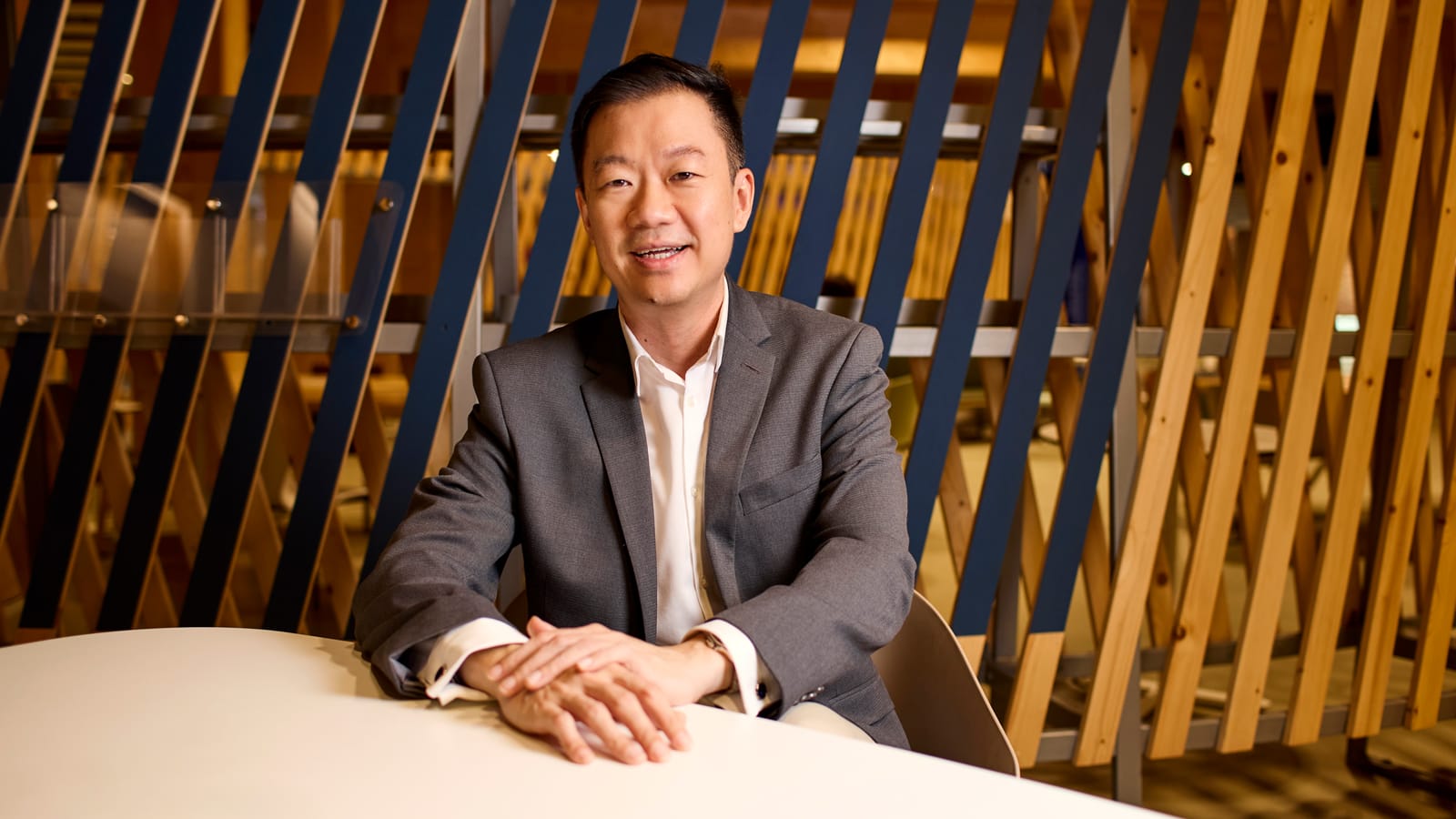
Professor Goh Kim Huat, associate dean (Graduate Studies) at Nanyang Business School (NBS), Nanyang Technological University (NTU), has seen this shift in his classroom. In his Data Analytics for Decision Making course, the focus has moved beyond using tools to understand what is worth analysing and how business needs can be translated into viable projects.
“AI can generate recommendations in seconds,” he said. “The harder question is deciding which recommendations to trust, which risks are acceptable and what direction an organisation should take. Those remain fundamentally human decisions.”
For professionals, the challenge is understanding how AI-generated outputs align with business priorities, risk considerations and accountability.
As AI makes information increasingly accessible, postgraduate education is becoming less about acquiring knowledge and more about learning how to evaluate, challenge and apply it. Through discussion, experimentation and exposure to diverse perspectives, students develop the judgment needed to make decisions when there is no obvious right answer.
At NBS, postgraduate programmes combine academic learning with practical exposure through projects, practicums and internships. Students also develop the strategic thinking, ethical judgment and leadership capabilities needed to navigate an AI-enabled business environment.
NTU AND NBS BY THE NUMBERS




TURNING TECHNICAL SKILLS INTO BUSINESS IMPACT
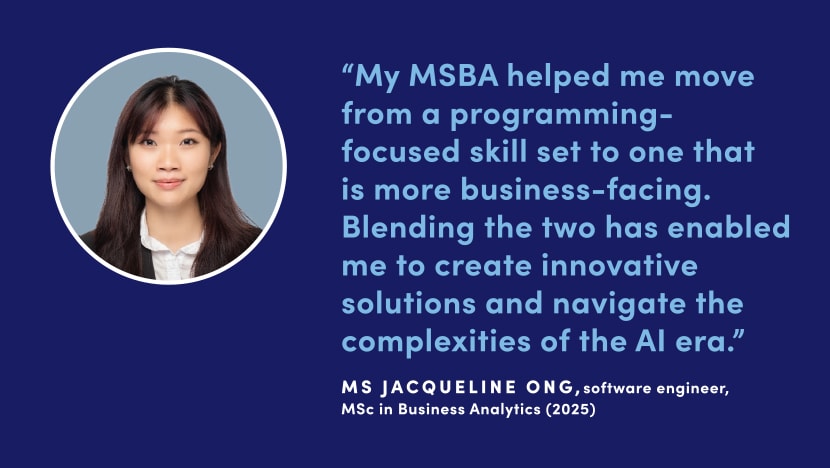
After three years as a software developer, Ms Jacqueline Ong saw building a stronger connection between technology and business as an important next step in her career. She wanted to better understand how technical solutions could be applied to business challenges.
In 2024, she chose the MSc in Business Analytics (MSBA) at NBS for its mix of analytics training and applied learning.
Her studies were supported by the ASEAN Development Scholarship, a partial scholarship for nationals of ASEAN member countries other than Singapore. The scholarship is part of NBS’ efforts to support economic and social progress in the region.
NBS stood out for a curriculum that went beyond data analytics to include topics such as AI and cybersecurity, as well as modules focused on design thinking. Together, these provided the interdisciplinary perspective needed in today’s job market.

The data analytics practicum offered a pathway into the aerospace sector, an industry Ms Ong had long aspired to join. After completing a five-month internship as a data scientist in generative AI at SIA Engineering last year, she secured a role as a software engineer with an aviation software solutions provider.
“Through the internship and my classroom projects, I learnt to lead exploratory projects that were operationally viable and grounded in clear business value,” she shared. “I use those skills every day in my current role by understanding complex technical systems and translating business requirements into workable solutions.”
AN EDUCATION BUILT FOR THE AI AGE
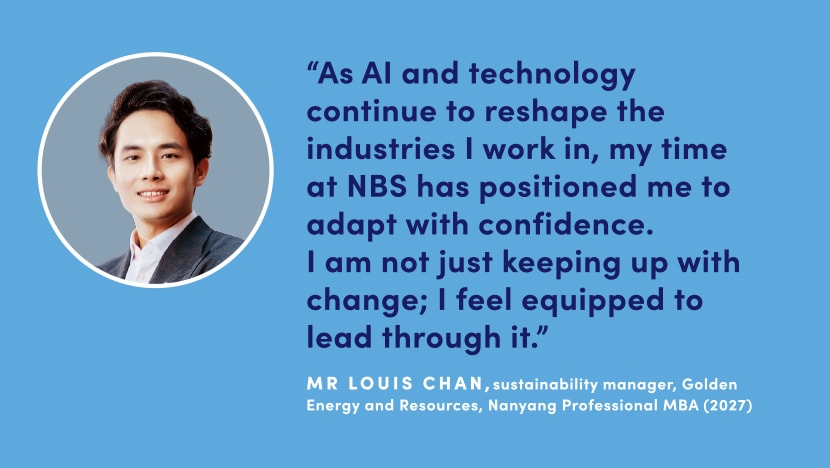
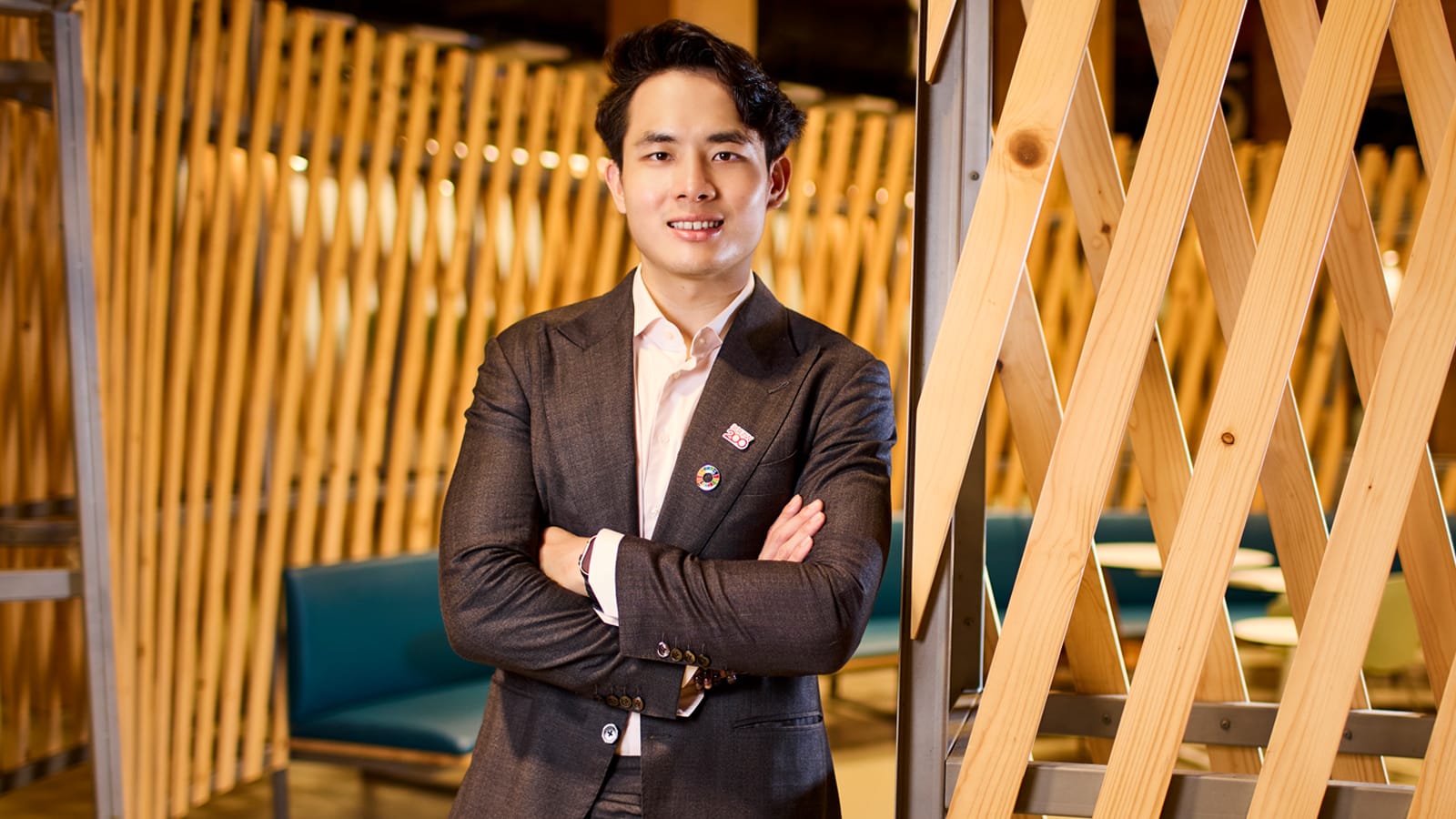
Like Ms Ong, Mr Louis Chan wanted to complement his technical knowledge with deeper fluency in business strategy, finance and organisational leadership. He completed the Nanyang Professional MBA (PMBA) at NBS this year.
A sustainability manager with an academic background in pharmaceutical science, Mr Chan chose NBS for the PMBA’s integration of AI into business learning.
“The Nanyang PMBA trained me to treat AI the way I would treat any analyst or advisor – as a resource whose output needs to be stress-tested and validated,” he said. “Learning to ask whether the output makes strategic sense has been one of the most valuable skills I have developed.”
He added that NTU’s approach to emerging technologies is especially relevant to the demands of the sustainability sector. “Sustainability is evolving rapidly and I needed a programme that could keep pace,” he said. “NBS offered a curriculum that is actively updated to reflect where the world is going, not just where it has been.”
The Nanyang PMBA’s combination of business exposure and a critical approach to AI use enabled Mr Chan to apply what he learnt directly at work. He now uses AI to identify emerging trends, test scenarios and challenge his own thinking.
“When I am developing a strategy or preparing to advocate for a course of action, I use AI to test the strength of my reasoning,” he said. “That process surfaces blind spots and strengthens my proposals before they reach decisionmakers. My judgment and domain knowledge remain essential in interpreting and acting on feedback from AI.”


SUCCEED IN THE WORKPLACE OF THE FUTURE
As AI continues to transform workplaces, professionals will need to keep learning and reassessing how knowledge work is done.
One way to do that is by taking a higher-level view of the value they bring to their organisations, advised Prof Goh. “Having the opportunity to do a postgraduate degree provides a useful cognitive reset to view knowledge work through different lenses,” he said.
The Nanyang Business School Postgraduate Fair 2026, taking place on Aug 29, will give prospective students an opportunity to explore the school’s postgraduate programmes and learn how they prepare professionals for an AI-enabled business environment. Visitors can speak with faculty, students and alumni about the curriculum, student experience and career pathways.
For professionals preparing for what comes next, Prof Goh’s advice is to stay open-minded, curious and motivated. AI can enhance how people learn and work, but as such tools become easier to access, they may become less of a differentiator.
What matters more, Prof Goh said, is the ability to navigate ambiguity and lead people through change. “The challenge is no longer simply learning how to use AI,” he said. “It is learning how to think better with it.”
TAKEAWAYS FROM THE CLASSROOM