US-Iran talks stall amid mistrust, with Pakistan playing quiet facilitative role
“Talks are not dead. Both sides seek an off-ramp and they want an end to the conflict,” said defence analyst and retired Pakistan Brigadier Masud Ahmed Khan.
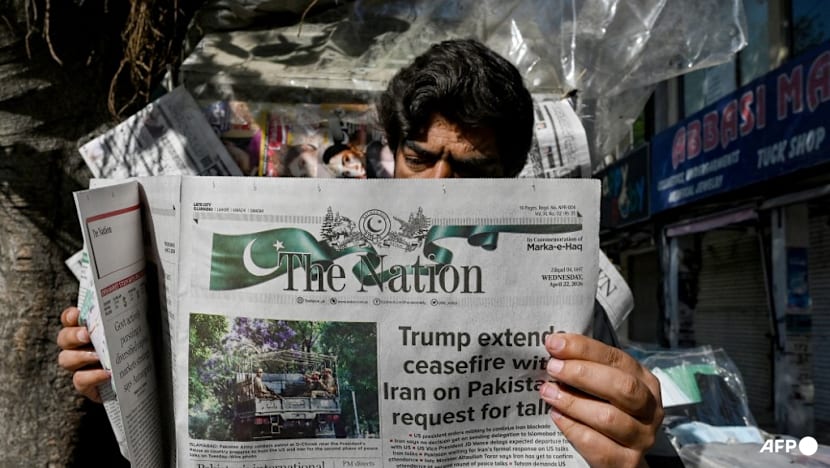
A man reads a newspaper with a front page article referring to anticipated US-Iran peace talks, at a stall in Islamabad on Apr 22, 2026. (File photo: AFP/Asif HASSAN)

This audio is generated by an AI tool.
ISLAMABAD: Deep mistrust and unresolved core issues between the United States and Iran are slowing progress in negotiations to end the war despite early signs of engagement, analysts said.
Nearly three weeks after the US and Iran held high-level talks in Islamabad, things appeared to be at a standstill on Wednesday (Apr 29).
US President Donald Trump is reportedly sceptical about Tehran’s latest offer to unblock the Strait of Hormuz in exchange for Washington’s lifting of its blockade on Iranian ports while broader negotiations continue.
“Talks are not dead. Both sides seek an off-ramp and they want an end to the conflict,” said defence analyst and retired Pakistan Brigadier Masud Ahmed Khan.
“But there is a huge trust deficit between the two countries.”
He added that while communication channels remain open, the pace of diplomacy has slowed amid rising political rhetoric and tensions played out on social media.
Trump has repeatedly lashed out at Iran on his Truth Social platform, including a profanity-laden post earlier this month that injected new volatility into the conflict.
Analysts said the initial phase of talks appeared promising in tone, but lacked substance.
“As far as optics were concerned, they were very reassuring … for the first time in 47 years, the United States and Iran were able to talk face-to-face,” said Pakistan’s former UN and US ambassador Masood Khan.
However, he noted that momentum slowed as discussions moved to more contentious issues, including Iran’s nuclear programme, sanctions relief and the governance of the strategic Strait of Hormuz.


These remain structurally difficult to resolve.
“It is not possible for Iran to agree to what the US demands and vice versa,” said Pakistan’s former ambassador to China Masood Khalid, adding that both sides will ultimately need to find a middle ground.
Such compromises are possible, he added, citing the 2015 nuclear deal between Iran and major world powers, in which Iran agreed to curb its nuclear programme in exchange for sanctions relief.
Khalid noted, however, that neither side is currently in a position to fully impose its preferred outcome on the other.
“The US is saying Iran should transfer its enriched uranium … Iran is not prepared to do that,” he said, adding that Iran is unlikely to compromise on what it views as its sovereign right under the Nuclear Non-Proliferation Treaty.


PAKISTAN’S FACILITATIVE ROLE
Against this backdrop, Pakistan has emerged as a quiet facilitator, helping to host talks and maintain backchannel communication.
This is notable for a country more often defined by its internal security challenges than by global diplomacy.
Analysts describe this as driven more by necessity than ambition, given Pakistan’s proximity to Iran and the risk of instability spilling across its western border.
Pakistan shares a roughly 900km border with Iran, and any escalation could have direct security implications.
A prolonged conflict in Iran would place additional pressure on Pakistan’s already stretched security apparatus, which remains engaged in counterterrorism operations along its western frontier.

Officials said Pakistan’s role has focused on keeping dialogue open rather than pushing either side towards concessions.
Pakistan is also continuing behind-the-scenes engagement with regional players, including China, Russia, Qatar, Türkiye, Saudi Arabia and Egypt, in an effort to prevent further escalation.
Officials have referenced Pakistan’s role in facilitating US–China rapprochement in the 1970s as a parallel for its current engagement.
However, analysts caution that the present context is more complex, with multiple actors, overlapping conflicts and reduced trust among key stakeholders.
Despite its engagement, Pakistan’s role has limits. Analysts note that while Islamabad can facilitate communication, it lacks the leverage to enforce concessions on either side.
RISK OF PROLONGUED DEADLOCK
With neither side conceding ground as yet, Masood Khalid, the former ambassador, warned that the talks could settle into a prolonged “no war, no peace” scenario.
Such an outcome risks wider economic fallout.
Reduced maritime traffic in the Strait of Hormuz has already raised concerns over supply chains and shipping costs, especially for energy-importing economies in Asia and Europe.
Pakistan, given its own energy dependence, is among the countries most exposed to any prolonged disruption.
Analysts would not say whether Washington or Tehran is more likely to make the first concession.
Both sides are under pressure, said Masood Khalid, but neither appears willing to move first on core issues.
For now, analysts expect any progress to be incremental at best, particularly as negotiations remain bogged down in technical and political complexities - a slowdown in diplomacy, but not a collapse.