Trump’s open-ended ceasefire buys time but lacks clear path forward, say analysts
The conflict has moved toward economic pressure, with the US blockade aimed at pushing Iran back to the negotiating table – though its effectiveness remains uncertain.
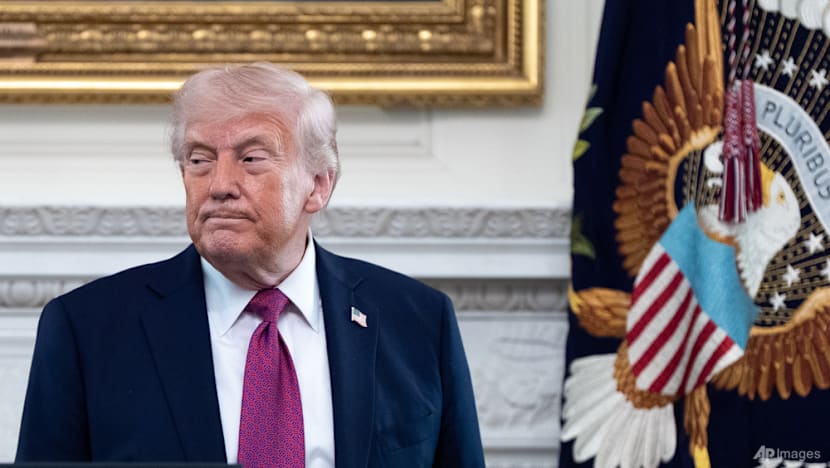
President Donald Trump departs after speaking at an event for NCAA national champions in the State Dining Room of the White House, Tuesday, April 21, 2026, in Washington. (Photo: AP/Alex Brandon)

This audio is generated by an AI tool.


United States President Donald Trump’s shift toward an open-ended ceasefire – instead of repeatedly setting and reversing deadlines – could offer a more realistic path to easing tensions.
But with the next steps still unclear, the pause may prove fragile, observers said.
Trump said on Tuesday (Apr 21) he would extend a ceasefire with Iran indefinitely – just hours before it was set to expire – to allow more time for negotiations, while maintaining a US naval blockade of the country’s ports.
ESCALATION RISKS REMAIN
The move reflects Trump’s wariness of renewed military action, which could risk a wider regional war, said foreign policy expert Barbara Slavin.
“An undefined, indefinite ceasefire is better than what we've seen from Trump so far, where he sets deadlines and then at the last minute, he reverses them. This is much more realistic, and it's also an effort to calm tensions a little bit,” said the distinguished fellow at the Stimson Center, a foreign affairs think-tank.
“It's like the boy who cried wolf. How many times can you set deadlines and then ignore them?”
But without a clear way forward in talks, the risk of renewed escalation remains high.
“The problem is that we still don't have a coherent negotiating path,” Slavin told CNA’s Asia First. “The US has put down a series of very maximalist demands which Iran has rejected.”
These include dismantling the country’s nuclear programme, halting uranium enrichment and curbing its missile capabilities.
The conflict has moved toward economic pressure, with the US blockade aimed at pushing Iran back to the negotiating table – although its effectiveness remains uncertain.
“The thought among some, is that the pressure of the US blockade on Iran will put pressure on the Iranians eventually to come back to the table, but I'm not so sure,” said Slavin.
SHIFT IN STRATEGY
That uncertainty raises questions about whether such tactics can sway Tehran’s position, especially given Iran’s track record of withstanding sanctions.
Past sanctions have often hurt ordinary Iranians more than the leadership, Slavin pointed out.
Now, Trump faces the difficult task of avoiding escalation while not appearing weak.
“He underestimated the strength of the Iranian regime,” stressed Slavin.
“He was convinced by (Israeli Prime Minister Benjamin) Netanyahu that eliminating the top leadership would either cause real regime change – not what we've seen – or would weaken the government so much that it would sue for peace and make enormous concessions.”
Instead, Iran was prepared for the attacks and has responded in ways that have placed significant strain on the global economy and regional stability.
“So he has been misled, made the wrong assumptions, or he didn't listen to proper advice. He certainly has not thought this through, and now he's scrambling because he doesn't want a full-scale war,” said Slavin.
“But he doesn't want to look like he's lost. The Iranians are not going to make this easy for him.”
She also pushed back against Trump’s characterisation of Iran’s leadership as “seriously fractured”.
“There are obviously different tendencies – some are more hardline – but it is a leadership that is unified in defying the United States, in trying to make sure that if there is any agreement, it's favourable to Iran,” she noted.
There are some indications of Iran's demands, including its insistence on the “right to enrich uranium on their own soil” even if it is willing to pause those activities temporarily, she said.
Tehran is also looking for sanctions relief, access to frozen assets and assurances against future attacks by the US and Israel.
REGIONAL STAKES RISE
Iran faces deepening isolation – a situation that is not new, said Stephen Zunes, professor of politics and director of Middle Eastern studies at the University of San Francisco.
He added that this is a posture the regime has learned to absorb and leverage, even as its actions have strained ties in the region.
Meanwhile, analysts said Gulf states cannot afford to remain passive as the conflict continues to take a toll on the region.
Their economies depend heavily on imports and stable trade routes, making any prolonged conflict an existential threat to development and even basic supply needs, Zunes noted.
“I don't doubt they are playing an active role, and indeed could have played a role in convincing President Trump not to immediately renew the war as he'd been threatening,” he told CNA’s Asia First.
Despite mixed signals from its leadership, the US appears to be receptive to these concerns, according to some analysts.
Pressure on Trump is coming not only from international partners, but also from a war-weary American public, said Zunes.
“All these things are being taken into account, despite his often dismissive attitude towards other people's opinions.”