



What we know about Pope Leo's lung cancer diagnosis
Pope Leo has undergone surgery to remove a cancerous tumour from his right lung, raising questions about his health and whether he will need further treatment. Here's what we know so far about his condition.
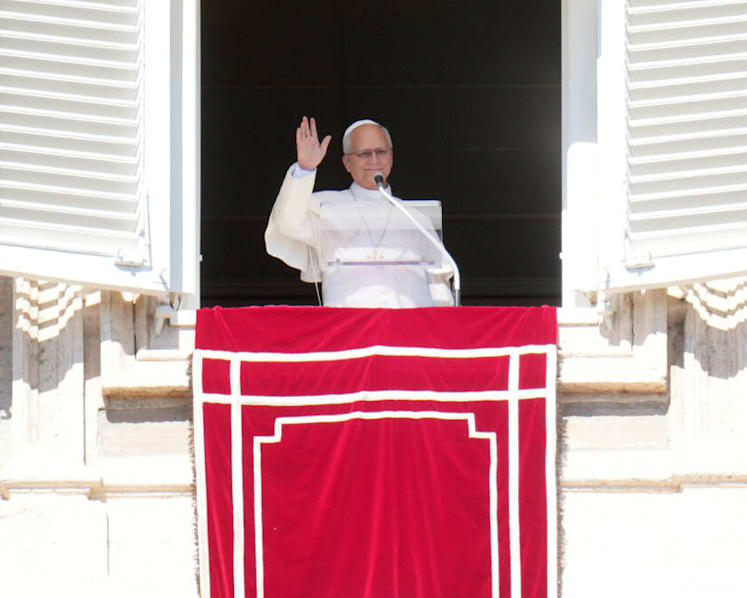
Pope Leo XIV waves at the end of the Angelus prayer from the window of his study overlooking St Peter's Square at the Vatican on Oct 11, 2026. (Photo: AP/Gregorio Borgia)

This audio is generated by an AI tool.


SINGAPORE: Pope Leo underwent surgery on Tuesday (Oct 13) to remove a cancerous tumour from his lung, raising questions about the 71-year-old pontiff's health and whether he will need further treatment.
The Vatican said the pope has been diagnosed with lung adenocarcinoma, a common form of lung cancer. The lower lobe of his right lung was removed during the surgery.
While the surgery was successful, it is not known yet if the pope will require further treatment.
The Vatican has not disclosed the size of the tumour or whether the disease had spread to nearby lymph nodes, key factors in determining prognosis.





Here's what we know so far about Pope Leo's condition.
What type of cancer does the pope have?
Lung cancer is broadly divided into two main types: non-small cell lung cancer, which is more common and makes up over 80 per cent of cases; and small cell lung cancer, which is more aggressive, said Dr Lim Hong Liang, a senior consultant and medical oncologist at Parkway Cancer Centre.
Pope Leo has lung adenocarcinoma, which falls into the former category. It is the most common type found in people who have never smoked.
"Adenocarcinoma is the most common lung cancer diagnosed nowadays, and its incidence is rising especially in people who have never smoked," Professor John Tam, who is the head of thoracic surgery at the National University Heart Centre's department of cardiac, thoracic and vascular surgery, told CNA.
Pope Leo, who was only elected last year, is relatively young for a Church leader. He enjoys sports, including tennis, and is not known to smoke or have had recent health issues.
Early-stage lung cancer may not cause any noticeable symptoms, while symptoms of a more advanced stage of the cancer include persistent coughing, shortness of breath and weight loss.
In the pope's case, the growth was discovered during routine medical examinations rather than following a reported illness. He told worshippers on Sunday that it was detected at "a very early stage" and is "well-localised".
Lung cancer is the top cause of cancer death worldwide, according to the World Health Organization (WHO), but the prognosis can vary significantly depending on the type of lung cancer and how advanced it is when first detected.
What exactly did the procedure involve?
Human lungs have five lobes - three in the right lung and two in the left.
Surgery for lung cancer involves the removal of part or all of a lung affected by cancer to stop the spread of the disease.
The pope underwent a lobectomy, an operation to remove a section, or lobe, from his lung.
It is a common procedure for lung cancer surgery, said Prof Tam, adding that the goal of the surgery is to completely remove the growth and to ensure no further spread by also removing the surrounding lymph nodes.
Pope Leo's lead surgeon, Dr Stefano Margaritora, and his personal physician, Dr Luigi Carbone, said in a statement that the procedure lasted about 90 minutes, with no complications.
"In order to make the procedure curative, the lower lobe of the right lung was removed using a video-assisted technique," they said, making clear that the aim was to eliminate all cancerous tissue.
According to the Vatican, tissue examined during the operation confirmed the diagnosis of lung adenocarcinoma that doctors had suspected from earlier tests.
Can someone live normally after having part of a lung removed?
Yes.
Lobectomies would not be performed if they left patients unable to breathe adequately or feeling permanently short of breath, according to the University of Texas MD Anderson Cancer Center.
However, while the body adjusts to its new anatomy, a patient might feel slightly short of breath for a couple of weeks, or some discomfort when taking deep breaths.
"Patients routinely return to normal life and function after recovery," said Prof Tam, who is also a professor at the department of surgery at the National University of Singapore's Yong Loo Lin School of Medicine.
Dr Lim noted that the removal of a lobe could lead to a reduction in some lung function, but added that typically, "the loss of one lobe will have minimal impact on daily activities".
As such, the pope, who is known to be sporty, should be able to resume activities such as jogging and tennis.
"There's a lot of reserve in the lung, and people can have an entire lung removed and live a normal life," David Carbone, director of the Oncology Center at Ohio State University, told AFP.
In the pope's more immediate future, though, the Vatican has said it expects him to remain in hospital for about a week. His public engagements have been cancelled through Oct 20.
He is due to make an 11-day tour of Uruguay, Argentina, and Peru from Nov 6 to Nov 17, but it is unclear whether the trip will still go ahead.
The current itinerary for the trip is ambitious and the longest of his papacy to date, calling for the pope to clock just over 31,000km on a dozen flights and two helicopter rides, and a significant altitude change in Peru.
Is the cancer gone?
It is hard to tell, as the Vatican has not disclosed information on the size of the tumour and whether the cancer has spread to the pope's lymph nodes.
"While we have the diagnosis, we do not yet have the stage. This is critical to prognosis and treatment," said Dr Stephen Liu, a lung cancer expert at Georgetown University in Washington and division chief of haematology-oncology at MedStar Georgetown University Hospital.
"If this is a small lung cancer with no lymph nodes involved, surgery itself is likely to be curative," he told Reuters. "But if final analysis reveals a greater extent of cancer involvement, this indicates a poorer prognosis."
Dr Lim from Parkway Cancer Centre said that even if surgery is successful, there is still a risk of recurrence.
Pope Leo will be considered as cured from this cancer after five years of being documented as cancer-free, added Prof Tam.
Will the pope require chemotherapy or other treatments?
Aside from surgery, other types of treatment for lung cancer include chemotherapy, radiotherapy, targeted therapy and immunotherapy. The pope may not need to undergo any of these if the surgery alone proves sufficient in its effectiveness.
According to Prof Tam, the answer will depend on several factors, such as the size and location of the cancerous mass removed, the status of the lymph nodes, whether or not the disease has spread and the completeness of the surgery.
If the tumour is contained within the removed lobe, and no evidence of any spread is found, then other post-surgery treatments like chemotherapy may not be needed, he said.
A Vatican source indicated that additional testing is underway.
For Dr Carbone, the fact that the pope has already undergone surgery is encouraging.
"Because if it had spread to, for example, the lymph nodes in the centre of the chest, he would have had some treatment before surgery, which he didn't have," he explained.
"They really do go straight to surgery only for the earliest stage tumours, which makes me think this was a very early-stage tumour, and has a quite good prognosis."
He stressed that treatment for lung cancer has improved considerably over the past few decades, "and the prognosis is better than ever".
What are his chances of a full recovery?
The outlook for lung adenocarcinoma varies depending on how early the disease is detected and whether it has spread.
Prof Tam said that Pope Leo has an "excellent" chance of making a full recovery, given his age, fitness level and the likely early detection of the cancer.
Dr Juanita Mora, medical spokesperson for the American Lung Association, told AFP that when this type of cancer is "caught in early stages, then it has a very, very good prognosis".
Much would depend on the stage of the cancer, and whether it had spread, she said.
"When we look at five-year survival rate from lung adenocarcinoma, and it's nicely localised, the rate is approximately 63 to 67 per cent," Dr Mora said.
"But if we catch it early, it becomes 80 to 98 per cent, especially after surgical removal."
This is believed to be Pope Leo's second hospitalisation. In 1985, when he was a young priest, he came down with typhoid fever in Chulucanas, Peru and was hospitalised.
He recounted the experience in his only major interview given as pope, in a book for Penguin Peru.
Pope Leo said the pain was so bad that he asked God to die rather than continue suffering. He took his survival as a sign from God that "We need you here (on Earth)", he said.
"I never looked back," said Pope Leo.