Oil steady as Hormuz shipping constraints counter US-Iran peace hopes
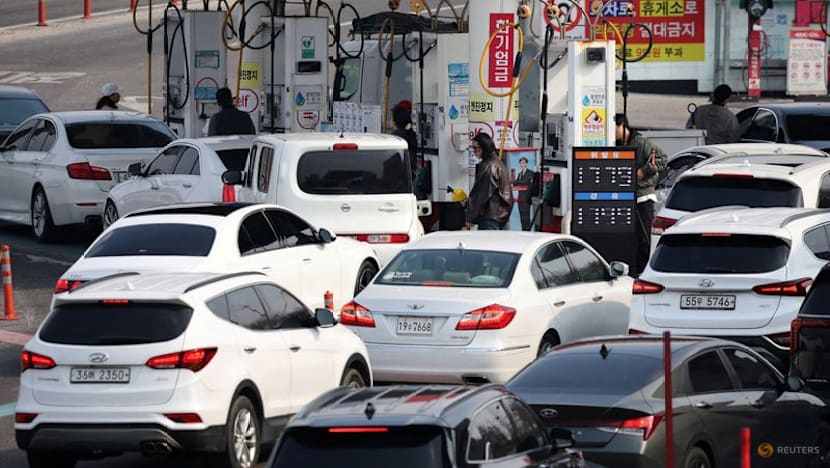
Cars line up at a gas station in Seoul, South Korea, Mar 9, 2026. (Photo: REUTERS/Kim Hong-Ji)
NEW YORK: Oil prices were little changed on Wednesday (Apr 15) after US President Donald Trump said the war with Iran could end soon, telling the world to watch out for an "amazing two days", while US forces imposing a blockade turned back vessels leaving Iranian ports.
Brent futures LCOc1 rose 31 cents, or 0.3 per cent, to US$95.10 a barrel at 10:44am EDT (10:44pm, Singapore time), while US West Texas Intermediate CLc1 crude rose 63 cents, or 0.7 per cent, to US$91.91.
"I think you're going to be watching an amazing two days ahead," Trump told ABC News reporter Jonathan Karl, according to a post by the reporter on X, adding he did not think it would be necessary to extend a two-week ceasefire that expires next week.
But, 45 days after Iran's Revolutionary Guards declared the strait closed, effectively shutting in about 20 per cent of global oil and LNG shipments, transit through it remains at only a fraction of the 130-plus daily crossings before the war, sources said.





The US has enacted a blockade of shipping leaving Iranian ports that its military said on Wednesday has completely halted trade going in and out of the country by sea.
The US-sanctioned Chinese-owned tanker Rich Starry made its way back to the Strait of Hormuz on Wednesday after exiting the Gulf the day before, shipping data showed.
Turkish President Tayyip Erdogan said Ankara was working to extend the two-week ceasefire between the US and Iran, ease tensions and ensure the continuation of talks.
Trump asked President Xi Jinping not to give Iran weapons, and Xi responded that China was not supplying Tehran. Iran secretly acquired a Chinese spy satellite in late 2024 that has allowed it to target US military bases across the Middle East, the FT reported, an account Beijing dismissed as untrue.


WORLD COPING WITH SUPPLY DISRUPTIONS
Finance ministers from almost a dozen countries led by Britain called on the US, Israel and Iran to implement their ceasefire in full and said the conflict would weigh on the global economy and markets even if it was resolved soon.
Treasury Secretary Scott Bessent said the US economy will be slower this quarter, but it is in good shape and will rebound, adding that oil prices do not appear to be weighing on inflation expectations.
Adding to economic uncertainty, Trump threatened to fire Jerome Powell from his separate seat on the US central bank's Board of Governors if the Federal Reserve Chair does not vacate that post as well when his term as Fed chief ends on May 15.
Analysts worry that involving more politics in interest rate decisions could reduce the Fed's ability to control inflation. Trump wants the Fed to cut rates, which would reduce consumer costs and could boost economic growth and demand for oil.
Japan said it would establish a financial framework worth about US$10 billion to help Asian countries procure energy resources and bolster their stockpiles as Middle East tensions drive prices higher and disrupt supply chains.
Although Germany is not involved in the Iran war, the country is feeling its economic impact directly, German Finance Minister Lars Klingbeil said.
Russia is ready to increase energy supplies to China ahead of an expected visit by President Vladimir Putin, Russian news agencies quoted Foreign Minister Sergei Lavrov as saying.
Israel's security cabinet will convene to discuss a possible Lebanon ceasefire, a senior Israeli official said, more than five weeks into a war with Hezbollah.
US OIL INVENTORIES
One factor supporting crude prices was the surprise US Energy Information Administration (EIA) report showing energy firms pulled 0.9 million barrels of crude from stockpiles during the week ended Apr 10.
That compared with the 0.15 million barrels analysts forecast in a Reuters poll and an increase of 6.1 million barrels that market sources said the American Petroleum Institute (API) trade group reported on Tuesday.