UK boosts security for Jews after London stabbings
Britain's government announced an extra £25 million (US$33 million) for security outside synagogues and schools, and will fast-track new legislation to allow the prosecution of people acting as a proxy of a state-sponsored group.
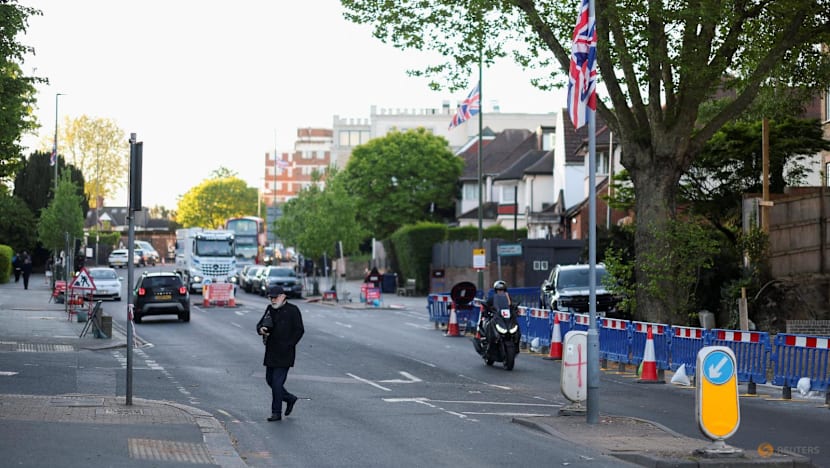
A man walks near the scene where a man was arrested following a stabbing incident in which two Jewish men were wounded in the Golders Green area, which is home to a large Jewish population, in London, Britain, on Apr 30, 2026. (Photo: Reuters/Hannah McKay)
LONDON: The United Kingdom government on Thursday (Apr 30) announced an extra £25 million (US$33 million) for security outside synagogues and schools, a day after two Jews were stabbed in the latest attack on the community.
The government said that would bring the total funding this year to £58 million.
Two Jewish men were stabbed on Wednesday in north London in broad daylight in what police said was a suspected terrorist incident.
Police said the two victims, aged 76 and 34, were both in a stable condition in hospital, and officers, some of whom the suspect also attacked, had arrested a 45-year-old man after stopping him with a Taser stun gun.
There have been arson attacks on synagogues and other Jewish sites in the area and a deadly attack in which two people died at a synagogue in Manchester last year.
"People have a sense of deep insecurity ... and that is why the government is bringing forward investment, an additional £25 million to invest in the security of our Jewish community," interior minister Shabana Mahmood told Sky News.
"That will pay for more protective security for our Jewish synagogues, schools, places of worship, community centres," she added.
The suspect is a British national, born in Somalia, the Metropolitan Police said in a statement. He was initially taken to a hospital, but has since been discharged and taken to a London police station where he remains in custody.
Detectives believe the suspect was also involved in a separate altercation earlier on Wednesday in southeast London. The suspect was armed with a knife in that incident and a person received minor injuries, the police said.
Rabbi Ben Kurzer, of the Golders Green Synagogue, called on the government to do more to protect Britain's Jews.
"There is definitely not a significant police presence on a regular basis in these areas. We have little bits here and there, but most of the security that we're seeing is private," he told BBC Radio.
A little-known group believed to be linked to Iran, and which has claimed responsibility for the London arson attacks, said one of its "lone wolves" was behind the stabbings, the SITE Intelligence Group reported.
Harakat Ashab al-Yamin al-Islamiya (HAYI) - meaning The Islamic Movement of the People of the Right Hand - made the uncorroborated claim in a video posted online, according to SITE.
Britain's independent reviewer of terrorism legislation, Jonathan Hall, told the BBC the attacks had become "the biggest national security emergency" since 2017, when there was a string of high-profile attacks.
The attacks have occurred amid warnings from security officials that Iran has sought to use criminal proxies to carry out hostile activity.
Police said after an arson attack at a synagogue this month that they were investigating possible Iranian links to the incidents. A pro-Iranian government group has said it was responsible.
NEW LEGISLATION TO BE FAST-TRACKED
Britain's government on Thursday said it would introduce new legislation to tackle state-sponsored threats carried out by proxies.
Mahmood said the legislation will deal with "a gap in the law when it comes to organisations that may be linked to hostile states" and their proxies.
Security minister Dan Jarvis told Times Radio the government would fast-track legislation which would allow the prosecution of people acting as a proxy of a state-sponsored group under Britain's National Security Act.
The government said the new powers would mean proxies could be dealt with in the same way as foreign intelligence services.
Last year the government of Labour Prime Minister Keir Starmer announced it would give police greater powers to restrict protests.
They were aimed at allowing police to take into account the "cumulative impact" of frequent protests.
Monitoring groups have reported a surge in antisemitic and Islamophobic incidents in Britain, particularly since the start of the war between Israel and Hamas in Gaza.