



China's Xi Jinping says Middle East should not become battleground for great power rivalry
"The Middle East Gulf region should not become an arena for great-power rivalry and geopolitical conflict. Peace and stability in the region require joint nurturing and protection by all parties," says Chinese President Xi Jinping.
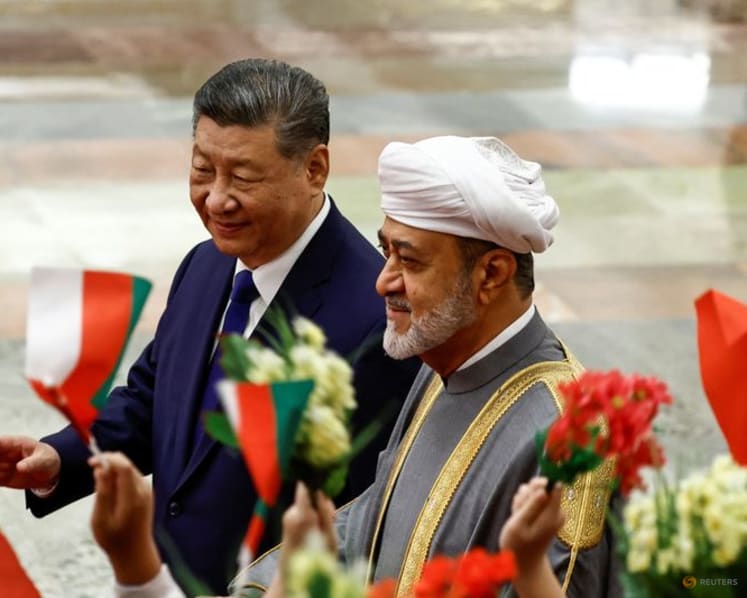
Chinese President Xi Jinping and Oman's Sultan Haitham bin Tariq attend a welcoming ceremony during the Sultan's state visit to China, at the Great Hall of the People, in Beijing, China November 2, 2026. REUTERS/Tingshu Wang/Pool
BEIJING: The Middle East and Gulf region should not become a battleground for great-power rivalry and China is willing to work with Arab nations to achieve lasting peace, Chinese President Xi Jinping told Oman's sultan on Monday (Nov 2).
China has traditionally played a low-key diplomatic role in the Middle East, but has stepped up efforts to try to help end tensions amid the US-Israeli war on Iran, which has snarled the Strait of Hormuz and driven up global energy and shipping costs.
Xi told Omani Sultan Haitham bin Tariq al-Said that the world is undergoing profound changes.
"The Middle East Gulf region should not become an arena for great-power rivalry and geopolitical conflict. Peace and stability in the region require joint nurturing and protection by all parties," Xi said, according to China's Foreign Ministry.





China has consistently been committed to stopping the war, and hopes to contribute "wisdom and solutions to resolving the region's security dilemmas", he added.
China is willing to strengthen communication and coordination with Arab countries, including the Gulf Cooperation Council states, to work together toward restoring peace and achieving lasting stability and security, Xi said.
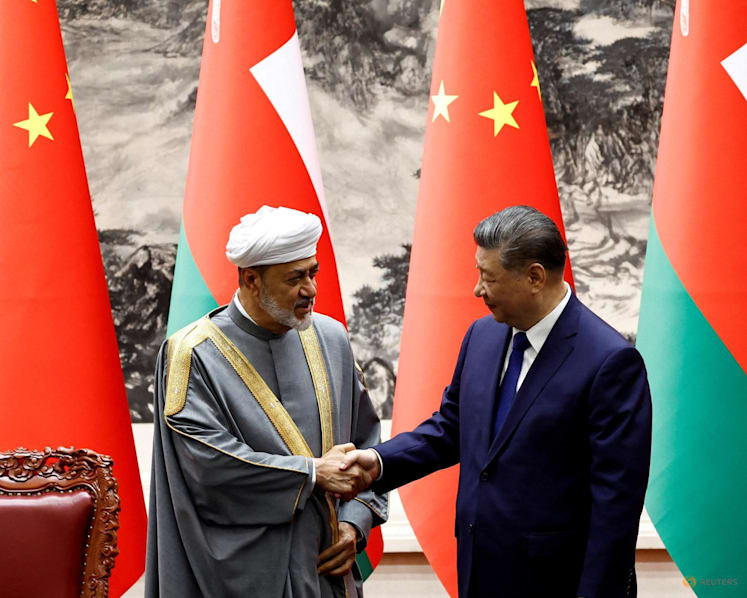
In a 20-point joint statement, both sides said they agree that normal and safe navigation should resume in the Strait of Hormuz. The countries also called for the US and Iran to pursue peaceful options, return to the agreement struck in June aimed at ending the conflict and restart dialogue.
Separately, China's Foreign Minister Wang Yi said on Monday that all parties in the Middle East conflict should focus on political solutions rather than resorting to arms again, in a meeting with an Iranian national security official in Beijing.
Dialogue and negotiation are the way to resolve Middle East conflicts, Wang told Ali Bagheri Kani, the deputy secretary of the Iran Supreme National Security Council, according to Chinese state news agency Xinhua.
Wang also said China supports Iran in safeguarding its sovereignty and security.
China, which is pressing for a bigger diplomatic role in the Middle East, also announced that its special envoy to the Middle East, would visit Iran, Oman and Saudi Arabia this month.
FIRST CHINA TRIP
Haitham arrived in Beijing on Sunday for a two-day visit, the first by an Omani head of state since the countries established ties in 1978.
Haitham told Xi his government had deep appreciation for China's positions on key issues concerning the region, Omani state media reported.
"We believe that development and stability are inextricably linked," he said.
"The prosperity of nations requires an environment defined by security, peace, respect for state sovereignty, and adherence to international law — an environment where disputes are resolved through peaceful means."
Chinese President Xi Jinping has offered to help protect maritime shipping in the Middle East amid the turmoil due to the US war on Iran. He made the offer as he met his Egyptian counterpart Abdel Fattah al-Sisi in Cairo. It's his first trip to Egypt in a decade. Rebecca Metteo reports from Beijing.
He also said Oman was open to entering into a preferential bilateral trade and investment agreement with China.
"We are confident that such an agreement would open new avenues for trade and investment, facilitate and enhance commercial and investment exchanges between our two nations," Haitham said.
China is Oman's largest trade partner, with tourism and business links boosted by direct flights between Beijing and Muscat since November last year.
Oman, which exports crude oil and energy products to China, has also been looking to further develop its renewable energy supply chains and digital commerce.
The Omani leader, who was welcomed on the tarmac in Beijing by People's Bank of China Governor Pan Gongsheng, also emphasised cooperation between investment and financial institutions.