CNA Explains: Why Trump wants the Abraham Accords tied to an Iran deal
"It won't happen. Period. It's as simple as that ... this thing doesn't stand a chance," says an analyst.
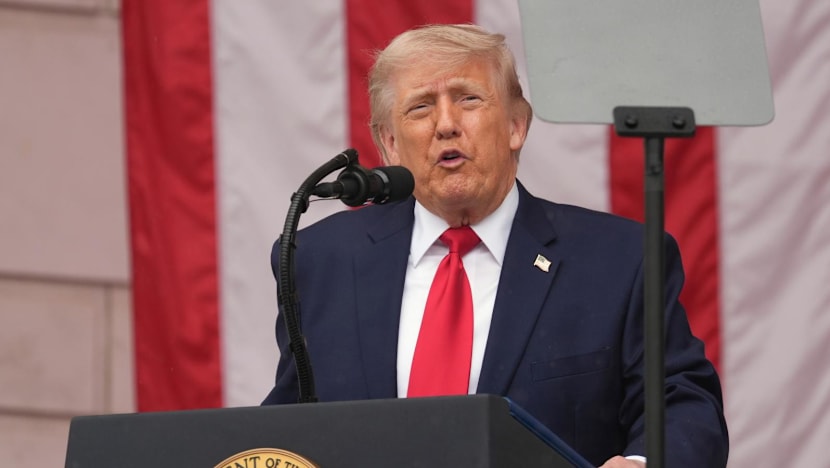
US President Donald Trump speaks during the 158th National Memorial Day Observance coinciding with the nation's 250th anniversary, at the Memorial Amphitheater in Arlington National Cemetery, May 25, 2026, in Arlington, Va. (Photo: AP/Alex Brandon)

This audio is generated by an AI tool.


SINGAPORE: As talks over a potential peace deal between Iran and the US gather pace, President Donald Trump has added a new condition - more countries must join the Abraham Accords.
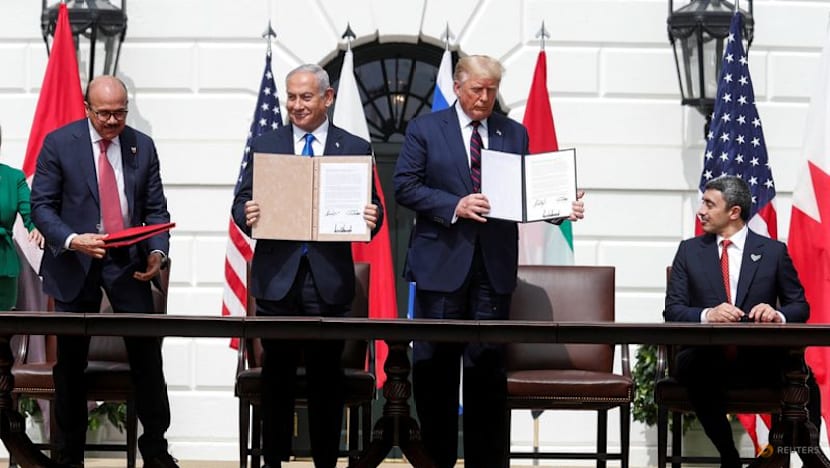
The Accords were brokered during Trump's first term in office and aimed at normalising ties between several Middle Eastern countries and Israel.
In a social media post on Monday (May 25), Trump said that “after all the work done by the United States to try and pull this very complex puzzle together, it should be mandatory that all of these countries, at a minimum, simultaneously, sign onto the Abraham Accords”.
The demand came as the emerging deal faced criticism from fellow Republicans who favour a harder line on Iran.





So what are the Abraham Accords, and why is Trump tying them to a potential US-Iran deal?
What are the Abraham Accords?
The Abraham Accords are a series of US-brokered agreements aimed at normalising relations between Israel and several Muslim-majority nations.
The deals were forged between the United Arab Emirates (UAE), Bahrain, Sudan and Morocco in 2020. However, the ongoing instability in Sudan has delayed the formalisation of its ties with Israel.
Kazakhstan joined the accords in November 2025, although it has had normalised relations with Israel since the 1990s.
Efforts to get Saudi Arabia on board, which were gaining momentum until the Israel-Hamas war, have stalled and the conflict has led the Saudis to insist on the creation of a path towards an independent Palestinian state.
While the accords were welcomed in diplomatic circles as a step towards a more peaceful Middle East, they remain unpopular among the public in many parts of the region, not least because they do not address the Israeli-Palestinian conflict.
The accords were named to emphasise the shared Abrahamic roots of Judaism, Islam, and Christianity.
They also mark the first formal normalisation of Arab-Israeli diplomatic relations since Israel’s 1994 peace treaty with Jordan and the 1979 Egypt-Israel agreement, according to the Middle East Institute.
The normalisation has seen diplomatic relations established and embassies opened.
Direct flights also commenced between Israel and Morocco in August 2021, and Bahrain's Gulf Air launched direct flights to Tel Aviv in September that year.
According to the Abraham Accords Peace Institute, excluding tourism and services, trade between Israel and Arab countries of the Middle East grew by 234 per cent in the first seven months of 2021 compared to the same period in 2020.
The biggest prize in the accords for Israel was the agreement with the UAE, a major global oil producer and commercial and trade hub with diplomatic clout across the Middle East.
Israel and the UAE have since developed close economic and security ties, including defence cooperation and a free trade pact.
What does this mean for negotiations with Iran?
In a lengthy post on Truth Social on Saturday, Trump listed countries whose leaders he spoke with in a conference call on Saturday about efforts to end the war with Iran.
He said then that most countries he spoke to "should be ready, willing, and able to make this settlement with Iran a far more historic event than it would, otherwise, be".
"It should start with the immediate signing by Saudi Arabia and Qatar, and everybody else should follow suit. If they don't, they should not be part of this deal in that it shows bad intention," he wrote.
The other countries the US president spoke to were Pakistan, Turkiye, Egypt and Jordan.
Trump even implied that Iran should sign on to the accords.
Dr James M Dorsey, an Adjunct Senior Fellow at Nanyang Technological University’s S Rajaratnam School of International Studies, said that what Trump is doing is similar to Iran's demands to end the war.
Tehran has previously said that any ceasefire should extend across all fronts of the regional conflict, including Lebanon. Hezbollah, meanwhile, has said it is confident that Iran will not abandon it.
Iran media reported that a memorandum of understanding (MOU) would first be announced, stressing an end to fighting on all fronts, including in Lebanon.
Dr Dorsey said that what Trump is doing is akin to Iran's demand - linking different conflicts together.
He added that Trump is "totally divorced from reality, at least from the reality of the Middle East".
"First of all, Israel, together with the United States, initiated this war and Arab states ... or Muslim majority states are not about to reward Israel for doing so, because it's created an incredible, incredibly difficult situation for various countries," Dr Dorsey told CNA on Tuesday.
When asked how Iran might interpret the inclusion of the Abraham Accords as part of Tehran's deal with the US, Dr Dorsey said it might reinforce the belief the country had - that Israel retains significant influence within the Trump administration.
"It's going to basically reinforce what Iran already believes ... that Israel retains significant influence within the Trump administration, and that the United States essentially is protecting Israel and Israeli interests ... but that's been Iran's analysis all along," he said.
"This reinforces it, or reconfirms it. It doesn't change anything," he added.
What is Trump's objective?
Dr Dorsey said there could be several reasons that Trump might want to include the Abraham Accords in any deal with Iran.
They include placating support within his party and his Make America Great Again movement, as well as appeasing Israel.
"Because whatever agreement he ultimately reaches with the Iranians is not going to be an agreement that the Israelis are happy about, or that Netanyahu is happy about," he said.
The deal to end the Iran war also drew heavy criticism from some fellow Republicans who favour a tougher line against the government in Tehran.
The deal Trump had said was “largely negotiated” had left a range of lawmakers, former Cabinet members and conservative analysts wondering aloud whether the terms as currently known will render the conflict all “for nought”.
The US president later dismissed objections to a deal that he said was not “even fully negotiated yet”.
"Whatever agreement is going to be reached will not really justify having abrogated the 2015 international agreement that curbed Iran's nuclear programme, nor will it really justify the cost, and what have you, of the war," Dr Dorsey said.
Under the 2015 Iran nuclear deal negotiated during former US president Barack Obama’s administration, Iran agreed to limit uranium enrichment to 3.67 per cent and allow extensive inspections by the International Atomic Energy Agency (IAEA).
Trump withdrew the US from that agreement in 2018 during his first term in office.
Ali Vaez, Iran project director at the International Crisis Group said: "Trump is trying to sell an Iran deal as an Abraham Accords sequel: good for Israel, good for the region, tough enough for Washington."
"But he is trading one fantasy for another - from forcing Iran to surrender to pretending a fragile deal can anchor a new Middle East order."
What's next?
Aaron David Miller, a senior fellow at the Carnegie Endowment for International Peace, said it was very unlikely Trump's appeal would succeed, partly because of regional rivalries between nations.
Anna Jacobs of the Arab Gulf States Institute in Washington said Gulf nations concurred with Miller's sentiments that countries were unlikely to accept Trump's maximalist demand.
"The national security of the Gulf states has been threatened more than ever before because of President Trump's reckless decisions, and he expects Arab states to thank him and to normalise relations with Israel, which they will not do at this stage," she said.
"It won't happen. Period. It's as simple as that ... This thing doesn't stand a chance," Dr Dorsey said in reference to nations signing up to the Abraham Accords as part of the peace deal.
Dr Dorsey also added that the relationship between Gulf states and the US - especially in relation to defence and security - might "become more conditional and more consultative".
There might also be more diversity in the pacts that Gulf states could make.
"Discussion about some regional security architecture that would not involve external parties, so that's something that the Iranians have been suggesting for a very long time."
But he also cautioned that Gulf states have "nowhere else to go in terms of a defence shield".
"There is no other country but the United States that is willing and capable of providing that defence shield. The problem is the defence shield has become a double-edged sword."
Want an issue or topic explained? Email us at digitalnews [at] mediacorp.com.sg. Your question might become a story on our site.