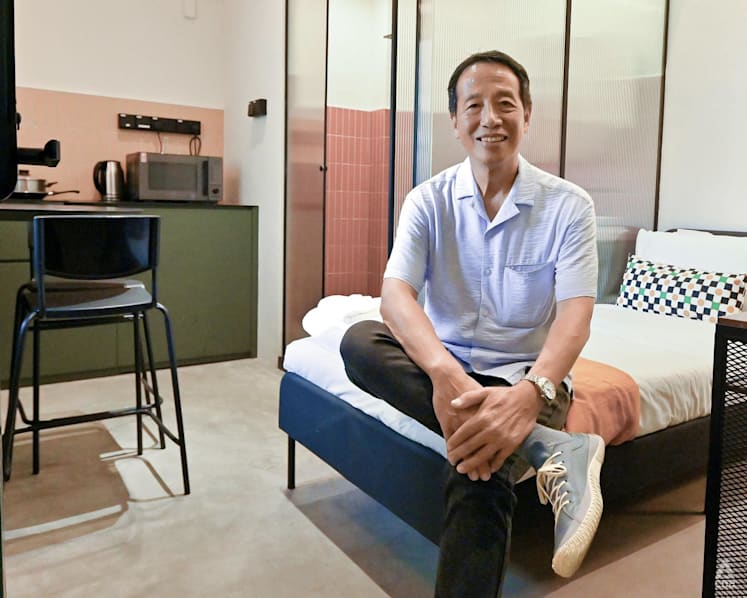
'Feels more of a hotel, less like a home': Why residents at this Hillview condo are unhappy with co-living setups
As co-living takes root in more condominiums, some residents in at least one condo are up in arms. Their complaints include having to jostle for facilities, strangers entering the compound and increased wear-and-tear in common areas.
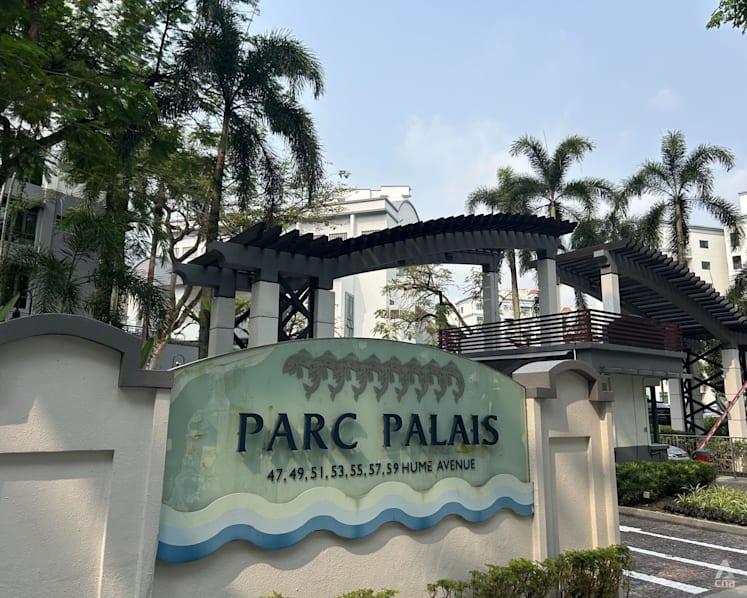
Owners at Parc Palais in Hillview attended a meeting in July to discuss co-living and how the condominium could address their concerns. (Photo: CNA)

This audio is generated by an AI tool.


After living at her Hillview condominium for 15 years, Madam P Lina is familiar with most of the residents at the 517-unit estate.
"If you stay here for a long time, you will know everyone you meet," she told CNA TODAY.
But in the last two years, the 62-year-old has sometimes found it hard to put a name to a face.
Groups of unfamiliar faces started appearing at Parc Palais condominium, with many using the facilities like the gym, swimming pool and the poolside showers.
The retiree, who swims two to three times a week, said that it's now not unusual to see groups of 10 to 15 people taking a dip in the pool, which used to be relatively quiet.
She has also noticed more people using the common bathrooms by the pool, which she said were barely used in the past as residents preferred to head home to shower.
Mdm Lina attributes these changes to the emergence of co-living units in her estate, with at least five such units there now.
Co-living generally refers to accommodation arrangements where tenants have their own private living spaces and share communal facilities such as kitchens and lounges.
Up to six unrelated people can generally live in a private residential property, with each occupant required to stay for at least three consecutive months.





For larger homes of at least 90 sqm, however, owners are required to register with the Urban Redevelopment Authority (URA) if they wish to house up to eight unrelated people under a temporary relaxation of the occupancy cap that has been extended until the end of 2028.
Co-living is not new to Singapore, but the model has gained traction in recent years with private homeowners drawn to it as a way to increase rental income.
CONCERNS ABOUT SECURITY, CROWDING, WEAR AND TEAR
Mdm Lina and other Parc Palais residents' concerns about co-living arrangements at their estate prompted the condominium's Management Corporation Strata Title (MCST) to hold a meeting with property owners on July 31.
CNA TODAY understands that about 30 owners attended the meeting.
Residents, who spoke to CNA TODAY on the condition of anonymity, said questions raised at the meeting included:
- How the management would keep track of this pool of transient occupants
- How facilities would be managed given they were getting more crowded
- What measures would be put in place if the number of co-living units increased.
Fire safety was also raised given how co-living units are sometimes partitioned to create additional bedrooms to house more tenants.
The discussion also included concerns about the increased use of shared amenities such as the pool, lifts, and other communal facilities, leading to greater wear and tear and potentially higher maintenance costs.
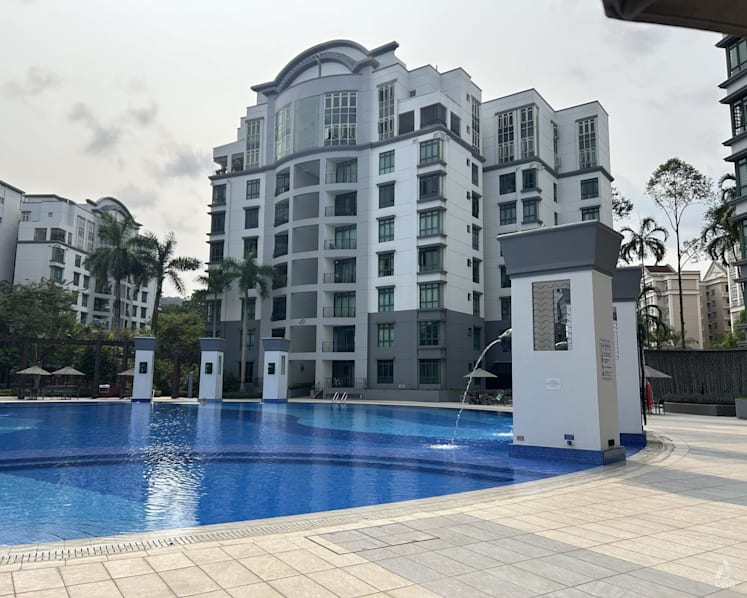
The residents noted that co-living units increase the number of people in the estate than would otherwise have been the case if the units had been rented out to families or couples.
Speaking to CNA TODAY after the meeting, Mdm Lina questioned whether it was fair for units with substantially fewer occupants to make the same maintenance contributions.
She said that units with more occupants could place greater demands on common facilities and result in higher maintenance costs.
Another resident, who has lived at the condominium for three years, said her main concern is the frequent turnover of tenants, which makes the estate feel "more of a hotel and less like a home".
"I have seen pictures shared by neighbours showing large groups of people walking in with their suitcases, guided by someone who looks like a property agent," she said.
"With tenants who rent for at least a year, they make the effort to get to know their neighbours and be a part of our community. But with people staying short-term, there are fewer reasons to care."
DOES CO-LIVING HAVE TO BE A PROBLEM?
CNA TODAY's checks with residents, management council members and property managers at 10 other condominiums with co-living units, however, suggest that the level of tension seen at Parc Palais is not widespread, at least for now.
Mr Dennis Tan, president of the MCST Association of Singapore, said that the association has observed a gradual increase in co-living-related issues cropping up at condominiums since early 2025.
He said that while the numbers have not been significant, the cases reaching the association may understate the extent of the issue, as MCSTs generally try to resolve problems themselves before seeking outside help.
At Rajah Tower in Balestier, for instance, management council chairman Kenny Lim said co-living units have existed for several years, but residents appear largely accustomed to them and complaints are limited to issues such as clutter outside units.
At The Bayshore in Bedok, management council chairman Chetan Khosla said the management has not received any complaints about co-living so far, although he has spotted online listings that appear to offer such arrangements in the development.
"We have to monitor. Once we see that dynamics of the estate are changing ... then we might have to make some guidelines," he said.
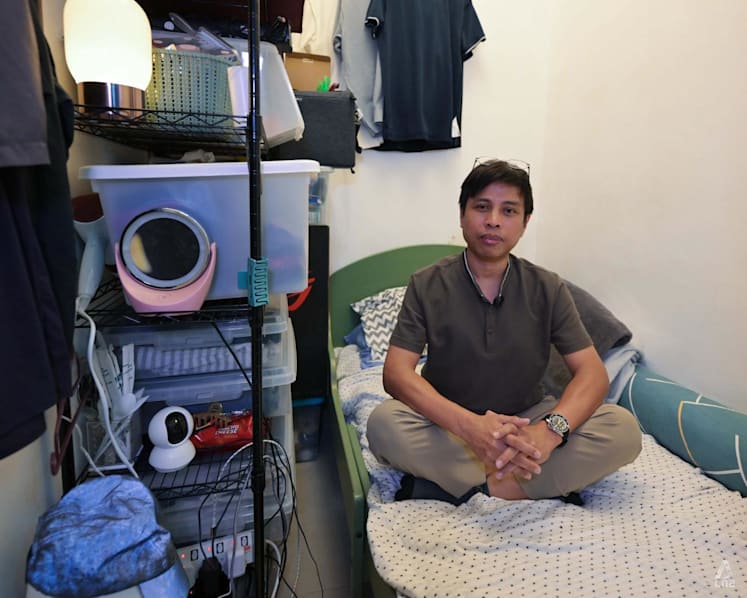

Real estate consultancy Knight Frank Singapore, which manages more than 55,000 units across 160 strata-titled developments, said complaints relating to co-living have so far remained "manageable".
Ms Eleana Teo, its senior managing director of strata management, estimated that co-living arrangements were present in about 10 to 15 per cent of the residential developments under the firm's management.
Another property firm, Ocean IFM, which manages about 170 strata developments, similarly said co-living-related complaints were not widespread across its portfolio, arising only occasionally at some developments.
Where complaints do arise, however, both firms said they tend to involve concerns similar to those raised at Parc Palais, including security and access control, unfamiliar or changing occupants, noise and the use of common facilities.
But Ocean IFM managing director Andy Lim said that such issues were not necessarily unique to co-living and could similarly arise from conventional tenancies.
"A properly managed co-living arrangement with occupants staying for the required minimum period may create little or no greater impact than a conventional tenancy," Mr Lim said.
Mr Ernee Ong, chief executive of co-living operator Bespoke Habitat, agreed with Mr Lim.
Mr Ong said that before operating in a new condominium development, his team checks its by-laws and requirements.
They also provide tenant details to the MCST for registration and verification and require tenants to comply with the condominium's access and security procedures.
"If concerns do come up, our approach is to speak with the relevant parties, understand the concern and work towards an amicable resolution," said Mr Ong, adding that his firm had managed a Parc Palais unit for about three years until earlier this year.
CNA TODAY reached out to other co-living companies operating in Parc Palais, as well as real estate agents marketing co-living units there. They either declined to comment or did not respond.


USE OF BY-LAWS REMAINS LIMITED
Parc Palais' meeting on co-living ended after two hours with no clear conclusion, though residents were told they could submit their suggestions to the management office.
Various options were discussed, including improving access control by upgrading the security management system and ways to better keep track of occupants, but it remained unclear what powers the MCST had in regulating lawful co-living arrangements.
A spokesperson for the MCST's management council of Parc Palais declined to comment when CNA TODAY asked how it planned to manage residents' concerns on co-living arrangements.
What was clear, though, from residents CNA TODAY spoke to was that there is no straightforward way for the MCST to prevent owners from renting out their units for co-living, as long as they comply with URA regulations.
An MCST comprises all unit owners in a strata development, while its management council is an elected group of owners that oversees day-to-day matters.
A recent dispute at another condominium highlighted the limits of what MCSTs can achieve through by-laws. In June, the Building and Construction Authority (BCA) clarified that condominium by-laws cannot restrict an owner's right to lease his or her property.
The clarification followed reports about Casa Aerata, a 78-unit condominium in Geylang, where its management council had passed by-laws restricting certain groups of foreign workers from living in the development.
One by-law passed in March 2025 prohibited unit owners from housing work permit holders, while another passed in January this year stipulated which groups of foreign employees were eligible to rent units there.
BCA subsequently said that while MCSTs can make by-laws regulating the management and use of common property, these cannot restrict an owner's right to transfer, lease, mortgage or otherwise deal with his or her property.
For condominiums grappling with co-living, the focus is therefore largely on managing its impact on the wider estate rather than trying to prevent owners from renting out their units.
Ms Winnie Wong, senior managing director of property management at Savills Singapore, which manages Parc Palais, declined to comment on the situation at the condominium specifically.
Speaking about co-living more generally, Ms Wong said these arrangements could create additional management challenges, including the heavier use of facilities, wear and tear, security and overcrowding.
Ms Wong said some condominiums have introduced facial-recognition systems, partly because conventional access cards can easily be passed from one occupant to another when tenants change.
"We cannot stop co-living. We can only manage the situation," she said.
Two lawyers told CNA TODAY that MCSTs can use by-laws to regulate matters such as common property, security, noise, nuisance and facility use, but by-laws that single out co-living arrangements or seek to restrict an otherwise lawful residential use may be open to challenge.
"The focus therefore has to be on regulating conduct and the use of common property rather than restricting ownership rights," said Mr Ivan Tay, director at Robertson Chambers LLC.
Ms Elaine Low, director at Peter Low Chambers LLC, similarly said that where co-living arrangements are lawful, MCSTs should not try to "eliminate or economically penalise the model".
When it comes to crowded facilities, Mr Tay said a theoretical by-law allowing only two occupants from a co-living unit to use the pool or gym at once, while allowing larger groups from other households to do so, could be criticised as discriminatory.
A more defensible approach, he said, would be to impose capacity limits that apply equally to all residents.
For facilities that require reservations, such as tennis courts or function rooms, Mr Tay said MCSTs could also allocate bookings on a per-unit basis, giving every unit the same number of slots regardless of how many people live there.
He said this would be easier to justify because it treats all units equally and manages competition for limited facilities without distinguishing between family households, tenants or co-living occupants.
"However, the specific by-law should still be carefully drafted to ensure it is reasonable and proportionate," he said, adding that it should also prevent residents from abusing the booking system to deprive others of access to the facilities.
Ms Low added that rules do not necessarily have to apply identically to every unit, but any differential treatment should be "objectively connected to the operational impact" rather than simply targeting a unit because it is labelled as co-living.
There is, however, less flexibility when it comes to maintenance contributions.
Both lawyers said these are generally determined according to a unit's share value rather than the number of people living there. Ms Low said maintenance- and sinking-fund contributions "must be levied in proportion to each lot's share value", with narrow exceptions unlikely to apply in this situation.
Even if residents flag suspected overcrowding or unauthorised internal partitions to the management council, the MCST has "no general statutory power" to enter a private unit to investigate, Ms Low said.
Suspected occupancy breaches are principally a planning-enforcement matter for URA, she added. BCA may also be relevant where partitions constitute unauthorised building works or affect structural or building-control requirements, while the Singapore Civil Defence Force may be involved where the configuration creates fire-safety risks.
For property managers, however, clearer rules could help as co-living becomes more common.
Knight Frank's Ms Teo said it would help if the authorities introduced standard co-living guidelines and model by-laws that set out more clearly the responsibilities of owners, operators and MCSTs.
A private condo is not the right place to have co-living units. We are not ready.
In response to CNA TODAY's queries, URA said that existing rental rules seek to balance homeowners' flexibility to rent out their properties with the need to "safeguard the residential character and amenity of neighbourhoods" and maintain a conducive living environment.
The agency said it investigates suspected breaches of occupancy caps and minimum-stay requirements in private residential properties. In 2025, it investigated 544 cases involving suspected occupancy-cap breaches, up from 534 in 2024.
Cases involving suspected breaches of the minimum three-month stay requirement rose from 200 in 2024 to 219 in 2025.
URA said it does not track how many such cases involved properties marketed as co-living spaces, nor does it maintain separate statistics on co-living-related feedback.
Asked whether additional guidelines were needed for co-living arrangements within private condominiums, URA noted that co-living is not a formal planning or regulatory term and that prevailing rental rules apply regardless of whether a private residential property is marketed as co-living.
For concerned residents like Mdm Lina, knowing that co-living units in her condominium are not breaking any laws provides little solace.
Even when such arrangements comply with occupancy and minimum-stay requirements, Mdm Lina remains unconvinced that conventional condominiums are equipped to accommodate the model.
"A private condo is not the right place to have co-living units. We are not ready."