North Korea not ready to talk to US or South Korea; Singapore won't seek mediator role: Vivian Balakrishnan
North Korea prefers to focus instead on self-reliance and military deterrence, says Singapore's foreign affairs minister.
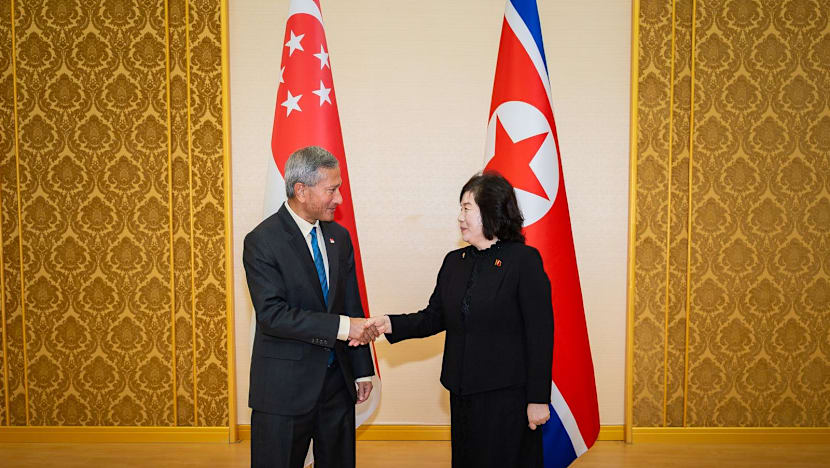
Singapore Foreign Affairs Minister Vivian Balakrishnan (left) and his North Korean counterpart Choe Son Hui (right) meet in Pyongyang, North Korea on May 26, 2026. (Photo: Ministry of Foreign Affairs)

This audio is generated by an AI tool.


SINGAPORE: North Korea is not ready to open significant channels of communication with the United States or South Korea, instead focusing on building up its self-reliance and military deterrence, Singapore's foreign affairs minister said on Thursday (May 28).
Dr Vivian Balakrishnan was speaking to Singapore media at the end of his five-day visit to Northeast Asia, during which he made stops in China, South Korea and North Korea – formally known as the Democratic People's Republic of Korea (DPRK).
"As far as Singapore is concerned, we are an outsider to the region and we have an independent relationship with DPRK," he said.
"All we can offer from outside as a friend is to say that it would be, in our opinion, a good idea to keep lines of communication open. But in the end, these are decisions that have to be made by them and by them alone."





Responding to a question from CNA on North Korea's relationships with its regional neighbours and the implications for Singapore, Dr Balakrishnan acknowledged it was "a potentially sensitive question”.
The sanctions regime has been tough on North Korea, but his observations in Pyongyang pointed to a country that has continued to develop. He noted new housing estates, shops stocked with goods and merchandise, and e-commerce services.
“They have the accoutrements of modern life,” said Dr Balakrishnan, who last visited the country in 2018.
“They continue to show signs of economic progress, and all the more remarkable if you think about the isolation that they've been through, especially during the COVID years.”
Another shift since his last visit is North Korea's "outright categorical rejection" of reunification with South Korea – a hardened position he attributed to domestic factors.
A ROLE FOR SINGAPORE?
On whether his visits to both Koreas could signal a mediating role for Singapore, Dr Balakrishnan said this was speculative.
“We are not putting our hand up to offer any role. Our relationship with DPRK is one based on friendship and mutual respect,” he said.
Singapore is constrained by United Nations Security Council resolutions, which limit its economic ties with North Korea.
Within those limits, however, it remains committed to keeping a line of communication open and to encouraging Pyongyang to engage, Dr Balakrishnan said.
He said he had invited his North Korean counterpart, Foreign Minister Choe Son Hui, to attend the ASEAN Regional Forum, a key Asia-Pacific security dialogue.
“I told her that it was still important for the voice of the DPRK to be heard on the international stage, and to look for appropriate opportunities in an appropriate way, manner and timing which fits their own political priorities, for them to continue to engage the larger world,” he said.
DANGEROUS TIME FOR SMALL STATES
Dr Balakrishnan’s Northeast Asia trip concludes a month in which he held meetings across 13 countries, spanning the Middle East, South America and Southeast Asia.
“We live at a time of great global volatility, disruption to supply chains, exploitation of choke points, war and confrontations,” he said, describing it as particularly dangerous for small states like Singapore.
The trips were necessary to shore up partnerships, secure new growth opportunities and sources of supplies, including for energy.
The world order has not yet settled, Dr Balakrishnan said, with the old order giving way to a new one whose shape has yet to emerge.
Dr Balakrishnan welcomed the recent meeting between US President Donald Trump and Chinese leadership, noting both sides appeared pleased with the outcome.
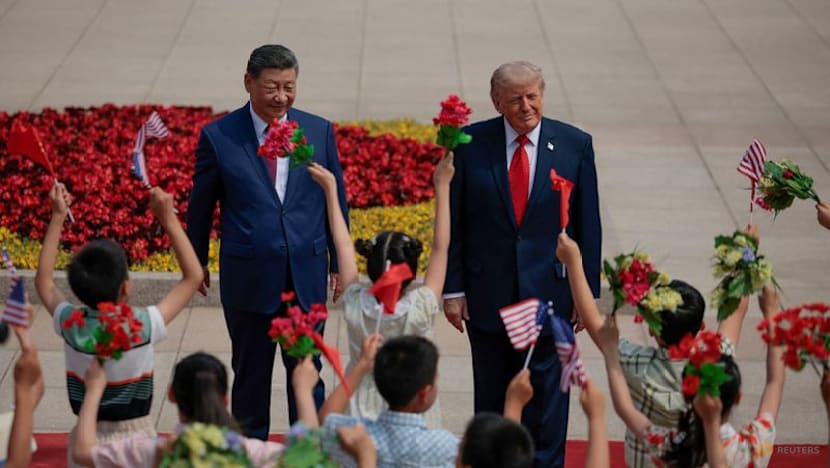
He said the current US-China rivalry differs fundamentally from the Cold War, when the US and Soviet Union operated in entirely separate economic systems separated by an iron curtain. Washington and Beijing, by contrast, are embedded in the same economic universe.
“The old strategies of containment and exclusion will not work, so the key point is somehow, one way or the other, sooner or later, the United States and China need to find a modus vivendi,” he said.
The recent presidential-level engagements and mutual recognition of each other as long-term peer superpowers are positive and stabilising in the short term, he said.
Still, Dr Balakrishnan cautioned against complacency, warning that miscalculation or misunderstanding could still tip the rivalry towards conflict.
For small city-states like Singapore, with vital interests in both superpowers and in a functioning rules-based global order, the imperative was to be “exquisitely sensitive and to understand what is going on, and to the extent possible, in our own small way, understand and be constructive”, he said.