Sunset Way housing plans 'not final'; HDB says it remains open to feedback
More than 100 residents attended a closed-door session on Friday to raise concerns about the loss of Maju Forest.
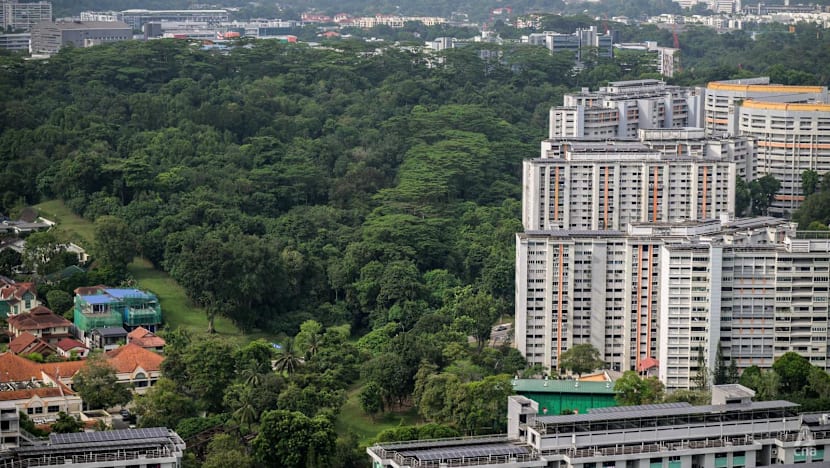
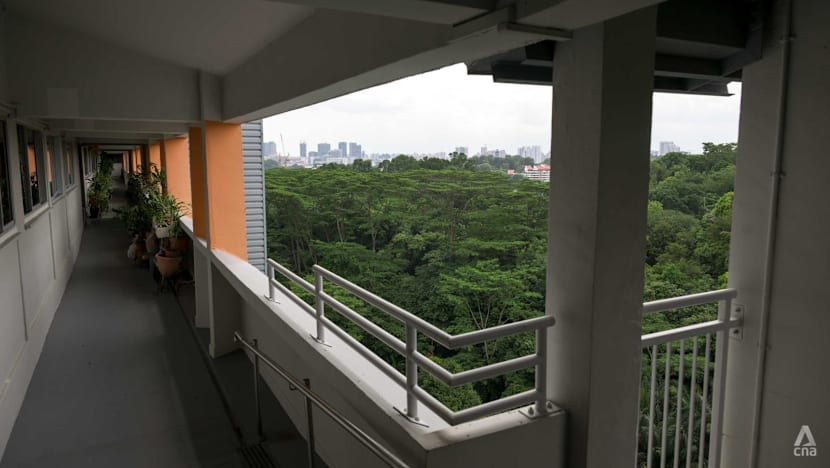
A view of Maju Forest from Clementi Ridges on Jul 16, 2026. (Photo: CNA/Wallace Woon)

This audio is generated by an AI tool.




SINGAPORE: Development plans for Sunset Way are not final, as the Housing and Development Board (HDB) looks to balance resident concerns over Maju Forest with housing needs, its chief town planner Chong Fook Loong said on Friday (Jul 17).
“We have to make trade-offs. We have to understand how to balance housing and nature to bring about the best plan, as we always do wherever we go,” said Dr Chong, who is also group director of HDB’s urban planning division.
He was speaking to CNA ahead of an engagement session for the proposed residential development at Sunset Way. At least 100 residents, as well as Members of Parliament for Holland-Bukit Timah GRC Christopher de Souza and Sim Ann, attended the closed-door session at Bukit Timah Community Club.
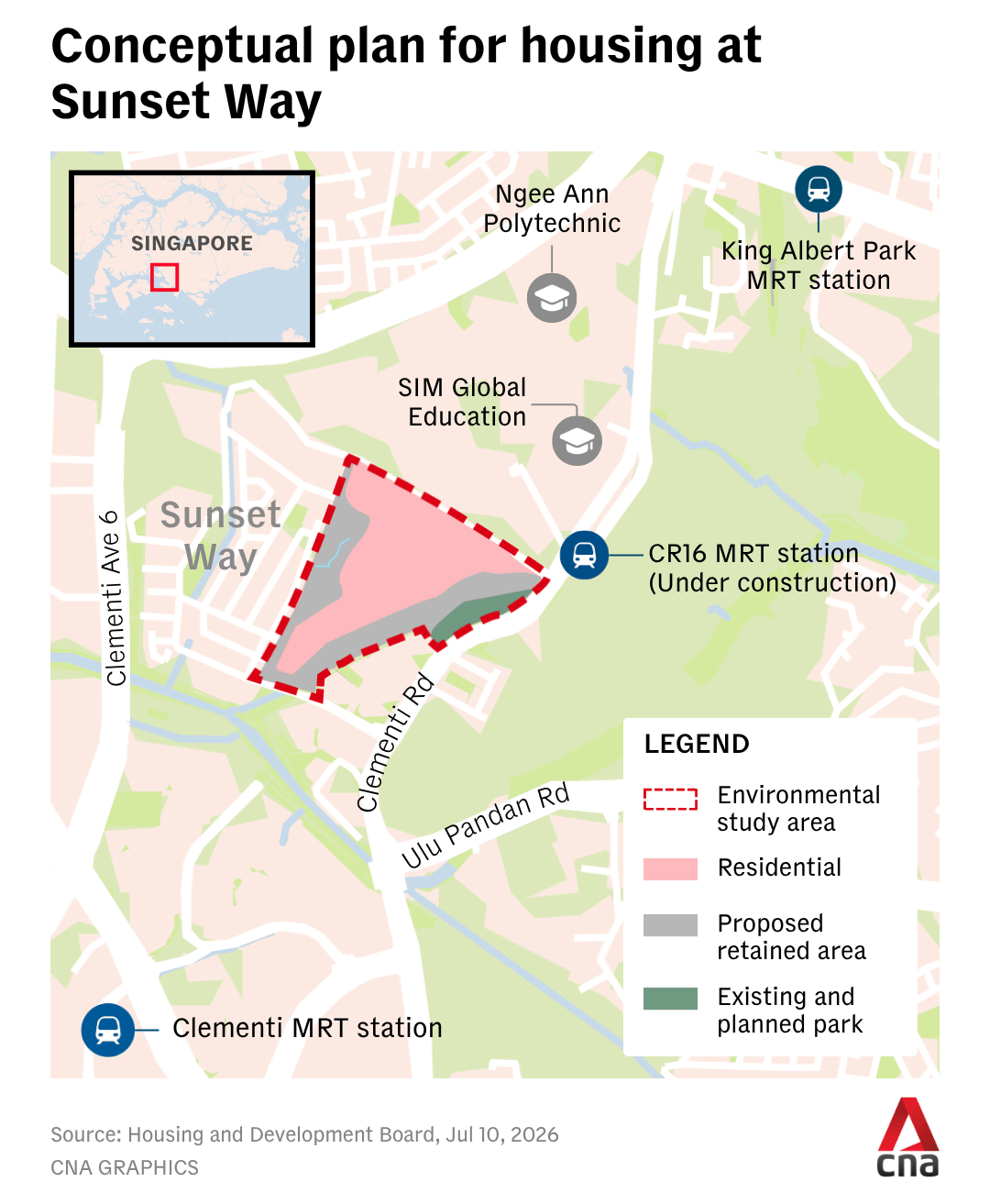
HDB announced last Friday (Jul 10) that Sunset Way, along with Gillman Barracks, will be developed for housing. Much of the Sunset Way site within Maju Forest has been zoned for residential use since the 1980 master plan.
Under the development plans, about 8ha of the 23ha study area will be retained, mostly along the forest's periphery.





Dr Chong pointed to the recent Clementi Build-to-Order (BTO) exercise, which was more than four times oversubscribed, as evidence of a "great need" for more housing supply.
“Our first inkling and priority is to go for brownfield sites. Unfortunately, within Clementi and the region, there are very, very few such sites. So, we have to now focus on Sunset Way site to see how that can help to enhance the supply,” he said.
Brownfield sites are land that has been previously developed while greenfield sites like Sunset Way are largely undeveloped land, often with existing greenery or ecosystems.
The development of Sunset Way is guided by an Environmental Impact Assessment that helps HDB understand the site's ecological features and significance, he added.
“Now again, that plan is not final. We are working on it. And through these plans and through these trade-offs, we hope to work further with residents and stakeholders,” Dr Chong said, adding that HDB is seeking feedback following the publication of the environmental study.
Ms Sim, who is also Senior Minister of State for Foreign Affairs and Home Affairs, said Friday’s session gave residents a chance to air their views and concerns directly to the agencies involved.
“Some residents have expressed a sense of loss for the greenery. Some residents have also expressed concern about the possible impact on future traffic, and we have also residents who are concerned about what construction might mean, what kind of interim disamenities might arise, such as noise,” she said, adding that others were curious about what amenities would be added to the neighbourhood.
The engagement session ran for more than two and a half hours, with representatives from HDB and the MPs addressing residents before the floor was opened to questions, residents who attended said.
Concerns raised included overdevelopment, deforestation and traffic congestion. Some residents told CNA after the session that they remained unsettled about the development plans, though they hoped the agencies would take their feedback into account.

CONCERNS ABOUT MAJU FOREST
Most of the 11 Sunset Way residents CNA spoke to earlier this week said the announcement has been difficult to accept.
Among them is Madam Teo, a 68-year-old retiree who has lived in an HDB flat at Sunset Way for three decades and asked to be identified only by her surname.
Mdm Teo regularly photographs wildlife at the forest's edge, including long-tailed macaques and monitor lizards. In January, she recalled, nature photographers flocked to the estate to capture images of Himalayan vultures there.
"I was devastated when I read it," Mdm Teo said of the announcement. "For those who have not been so close to it, they may dismiss it as just another patch of forest, and then to cut it down for housing is no big deal.
"But for us within the Sunset Way Estate, it is this rare opportunity to live in an urban environment and still be so close and to be able to experience this bond."
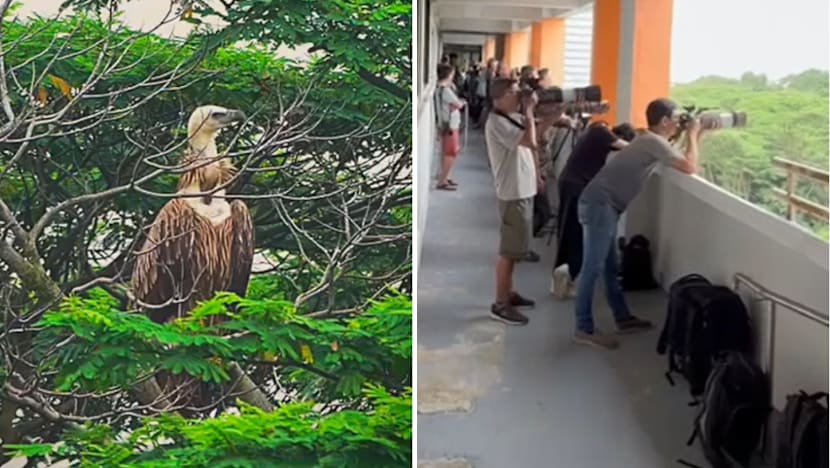
She hopes the authorities will review the plans and preserve more of the forest. Members of the public can submit feedback on the plans until Aug 6.
Thousands have also signed online petitions calling for Maju Forest to be preserved. One of the most prominent, addressed to several government agencies, has drawn more than 17,000 signatures as of Friday evening.
It urged authorities to "pause the clearance" of the forest and prioritise brownfield sites such as expiring golf courses and ageing industrial land for housing instead.
Long-time residents Felicia Koh and Alastair Hunt, who signed the petition, moved in 2020 from a nearby condominium to a flat facing Maju Forest to be closer to nature.
“The Maju Forest is a small forest with a big heart," said Mr Hunt, the founder of a health practice. "It's a tiny but vibrant piece of forest that provides us all with fresh air, cool breezes, access to nature, mental and physical health.
“It gives people joy and pleasure in our community and outside the community … It is such a valuable resource for this part of Singapore,” he said.
Ms Koh asked whether authorities could explore alternative sites for housing. “Use brownfield sites first before you even dig into any forest in Singapore. We've lost too much in the last 10 years.”
OTHER COMPETING INTERESTS
Not all residents CNA spoke to opposed the development. One long-time resident, who declined to be named, backed the redevelopment as necessary for Singapore's growth.
The man, who has lived in Sunset Way for around four decades, was strolling along a popular trail leading from Maju Forest to the Sunset Way neighbourhood centre when CNA approached him.
"Singapore has so many people but its land is limited," he said in Mandarin. "There is nothing to be done about it."
He added that he hoped to move into one of the new flats, as his current block was ageing.
Another resident, Mr Raymond Ho, who lives in a ground-floor maisonette in Sunset Way Estate, said he expected the forest's redevelopment would mean fewer monkeys wandering into the neighbourhood.
The 79-year-old said the animals have occasionally entered his home through the balcony.
Other residents raised concerns about traffic congestion from an influx of new residents. A new road linking Sunset Way and Clementi Road, completed in 2024, was meant to ease congestion. Before it was built, Sunset Way was the only road in and out of the area.
Potential noise and debris from construction were also flagged as concerns, though residents said these were secondary to the potential loss of Maju Forest.
Mr Winston Choo, 85, who bought his landed property in Sunset Way in 1964, said he appreciated how the forest had served as a buffer that kept the neighbourhood quiet.
“If we have to build the housing, design it such that it doesn't affect the privacy, the wind flow, and the noise level for the people living in this neighbourhood,” said the retiree.