



Singapore, Indonesia setting up joint task force to probe firms linked to forest fires; hotlines to manage differences
The task force, announced by the two countries' foreign ministers on Tuesday (Oct 27), will coordinate action and share information on companies linked to forest and land fires.
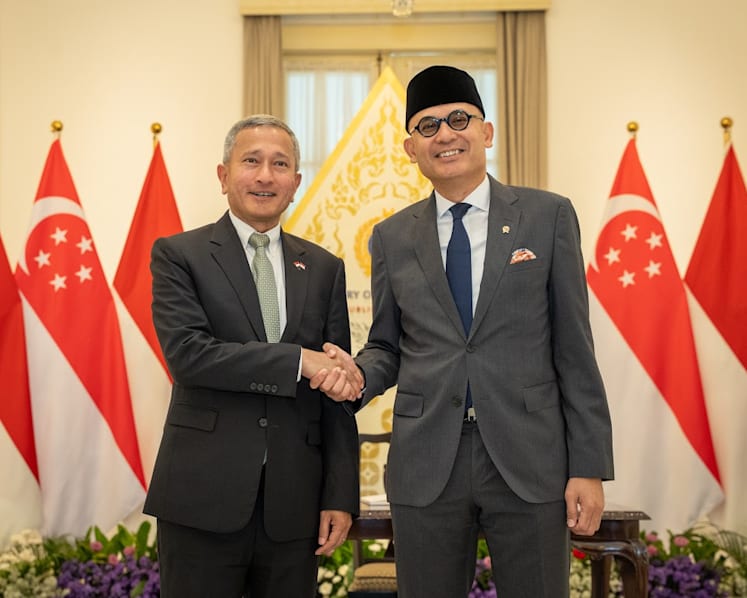
Singapore Foreign Minister Vivian Balakrishnan (left) and Indonesia Foreign Minister Arrmanatha Nasir at a joint press conference in Jakarta, Indonesia, on Oct 27, 2026. (Photo: Ministry of Foreign Affairs)

This audio is generated by an AI tool.


SINGAPORE: Singapore and Indonesia will set up a joint task force to investigate companies linked to forest and land fires behind the transboundary haze, the two countries' foreign ministers said on Tuesday (Oct 27).
Speaking at a joint press conference in Jakarta during a visit by Singapore Foreign Minister Vivian Balakrishnan, Indonesia Foreign Minister Arrmanatha Nasir said that Indonesia is committed to working with Singapore and others to bring those responsible to justice.
“Smoke can cross borders, so can money. That is why we must follow the money trail these companies have left behind. Singapore offered to share data on companies linked to the fires, which we welcome as a valuable opportunity,” he said.
“In this context, we discussed establishing a joint task force on strengthening business responsibility. It will link information sharing, financial intelligence, and cross-border evidence gathering, with and where possible hopefully asset recovery. No border should shield those who profit from burning our forests.”
Dr Balakrishnan added that Singapore agrees with the establishment of such a task force.
“And we are in effect putting all the companies on notice that the joint task force will ensure that there is a very close coordination of actions and sharing of information between Indonesia and Singapore,” he said.
Authorities expect the “deterrence impact” of this joint task force “to make a difference,” he added.
Dr Balakrishnan also said Singapore would exercise “every single legal and regulatory power” available against firms responsible for the haze and “is prepared to use a wider range of legal, regulatory and economic measures to deter future violations”.
The press conference, which lasted about 20 minutes, saw the two ministers reading from prepared remarks without taking questions.






HOTLINE BETWEEN NATIONS
Both sides will also set up a hotline to handle any differences in bilateral issues, added Mr Arrmanatha.
He said both sides recognised that "from time to time there will be differences where we have to address it in an efficient manner".
“In this context, we agreed to strengthen our channel of communication through a hotline at ministerial as well at senior official levels," he added.
The Indonesian foreign minister said that the Indonesia-Singapore relationship is "mature" enough to speak candidly, especially when opinions differ.
“What matters is not what we differ (on), but how we resolve our differences constructively, respectfully, and openly. We will continue to respect each other's domestic process, legal framework, and national circumstances,” he added.

Amid the haze, remarks by Indonesian officials about neighbouring countries have also prompted controversy.
Earlier this month, Indonesia’s Government Communications Agency head Syahganda Nainggolan defended the country against criticism over transboundary haze, saying: "We're not just sending over the haze. When there's no haze, we send oxygen. The oxygen in Singapore and Malaysia comes from our forests, right?"
He added that the forest fires are "beyond human error" and a natural phenomenon.
In an interview with Singapore media, Senior Minister K Shanmugam on Oct 19 expressed disappointment over the remarks, but also welcomed Indonesian President Prabowo Subianto's efforts to tackle the transboundary haze crisis.
Mr Shanmugam added that he did not believe the official’s view was widely shared within the country’s government or among the broader public, pointing to reactions to the remarks.
"WE WILL USE THE FULL FORCE OF THE LAW"
On Tuesday, Mr Arrmanatha pointed out that the first victims of the fires are Indonesians.
“It is our farmers, our children, and our families in Sumatra and Kalimantan who (have) to breathe the smoke first,” he said.
“That is why President Prabowo has made tackling the fires a top national priority, and I made this very clear to Minister Vivian.”
Mr Prabowo has directed his administration to "intensify, better coordinate, and sustain national response", and to use all available national resources to fight the fires, from water bombing, the use of dry ice, weather modification, added Mr Arrmanatha.
At the same time, he highlighted difficult weather conditions as a potential roadblock, including the El Nino event.
The Indonesian foreign minister also added that around 71,000 ground personnel and about 51 "aerial units" have been mobilised, with more ready to be deployed.
"Know that when we protect our own people, we are also protecting our neighbour and our region," he added.
Mr Arrmanatha added that Indonesia is also undertaking its own "coordinated and rigorous" national investigation.
"Hundreds of individuals and over 50 corporations have been and are being investigated and prosecuted, and some have been found guilty under Indonesian law," he said.
"We will use the full force of the law to make sure those who profit from fire must answer for the fire."
Singapore’s authorities last week laid out several measures to tackle the transboundary haze which has caused stretches of unhealthy air quality since Sep 4.
This included the setting up of a specialist panel to probe firms that may be responsible for, or have contributed to, the fires causing haze in Singapore.
The panel will comprise law firms, audit firms and investigative firms with expertise in conducting cross-border inquiries and investigations, said the Ministry of Law.
The National Environment Agency on Friday also issued notices to 10 Singapore-based firms to seek documents and information, the first time the agency has done so since the Transboundary Haze Pollution Act went into effect.