School bullies to face stricter punishments, including suspension and caning
Offenders could face punishments similar to those for vaping, with clearer guidelines for schools to tackle misconduct.
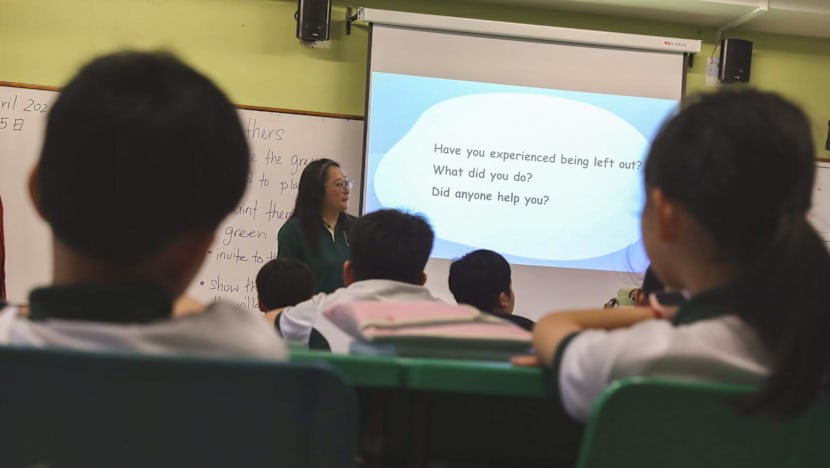
A teacher conducting character and citizenship education at Teck Ghee Primary School on Apr 15, 2026. (Photo: CNA/Mak Jia Kee)

This audio is generated by an AI tool.


SINGAPORE: Students who engage in bullying could face suspension, caning and lowered conduct grades under a stricter framework for student misconduct announced by the Ministry of Education (MOE) on Wednesday (Apr 15).
Under the guidelines – similar to those introduced for vaping offences – first-time offenders of serious misconduct face one to three days of detention and/or suspension.
Their conduct grade will be adjusted, and older boys may receive one stroke of the cane if there are aggravating factors.
For very serious offences, first-time offenders could face three to five days of detention or suspension, with their conduct grade capped at “Fair”. Boys in upper primary levels and above may also receive up to two strokes of the cane.





Repeat offenders of very serious offences face five to 14 days of detention or suspension, a “Poor” conduct grade, and up to three strokes of the cane for older boys.
These measures will be balanced with a rehabilitative approach, including counselling, said MOE. Conduct grades are issued each semester and are typically taken into account when students apply for certain programmes or other schools in future.
In assessing whether an offence is serious or very serious, schools will consider factors such as the impact of the behaviour, the perpetrator’s intent, whether the acts were repeated and whether the student is recalcitrant.
Serious offences include fighting, physical assault and repeated social bullying with clear intent to harm. Very serious offences involve persistent or recalcitrant behaviour despite intervention, or cases that warrant police investigation.
Previously, schools adopted a tiered approach to discipline based on severity, ranging from reflection for minor cases to detention, suspension or caning for more serious offences. In severe cases, police reports may be filed.
However, there were differences in how schools handled such cases, said Minister for Education Desmond Lee, who added that the more stringent framework aims to ensure a more consistent approach across schools.
From 2021 to 2025, schools recorded an average of three bullying cases per 1,000 primary school students and eight per 1,000 secondary school students, MOE said.
This is higher than from 2019 to 2023, when an average of two cases per 1,000 primary students and six per 1,000 secondary students per year were recorded.
The guidelines apply not only to bullying but also to other forms of misconduct, such as theft and vandalism, and will be implemented across all schools by the start of 2027.
MOE said schools will retain discretion to impose additional school-based consequences based on their assessment of each case. Mitigating factors – such as a student’s age, maturity, special educational needs and mental well-being – will also be considered before caning is administered.
School-based consequences may include writing reflections or having students share lessons learnt with their peers.
CLEARER GUIDELINES
The move follows a comprehensive review of how schools handle bullying and other hurtful behaviours, following a series of incidents that drew public concern.
In 2025, three students from Sengkang Green Primary School were suspended after threatening to kill a classmate and her family. Earlier that year, videos circulating online showed teenagers threatening a boy with a knife, as well as a separate fight involving students from Montfort Secondary School.
“Hurtful behaviours” include one-off incidents such as insensitive remarks or physical altercations, while bullying refers to repeated and intentional acts, MOE said.
Beyond disciplinary measures, MOE outlined additional measures to tackle bullying in schools, such as more funding for manpower and more accessible reporting channels.
Schools will also receive clearer guidelines covering areas such as response timelines, safety planning, counselling and restorative practices, to ensure cases are handled in a timely and consistent manner, the ministry said.
Related:



When bullying occurs, schools will now follow a structured process that prioritises student safety while addressing root causes. This includes implementing immediate safety measures, conducting investigations and applying appropriate discipline actions.
Throughout the process, schools will keep parents informed at key stages, collaborate on safety measures and prioritise the well-being of all students involved, the ministry said.
These enhanced measures will be progressively implemented from this year.
For cyber-related cases, students and teachers affected by online harms – such as harassment, doxxing and the sharing of intimate images – can seek recourse through the Online Safety Commission, which will begin operations at the end of June.
Victims are advised to first report harmful content to the relevant social media platform. If no action is taken within 24 hours, they may escalate the matter to the commission, which has the authority to order the removal of harmful content.
MOE added that schools will work with students and their families to address inappropriate online behaviour and provide guidance where needed.