Seafarer safety in Strait of Hormuz 'top of our mind', but right of passage non-negotiable: DPM Gan
Deputy Prime Minister Gan Kim Yong said Singapore is working closely with the ports along the coast to render support and assistance where necessary.
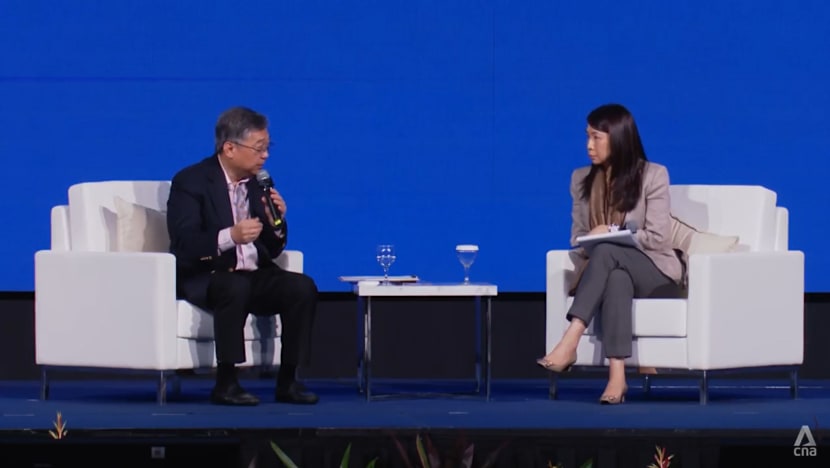
Deputy Prime Minister Gan Kim Yong taking questions from the floor at a fireside chat at Singapore Maritime Week on Apr 21, 2026.

This audio is generated by an AI tool.


SINGAPORE: The safety and well-being of seafarers caught in the Middle East conflict are at the “top of our mind”, and that the authorities are working hard to ensure their safe return, said Deputy Prime Minister Gan Kim Yong on Tuesday (Apr 21).
As for Singapore's decision not to negotiate with any parties on the right for seafarers to pass the Strait of Hormuz, Mr Gan said it was important for Singapore to "stay on course".
"Sometimes you have to make a hard decision, that this is a matter of principle, that we cannot negotiate something that is a matter of right," he said during a fireside chat as part of the Singapore Maritime Week.
He was answering questions from two audience members, who were from the maritime industry and had asked about the welfare and evacuation plans for seafarers trapped in the Strait of Hormuz.





In his response, Mr Gan said the Maritime and Port Authority of Singapore (MPA) is working "very hard" to maintain contact with the ship owners and operators to ensure the "safety and security of our seafarers on board our ships".
He added: “At the same time, we will be working very closely with the ports along the coast to render support and assistance where necessary.”
Since the war broke out at the end of February, Singapore-based shipping companies have 29 vessels stuck in the strait, according to a report by international news agency AFP.
After ceasefire talks with Iran earlier this month ended without an agreement, the US enforced its own blockade of the Strait of Hormuz.
Responding to another question from an audience member on the “diplomatic initiations” that Singapore has to free marine vessels that are stuck in the Middle East amid the conflict, Mr Gan reiterated Singapore’s stance of not negotiating on the right of passage.
“We cannot negotiate with Iran because the right of transit passage is a matter of right,” he said.
Should Singapore negotiate, and there is “some agreement” that is arrived at, it would mean that there will be a condition or conditions that Singapore must comply with in order to have that safe passage.
“And it is not conditional. The right is protected under UNCLOS (United Nations Convention on the Law of the Sea), and therefore we cannot possibly enter into a negotiation,” said Mr Gan, to which the audience broke into applause.
“I hope I made that clear, because we are very concerned about the safety and also the cargo that we do want to try to get them out and continue to ensure safe passage through the Straits of Hormuz, but it is important for us to continue to uphold the principle that it is a matter of right,” he said.
"It is not negotiable."

MARITIME AI AND UNMANNED VESSELS
A member of the audience also asked about the use of artificial intelligence (AI) in the maritime industry.
Mr Gan noted that MPA’s new OCEAN-X initiative seeks to use AI and robotics to carry out port operations.
“There are a lot of opportunities in logistics, supply chain, port operations, shipping lines, to adopt AI, but it also requires commitment,” he said.
“Some of the AI's work, some don't work. So you have to be able to discern what is a possible and potential proposition that AI may apply in a certain area,” he said.
Asked about how to address the “image problem” that the maritime industry has, Mr Gan said that the best way to market the industry would be for young people to join and “have a taste of what this is like”.
“Actually, it can be quite fascinating, because you get to see different parts of the whole supply chain, the whole logistics and the whole shipping industry and maritime industry,” he said.
He said that opportunities such as internships or to work on board ships for a short period of time is the “best way to have an accurate image of what the industry is about”.
Another audience member asked if there are plans for the widespread deployment of unmanned maritime vessels.
Mr Gan said that autonomous vehicles such as harbour craft are already being explored.
“(There) is a critical shortage of such manpower in Singapore and I'm sure around the world too. So I think autonomous ships and autonomous vehicles in the water is something we will be very keen (about), and we are actively looking at it,” he said.
“I believe our agencies are doing research and development in that regard, and watch this space, we may be able to announce some of these experiments in time to come.”