Singapore police to set up new unit to better combat scams and cybercrime
The new SPF Cyber Command will pull together counter-scam and cybercrime capabilities across the police force.
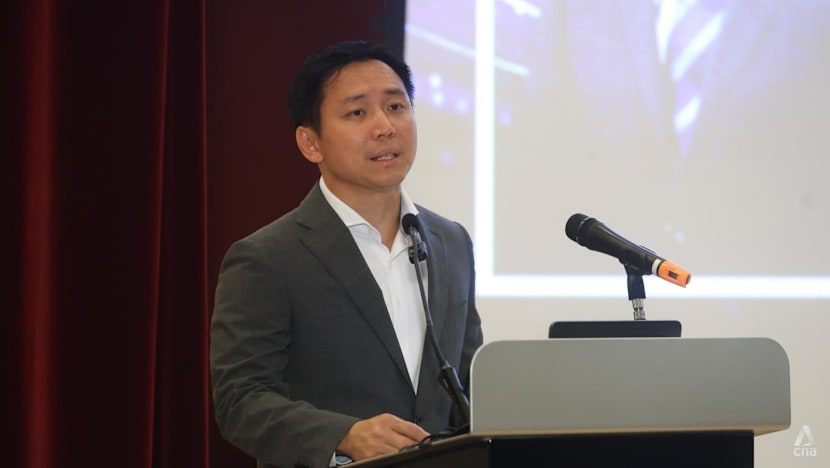
Minister of State for Home Affairs Goh Pei Ming speaking at the Anti-Scam Conference 2026 at Police Cantonment Complex on May 11, 2026. (Photo: CNA/Ooi Boon Keong)

This audio is generated by an AI tool.


SINGAPORE: The Singapore Police Force (SPF) will establish a new unit in July that will consolidate its counter-scam and cybercrime capabilities.
Known as the SPF Cyber Command, it will be a frontline unit with about 200 officers across operations, investigations and intelligence, Minister of State for Home Affairs Goh Pei Ming announced at an anti-scam conference on Monday (May 11).
The plan is to eventually double it to over 400 officers as the command grows its capabilities and operates alongside other police commands.
"The Cyber Command will be the tip of the spear in SPF’s response to cyber threats, and be at the forefront of protecting Singaporeans from the threat of cybercrime and scams," Mr Goh said.
In 2015, a cybercrime unit was set up within the Criminal Investigation Department. Four years later, the police created the anti-scam centre under the Commercial Affairs Department, and this was expanded to the Anti-Scam Command in 2022.
They will come under the Cyber Command once it is established.






NEW CYBER COMMAND
A new cyber operations centre within the Cyber Command will strengthen the police’s ability to proactively detect and disrupt online criminal activities, including scam enablers, in real-time.
The cyber operations centre will also uncover threat actors and their infrastructure, and work to disrupt these online activities.
“For example, the centre will leverage technology to detect phishing campaigns more quickly and at scale, trace upstream, identify the related scam enablers such as fake websites and malicious phone lines, and then move quickly to dismantle the syndicate’s operations,” Mr Goh said.
The anti-scam centre will have expanded tracing teams to interdict cryptocurrency and to leverage blockchain intelligence, he added.
It will also continue working with financial institutions to trace and recover funds, as well as build specialised cryptocurrency tracing capabilities, SPF said.
Two targets of the Cyber Command are scam and cybercrime syndicates.
For example, its investigation teams will look into transnational criminal syndicates behind ransomware, malware, and scams, and work with international partners to launch operations against both local and overseas threat actors.
Mr Goh said the new unit will build strong partnerships to fight cybercriminals wherever they operate.
"The cross-border nature of cybercrime needs a strong global network of like-minded partners … to help us work together to take down criminal syndicates," he added.
"To this end, the Cyber Command will lead SPF’s efforts to strengthen international and public-private partnerships in this field."
The unit will reorganise SPF’s existing partnership frameworks for cybercrime and expand them to strengthen public-private collaboration in key areas, including information sharing, disrupting cybercriminal threats, and investigating cyber-threat enablers and infrastructure, SPF said.
In talent development, the Cyber Command will serve as a hub for building specialist capabilities and technical skills.
“The command will recruit, train, and deploy both uniformed and civilian officers that will work together across different roles such as scams and cybercrime investigations, cyberthreat hunting, and disruption,” SPF said.
The police will expand the number of full-time National Service Cybercrime Operators over time and establish a contingent of national servicemen specialising in scams and cybercrime fighting capabilities.
“Through the Cyber Command and through working closely with our local and international partners, we will realise our vision of protecting Singapore’s cyberspace and keeping Singaporeans safe online,” Mr Goh said.
COMBAT SCAMS
As one of the world’s most digital societies with close to 96 per cent internet usage and as a high-trust society, Singapore is an attractive target for scammers, Mr Goh said.
There were 37,308 scam cases last year, down from the 51,501 cases recorded in 2024.
“Through exploiting technical vulnerabilities and social engineering, scammers have been able to perpetuate their crimes, resulting in the rise of scam cases and losses," Mr Goh noted.
He added that over the years, Singapore has mounted a comprehensive anti-scam response anchored on strong operational capabilities, a robust legal framework and partnerships.
The anti-scam centre has recovered over S$730 million (US$576 million) since 2019.
Mr Goh said Singapore’s efforts to combat scams are backed by legislation, including the Online Criminal Harms Act and the Protection from Scams Act.
“We have gone upstream to require higher-risk online service providers to introduce stronger protective measures. Ensuring that scams do not proliferate on their platforms must be part of their business model, and we will act decisively when they fall short,” he said.
He added that Singapore has strengthened penalties and expanded sentencing to deter scam mules, enacted legislation to stop victims from transferring more money to potential scams, and will continue updating laws to better protect citizens.
Mr Goh warned that the fight against scams is far from over.
"Criminals are constantly evolving, and with the use of technology, including AI, they can reach victims with speed and at scale," he said.
"A recent report by Interpol found that fraud enabled by AI can be up to 4.5 times more profitable than traditional methods.
"This is a serious concern for open and digitally connected nations like ours. To maintain trust in our society, we must stay proactive and keep ahead of these evolving threats."
The conference, held in Singapore from Monday to Wednesday, was organised by SPF in partnership with the International Security Cooperation Directorate of the French National Police, the United Arab Emirates' Ministry of Interior and the International Security Alliance.


CRYPTOCURRENCY SCAMS
Several officers also detailed the challenges of tackling cryptocurrency scams and ongoing efforts to prevent illicit transactions.
Assistant Superintendent of Police Lee Hua Sheng, who is the officer-in-charge of the crypto tracing team and anti-scam command at SPF, said they have worked on more than 2,800 cases since March 2025.
He said that given the complex and borderless nature of crypto transactions, recovery is inherently difficult. This is why the team has gone beyond reactive tracing.
"We have transitioned to a proactive approach, taking steps to identify and protect victims before further losses occur, preventing considerable sums from falling into the hands of scammers."
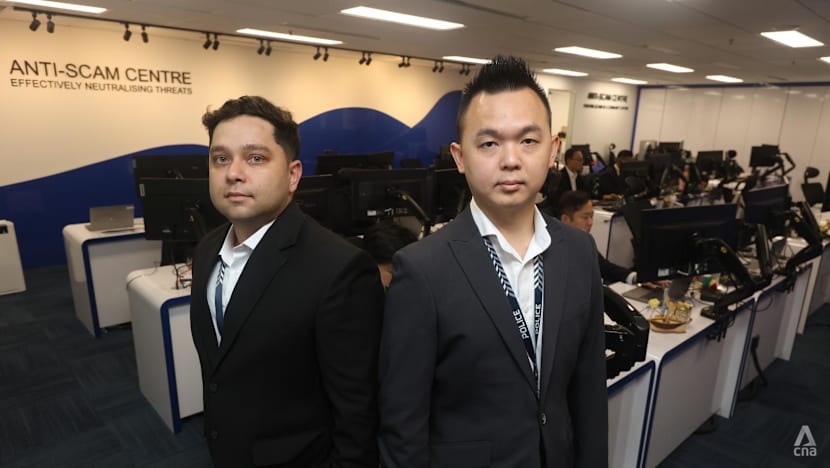
Assistant Superintendent of Police Shariff Munshi, who is the senior investigation officer of the crypto tracing team and anti-scam command, said crypto scams present a "unique set of challenges" compared with traditional scams.
"Unlike conventional bank transfers, crypto transactions are fast, borderless, and irreversible," he added.
"Once the funds are moved, freezing them becomes extremely difficult. Scammers exploit this by rapidly moving funds across multiple wallets and jurisdictions within seconds, deliberately obfuscating the trail."
Special Constable Bryant Neo said many people associate cryptocurrency with stories of overnight wealth, and this "get rich quick mentality" can cloud judgment.
"Scammers are well aware of this and deliberately exploit it to lure victims. On the other end, victims often assume that once they have been scammed, the funds can be easily recovered but that is far from the truth," he added.
He said recovery is a complex and challenging process with no guarantees, and public education and vigilance are important.