PMs Wong, Anwar agree on importance of diplomacy, discuss supply chain resilience amid Middle East crisis
Prime Minister Lawrence Wong said that he spoke with his Malaysian counterpart Anwar Ibrahim to discuss the latest developments in the Middle East.
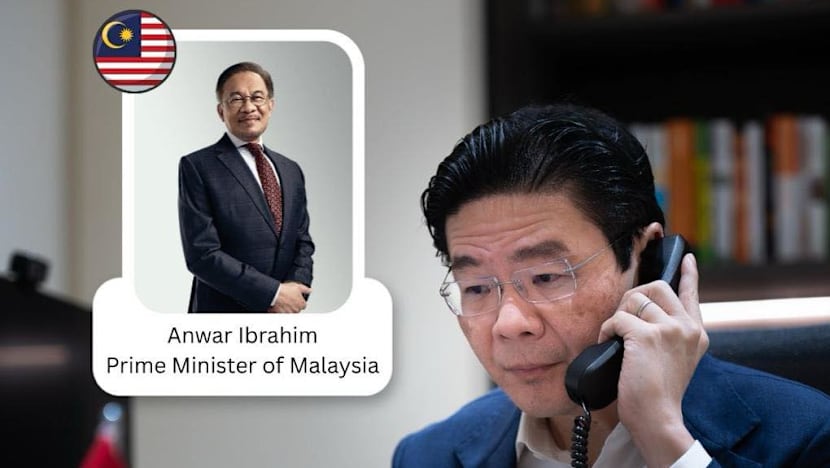
Prime Minister Lawrence Wong spoke with his Malaysian counterpart Anwar Ibrahim on Apr 20, 2026, to discuss the latest developments in the Middle East. (Photo: Facebook/Lawrence Wong)

This audio is generated by an AI tool.


SINGAPORE: Singapore Prime Minister Lawrence Wong said on Monday (Apr 20) that he and his Malaysian counterpart Anwar Ibrahim agreed on the importance of upholding diplomacy in a call amid the war in the Middle East.
The two prime ministers also discussed how Singapore and Malaysia can fortify supply chain resilience.
"We agreed on the importance of sustained diplomacy to secure a durable resolution to the crisis," said Mr Wong, who is also Singapore's Finance Minister.
"We also discussed how Singapore and Malaysia can work more closely to strengthen supply chain resilience," he added in a Facebook post.





Mr Wong said that he spoke with Mr Anwar on Monday afternoon to discuss the latest developments in the Middle East.
"At a time like this, it is all the more important for close neighbours like Singapore and Malaysia to stay coordinated and support one another," said Mr Wong.
In a Facebook post, Mr Anwar wrote that the two leaders also welcomed the temporary ceasefire and stressed the need for a lasting resolution to the conflict.
"Malaysia supports ongoing diplomatic efforts, including Pakistan’s role in facilitating dialogue, and underscored the importance of safeguarding freedom of navigation through the Strait of Hormuz," said Mr Anwar, who is also Malaysia's finance minister.
Mr Anwar said that the country is also focused on strengthening grid resilience and managing supply-demand pressures and is intensifying regional cooperation through the ASEAN Power Grid, which is an ongoing regional initiative.
"We will continue to prioritise domestic needs and ensure Malaysia and the region remain resilient amid global uncertainty," he added.


The war began on Feb 28 when the United States and Israel launched attacks on Iran, with Tehran in turn striking targets in Israel and Gulf nations.
Lebanon became involved in the conflict when Iran-backed Hezbollah attacked Israel.
On Monday, the US and Iran said that they were ready for war as the ceasefire's deadline approaches. Peace talks remain uncertain after the US seized an Iranian cargo ship attempting to breach its blockade.
Washington said that Vice President JD Vance would return to Islamabad for a second round of negotiations, but Tehran did not confirm its attendance.
Iran's Revolutionary Guards threatened to target vessels passing through the Strait of Hormuz, a crucial route for global oil supplies, if they did so without permission, while US President Donald Trump accused Iran of harassing shipping in the area.