Reopened Malay Heritage Centre captures community's evolution from diverse roots to 'shared sense of home': PM Wong
"What we have today is not just a Malay culture but it is a Singaporean Malay culture," said PM Lawrence Wong at the reopening of the Malay Heritage Centre.
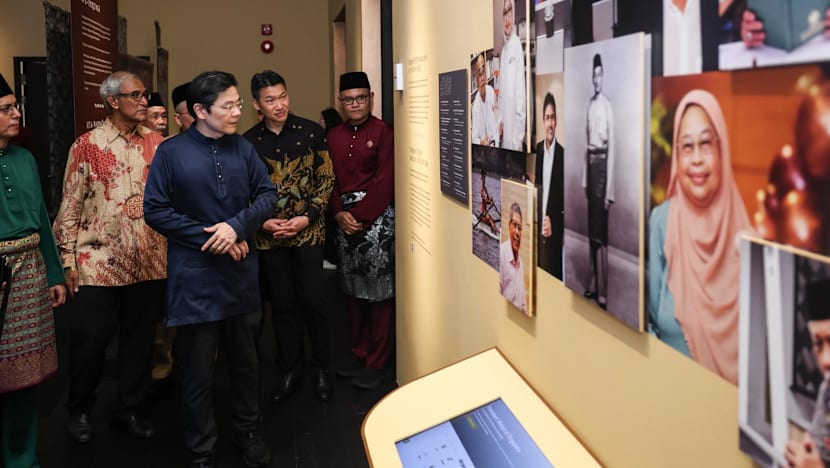
Prime Minister Lawrence Wong at the reopening of the Malay Heritage Centre. (Photo: Facebook/Lawrence Wong)

This audio is generated by an AI tool.
SINGAPORE: Singapore’s Malay community traces its roots to diverse origins, Prime Minister Lawrence Wong said at the reopening of the Malay Heritage Centre (MHC), highlighting how these varied beginnings have shaped a distinct Singaporean Malay identity.
The revamped centre reflects that very journey of how these diverse beginnings evolved into a "shared sense of home", said Mr Wong on Saturday (Apr 25).
"From our earliest days, Singapore was connected to the wider Malay world, or nusantara. People, ideas, and traditions flowed through this region and through Singapore. Over time, they took root here, and became part of who we are," he said.
"This Malay heritage is not monolithic. It’s rich and diverse - made up of many groups with roots across the region, of course people from the Malay Peninsula itself, but also Javanese, Bugis, Minangkabau and others."





"Each with its own traditions and customs, and yet over time, these distinct strands have come together here in Singapore."
Mr Wong said that the refreshed centre continues to honour the Singapore Malay community's rich heritage, which is integral to the national story.
And through this heritage, a distinct identity was forged.
"What we have today is not just a Malay culture but it is a Singaporean Malay culture," said Mr Wong.
He added that the centre does not just tell this story in new and meaningful ways, but it also connects more deeply with a new generation of Singaporeans.
Prime Minister Lawrence Wong said places such as the Malay Heritage Centre and Kampong Gelam can become spaces of shared meaning for all Singaporeans. Speaking at the opening of the revamped Malay Heritage Centre, he added that the government will continue supporting efforts to keep cultural precincts vibrant and alive. Muhammad Bahajjaj reports.
And it is not just about new artefacts and exhibits, even though there are plenty of these, as it goes beyond static displays to offer a wider range of experiences.
Through the centre, visitors can better understand how Singapore's past shaped who it is today, and how it can guide the country forward.
The Malay Heritage Centre is also part of the wider Kampong Glam precinct, one of Singapore’s most historic districts, Mr Wong pointed out, as he encouraged it to continue to work closely with the partners there to keep the area alive and vibrant.
The government will support these efforts by working with stakeholders and supporting heritage businesses and cultural activities, he added.
He also called on the centre to deepen collaborations across communities, including through cross-cultural programmes and performances that foster greater dialogue and exchange.
"Make this a space where culture is not preserved but lived and shared; where more Singaporeans can experience our Malay culture for ourselves, and gain a deeper understanding of our roots and shared identity," said Mr Wong.
"And in this way, we can ensure the Malay Heritage Centre and Kampong Glam are not just spaces for one community in Singapore, but places of shared meaning – that will be precious to all Singaporeans and that we all can take pride in and cherish together."