Singapore’s 15-year-olds second globally in using digital tools to solve complex problems: PISA
Singapore placed second in the world behind Macau and ahead of Beijing, Shanghai, Jiangsu and Zhejiang in China.
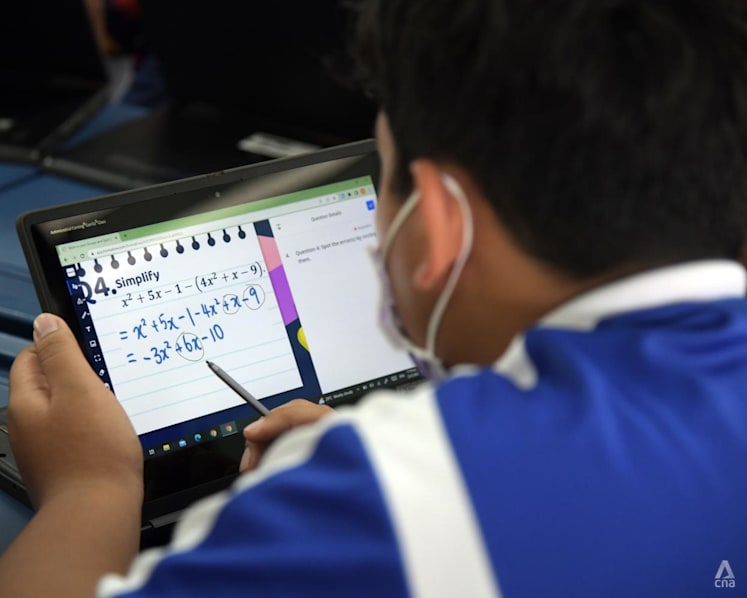
A student with his personal learning device during a mathematics lesson at Jurong West Secondary School. (File photo: CNA/Raydza Rahman)

This audio is generated by an AI tool.


SINGAPORE: Singapore's 15-year-olds ranked second globally in computational problem solving, a new Programme for International Student Assessment (PISA) domain that measures how students use computational thinking and digital tools to solve real-world problems.
The new domain was introduced as the focus of PISA 2025's new Learning in the Digital World assessment. Singapore placed second in the world in this area, behind Macau and ahead of Beijing, Shanghai, Jiangsu and Zhejiang in China.
PISA is an international study conducted every three years to assess how well 15-year-olds can apply their knowledge and skills to real-world situations.
The assessment covers reading, mathematics, and science, and evaluates students' ability to analyse, reason, and communicate effectively when solving problems.





It also includes an optional component focusing on 21st century competencies, which in 2025 focused on computational problem solving.
A total of 6,600 students from 145 public secondary schools and 12 private schools participated in the 2025 study. Top performers are students who score in the top two proficiency levels for a subject.
More than half of Singapore’s students are top performers in computational problem solving, compared to a quarter of students in Organisation for Economic Co-operation and Development (OECD) countries on average, said the Ministry of Education (MOE) in a press release on Tuesday (Sep 8).
“They are highly effective in applying computational practices such as conducting experiments, analysing data, and building and debugging computational artefacts to solve complex real-world problems,” the ministry said.
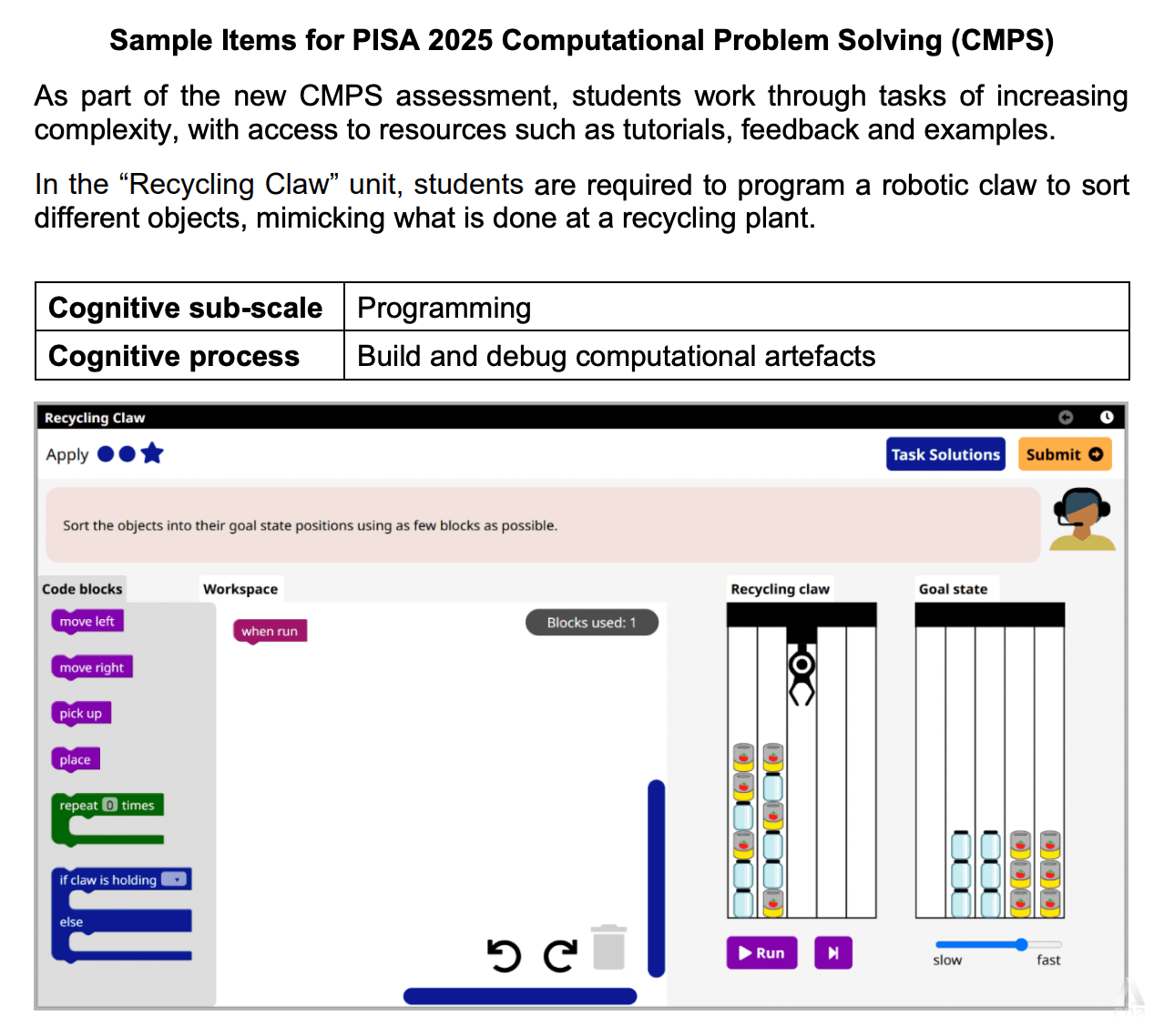
In one task in the 2025 study, students programmed a robotic claw to sort out different objects, mimicking recycling plant operations. In another, they modelled the relationship between different exercises and fitness for an application that could help astronauts stay healthy at low gravity.
Singapore’s 15-year-olds reported positive attitudes and healthy behaviours related to using digital devices – 78 per cent said they compare different sources when searching for information online, said MOE in the press release.
OTHER DOMAINS
Singapore’s students also ranked first in reading, and second in mathematics and science for PISA 2025, the study showed. They ranked ahead of students from China in reading, but behind them in mathematics and science. Chinese Taipei came in third for reading, while Macau ranked third for mathematics and science.
In 2022, Singapore topped the global league tables in all three subjects.
Singapore also had the highest proportion of academic all-rounders, or students who are top performers in all three domains, among all participating systems at 15 per cent, MOE said.
In participating OECD systems, academic all-rounders formed an average of 3 per cent of students.
They also have strong environmental knowledge and beliefs in effecting positive environmental change compared to their peers, the ministry said.
Students from Singapore ranked second for the new environmental science module, with 27 per cent of them reaching the top two proficiency levels, compared to the OECD average of 7 per cent.
As in PISA 2022, Singapore students perceived their families as less supportive of their learning than their OECD peers, with the figures declining further in 2025, MOE said.
About 49 per cent said they had weekly family discussions about how well they were doing in school, compared to the OECD average of 60 per cent. About 39 per cent said their family took interest in what they learned in school, below the OECD average of 58 per cent, the ministry added.
"Children desire and benefit from such interaction with parents. The Parenting for Wellness resources developed by Health Promotion Board, Ministry of Social and Family Development and Ministry of Education can support families in building stronger connections with their children’s learning," said MOE.
Although more students reported exercising outside school than in 2022, 23 per cent said they did not exercise outside school at all.
The PISA 2025 results provide useful insights about Singapore’s students – they are curious and care about the world around them, said MOE’s director-general of education Liew Wei Li.
“The findings also show where we can do better. We will continue to help our children, regardless of their background or starting point, to thrive and learn confidently,” she added.