More leave for parents, more work for the rest? Childcare leave boost sparks workplace debate
While broadly supportive of Singapore's push to boost fertility, some child-free workers worry that extended childcare leave and short-notice absences will leave them with less time for their own families.
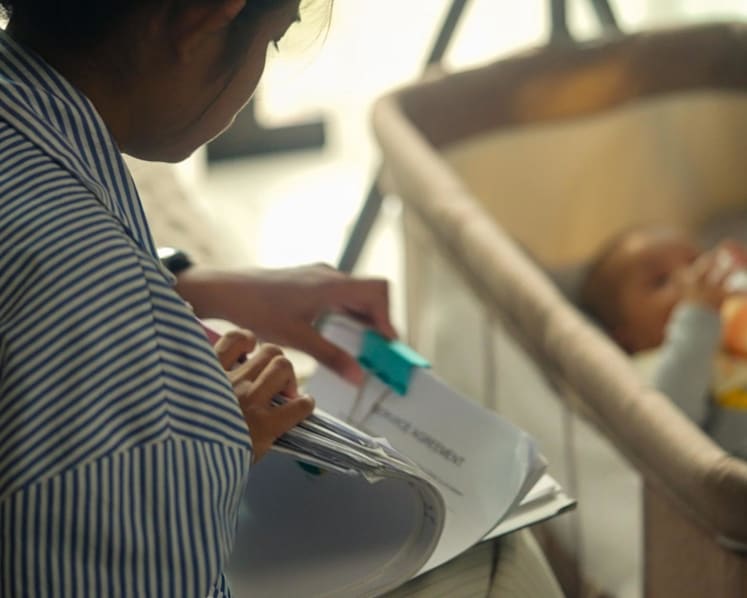
A working mother handles office documents while keeping her infant close in a bedside bassinet. (Photo: iStock)

This audio is generated by an AI tool.


SINGAPORE: Whenever a colleague takes childcare leave, 29-year-old finance professional Adam (not his real name) usually shares the extra workload with the rest of his team.
Most of the time, he does not mind that the two colleagues in his team of five take time off work to attend to their children, especially when their absences were planned for and the tasks are properly delegated.
But when they take childcare leave at short notice, Adam, who is unmarried, often finds himself reshuffling his own leave plans or shouldering additional work.
So when Prime Minister Lawrence Wong announced at this year’s National Day Rally on Sunday (Aug 23) that a new childcare leave scheme will give more time off to working parents, he felt conflicted as he was generally supportive of moves to address Singapore’s falling fertility problem.





“I work in a small company. If colleagues with children in my team are getting extended leave, more workload falls onto the people who do not have kids,” he said.
“I thought that the amount of leave they had was already quite substantial. I was taken aback when I heard they were increasing it.”
Under the new scheme, each parent will get eight days off if they have one child, 10 days if they have two children, and 12 days if they have three or more children.
This is up from the current six days off a year if the parent has a child aged six and below, or two days a year if the child is between seven and 12 years old.
Adam’s mixed feelings about the expansion of childcare leave were echoed by others.
CNA spoke to 10 people who were either single, married without children or have children above the age of 12, to understand how those who do not benefit directly from the childcare leave changes felt.
Like Adam, many were broadly supportive that the changes give parents the support they needed, but were worried that they could end up shouldering more work when their colleagues were away.
While those in bigger organisations said the impact would be minimal given that there is enough manpower to spread the burden, those in smaller firms are unsure that the work can be shared fairly.
Several also pointed out that short-notice childcare leave already causes staffing issues in leaner workplaces. Some worried that this could cause resentment between employees who are parents and non-parents.
The increase in childcare leave also gave rise to questions about fairness, as those interviewed felt that similar benefits could be extended to workers who provide care for elderly family members.
Asked about these concerns on CNA’s Talking Point on Monday, Minister of State for Digital Development and Information and for Health Rahayu Mahzam said they were “legitimate” issues.
Working as a lawyer before entering politics, Mdm Rahayu said she had also experienced the difficulties of shouldering the workload when her colleagues were on leave.
“Which is why we then need to manage the different stakeholders. And the government has always been doing this in collaboration with employers, with workers, with unions to try and come up with a middle ground that is workable."
She added that the government is not just in discussion with stakeholders about childcare leave, but flexible work arrangements and better manpower policies as well.
That means there is a need for proper human resources policies and conversations about supporting parents, she said.
“We are trying to encourage and nudge a culture where the whole society comes together and appreciates that we all may have different needs.”
WILL MORE CHILDCARE LEAVE CAUSE MANPOWER ISSUES?
Apart from the move to increase childcare leave, the government announced that it will also reimburse employers for the costs of the full duration of statutory child-related leave, up to a limit of S$2,500 (US$1,967) a week.
CNA previously reported that businesses welcomed the government's move to fully cover childcare leave costs, but some pointed to lingering questions over how to plug staffing gaps during absences.
To workers, this means that not all workplaces are staffed sufficiently to spread the workload fairly.
Mr David Lim, who is unmarried, acknowledged that more childcare leave for parents could mean more work for him, but said the move was necessary.
“At some point, the government has to do something to encourage people to have more children. Of course people will think it’s unfair, but they have to accept that it has to be done,” said the 31-year-old who works in a larger employer within the shipping industry.
While he has not had any “clashes” with colleagues over childcare leave, Mr Lim said he has seen how employees with children sometimes have to take leave at short notice because of illnesses or other unexpected needs.
Such absences can put a strain on day-to-day operations, especially when they coincide with leave already planned by other employees.
With the possibility of several people away at the same time, it could mean a heavier workload for the rest.
“If I put in a long week of leave, but their kid falls sick, the team might be short-staffed,” he said.
Mr Lim highlighted another concern that employees may not be comfortable using the leave they were entitled to.
“Some people might question why you’re always on leave,” he said. “How many people actually dare to take it?”
Chairman of the Families for Life Council Keith Magnus said leave on paper only makes a difference if parents feel able to use it without worrying that it will set back their careers.
The government bearing the cost of statutory child-related leave should also help employers support parents more confidently, he added.
“Ultimately, no single scheme determines whether people choose to marry or have children. Our aspiration should be a Singapore where people can build strong families and pursue their aspirations at the same time.”


A 32-year-old married man without children, who wanted to be known only as Faris, said the additional workload should be manageable if employers plan properly.
Speaking from his own experience, the engineer said he has postponed his own leave to cover for colleagues on childcare leave, but said his organisation was large enough to manage such absences.
Smaller companies, he said, could face greater pressure.
Assistant Professor Chong Sin Hui from Nanyang Technological University, who specialises in organisational behaviour, agreed that the limited manpower in small- and medium-size enterprises can make it difficult to find temporary staff or reassign colleagues when a parent takes childcare leave.
“Companies or supervisors can consider engaging their employees to discuss these issues openly so that they can come up with a contingency plan when a working parent goes on childcare leave,” she suggested.
“The plan should address whether there is a need and when there is a need for another colleague to take over the working parent's duties, and how these covering colleagues would be recognised or compensated for the extra work done.”
TRUST AND FLEXIBILITY ARE KEY
Some single Singaporeans said that the additional workload will be manageable if employers planned for absences properly and parents do not misuse their childcare leave for their own leisure or breaks.
Ms Lee Qiao Mei, who works in the business sector, said colleagues in her organisation typically take childcare leave for only one or two days at a time.
“It won’t translate to a huge increase in workload. I’m lucky to be in an environment where the management distributes responsibilities well, so it won’t be too much,” the 30-year-old said.
However, she added that trust between colleagues was important, particularly given the flexibility parents have in deciding when to use their childcare leave.
Under Ministry of Manpower (MOM) guidelines, parents can use childcare leave to spend time with their child for any reason and do not need to produce a medical certificate for the child.
“There must be a reasonable level of trust. We must also trust our colleagues to use their childcare leave for the intended purpose,” she said, adding that repeated or clear misuse would create problems.
Others who CNA spoke to questioned whether the flexibility for parents to take childcare leave was fair, especially if parents were able to tap it to go on holidays with their children, while those without children had to dip into their annual leave for holidays or other personal needs.
Asst Prof Chong said workplace fairness does not necessarily mean giving all employees the same benefits.
“Sometimes, fairness is about levelling the playing field so that different employees with different life circumstances are all able to perform at their best and contribute meaningfully to the company,” she said.
She added that employers should regularly review employees’ circumstances when administering benefits and allocating work.
“It is advisable for companies to continually discuss and review employees’ circumstances and develop performance indicators that are achievable given their current life stage.”
MORE BENEFITS FOR THOSE WITHOUT KIDS?
To this, Dr Tan Ern Ser, adjunct principal research fellow at the Institute of Policy Studies (IPS), suggested extending benefits to employees who take on additional work they need to cover someone else for taking child-related leave.
“If they are colleagues, and are expected to cover the workload of the person on leave, my view is that it'd be fair if they are compensated in some way, by cash or by receiving some other credits, including symbolic rewards.”
One suggestion raised by several people CNA spoke to was to have more family care leave for employees with other caregiving responsibilities, besides children.
After all, caregiving goes beyond parenting, said one 33-year-old who wanted to be known only as Sofie.
Adam, who currently has two days of family care leave, said: “I’m not getting any days off for wanting to spend time with my family or friends, but my colleagues get paid time off.”
“I understand they have new babies, but what if I have elderly family members that I need to take care of?”
A 32-year-old who works in the IT industry, who wanted to be known only as Wayne, described the four days of family care leave provided by his employer as “barely enough”.
His mother has a medical appointment every month and he has to take annual leave to accompany her.
“I don’t think that’s what annual leave is for,” Wayne, who is married and has no children, said.
“If I’m using my annual leave for caregiving and I can’t take a proper break, it’s a matter of time before the stress gets to me.”

WILL THE CHANGES HELP PARENTS-TO-BE?
Those who are married and intend to have children in the future felt positive about the prospect of additional childcare leave, with some saying that it could ease concerns about balancing work and home when they become parents.
Ivy (not her real name), who plans to have children, said the increase in childcare leave made the idea of starting a family more appealing.
She was also not worried about having to cover for colleagues.
“Where I work, and in all my past jobs, the company doesn’t burn down waiting for them,” she said.
“Everybody has the patience and understanding to give someone grace to catch up on work. I’m happy to cover for my colleagues or boss when I need to, because at the end of the day, it’s only one or two days,” the 30-year-old human resources professional said.
But there were some who felt that the new childcare leave measures add to the existing burdens for childless couples who want to eventually become parents.
For Adam, who plans to get married in the next few years, the announcement could lead to a vicious circle of pressures related to work and personal finances, which lead people to decide against parenthood.
“When more colleagues are going on leave and causing us to work harder, we cannot have kids because we’ll be so busy as well.”
Some parents with children above the age of 12 also said that while they no longer qualify for childcare leave under the new scheme, they welcomed the additional support for younger parents.
Susan (not her real name), who works at an after-school student care centre and is not eligible for childcare leave, has had to cancel plans when younger colleagues needed to care for sick children.
On one occasion, she gave up plans to celebrate her daughter’s birthday, which would have been their first together in three years, because the centre was short-staffed.
Still, having faced the same difficulties when her own children were young, she supported giving younger parents more flexibility.
“I’ve been in their situation before, where my babies fell ill and I did not have enough leave,” she said. “We need to have that empathy and understanding.”