More Singapore workers managing bots as firms ramp up AI use
As companies turn to AI agents to boost productivity, workers are increasingly taking on the role of managing them – raising questions about how jobs and on-the-job learning will change.
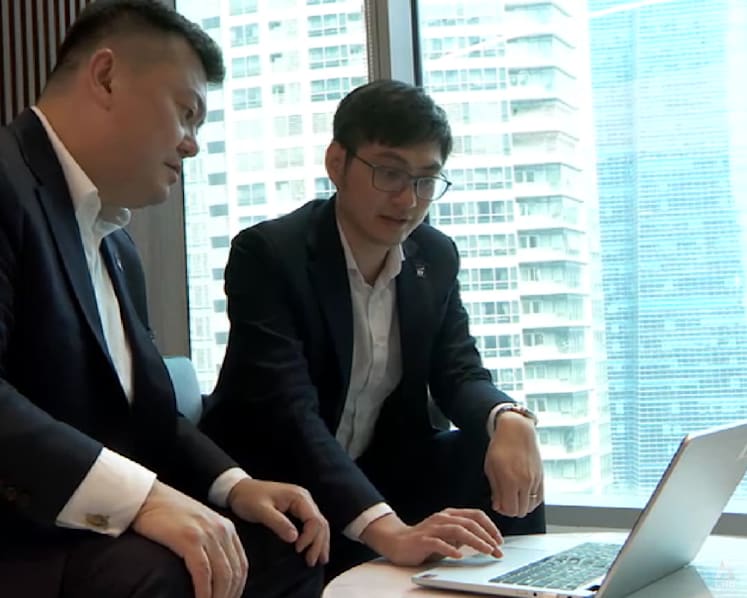
EY Singapore’s head of assurance Lee Wei Hock (left) with senior manager in assurance Ong Zhi Chuan (right) during a work discussion. (Image: CNA)

This audio is generated by an AI tool.


SINGAPORE: Workers may increasingly find themselves managing a new kind of colleague – one that can analyse documents, crunch data and complete tasks in minutes, but still needs to be questioned and checked.
As more companies in Singapore experiment with agentic artificial intelligence, employees are starting to take on the role of “AI agent managers”, directing digital agents and reviewing their output.
For Mr Ong Zhi Chuan, a senior manager in assurance at EY, AI agents have already changed the way he works.
With just a few clicks, he can direct AI agents to analyse working papers while he turns his attention to another task.





"That takes about three minutes to run the analysis that my staff has given me, as compared to if I'm to review (the documents) in detail, (it) will probably take two hours,” said Mr Ong.
But humans still make the final call.
“Our stakeholders, including regulators, still expect human judgement to be a very key part of our audit process,” said EY Singapore’s head of assurance Lee Wei Hock.
"The tolerance for error arising from AI hallucination is very thin. In fact, it's almost non-existent,” he added.
Mr Lee said humans must continue to bring their professional judgement and scepticism to the work, with accountability remaining “key” to the adoption of AI.
JOBS CHANGING BEFORE JOB TITLES DO
As AI agents become increasingly capable of handling a wider range of tasks, analysts expect more jobs to be redesigned to include directing, questioning and checking AI output.
"AI is changing job content much faster than it's changing job titles,” said Ms Audrey Chan, executive director and head of human resources practice at Kerry Consulting.
The workforce response so far has been to redesign jobs and upskill workers rather than replace roles wholesale, she said.
“Employers are increasingly looking for people who understand their function, who can apply AI to improve productivity and to redesign workflows and processes, as well as make much better use of data.”
She sees this taking place across functions including human resources, finance, legal, risk and marketing.
The adoption of agentic AI in local firms could accelerate further.
A survey by software company SAP across 200 firms in Singapore found that 92 per cent were exploring or already using agentic AI, up from 69 per cent last year.
It also found that AI currently supports an average of 27 per cent of tasks in Singapore businesses, with companies expecting that figure to reach 47 per cent within the next two years.
“AI has crossed a very important threshold, that it is no longer a tool that employees use on the side. Rather, it's becoming more and more embedded into the core processes that run businesses. So that's really been the big shift,” said SAP Singapore’s managing director Eileen Chua.
“This means that the essential workforce skill we need now is what we call AI bilingualism, being able to speak the language of your profession and that of AI,” she added.
A finance professional, for example, does not need to become a data scientist, she said, but should understand how AI can help with tasks such as forecasting, reconciliations or closing, while combining the technology with business context, professional judgement and accountability.
“We see that the opportunity is not to remove people from work, rather to redesign work so that people can really focus on the high value-added tasks such as judgement, creativity, and also being in tune with delivering business outcomes.”

WHAT HAPPENS TO LEARNING ON THE JOB?
But as AI takes on more of the work, another challenge is emerging – the risk of weaker critical judgement and less on-the-job learning, especially for those new to the workforce.
"The greatest risk is not so much about junior employees using AI. It's juniors using AI without learning to think for themselves,” said Ms Chua.
Companies therefore need to preserve the “spirit of apprenticeship” within jobs even as they redesign them around AI, she said.
Junior employees should still form an initial view of a problem themselves, she added, warning that speed should not come at the expense of judgement or critical thinking.
Ms Chua said that organisations that succeed in this era will be those that combine trusted data with well-designed processes while continuing to develop an “AI-bilingual” workforce.