Singapore made case against potential US tariffs to US Secretary of State Rubio: Vivian Balakrishnan
The US has "no technical or economic basis" to impose tariffs on Singapore, says Foreign Affairs Minister Vivian Balakrishnan.
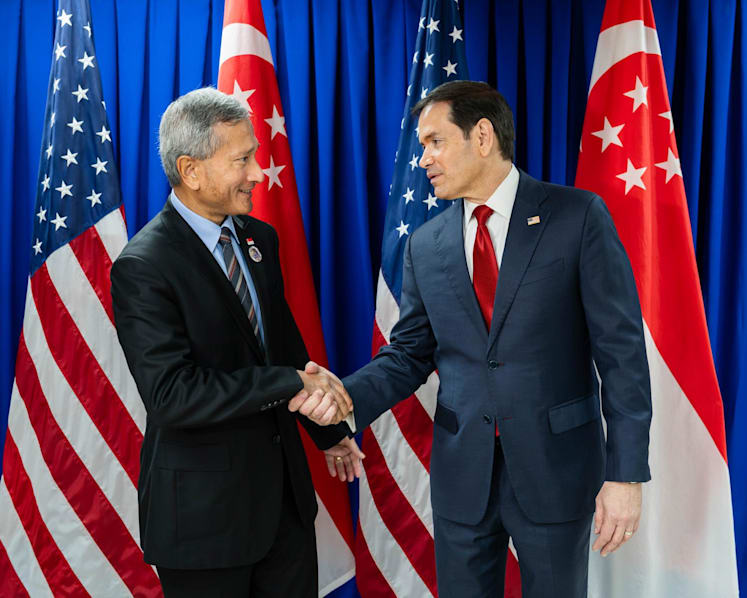
Singapore's Minister for Foreign Affairs Vivian Balakrishnan (left) and United States Secretary of State Marco Rubio shake hands in Manila on Jul 23, 2026. (Image: Ministry of Foreign Affairs)

This audio is generated by an AI tool.


SINGAPORE: Singapore has told the United States that it has "no technical or economic basis" for imposing tariffs on Singapore, Foreign Affairs Minister Vivian Balakrishnan said on Thursday (Jul 23).
He was speaking to reporters in Manila after meeting US Secretary of State Marco Rubio on the sidelines of the 59th Association of Southeast Asian Nations (ASEAN) Foreign Ministers' Meeting, being held from Jul 20 to Jul 24.
Asked whether Singapore had made the case for exemption from potential new US tariffs, Dr Balakrishnan said: "I made a point quite categorically that the US has a surplus, a trade surplus against us. In fact, it is growing."
The proposed tariffs stem from a US investigation under Section 301 of the US Trade Act of 1974 into trading partners' efforts to prevent the import of goods made with forced labour. Section 301 allows the Office of the US Trade Representative to take action against foreign practices it determines to be unfair.





Singapore is among the economies that were named and could face a 12.5 per cent tariff. Findings were released earlier this year.
In response, Singapore has told the US that it does not condone the use of forced labour in supply chains and has a comprehensive framework to enforce against such illegal practices within its borders.
On the trade surplus, Dr Balakrishnan reiterated there was no basis to impose tariffs on Singapore. "Nevertheless, you know as well as I do that the American administration, for its own domestic political reasons, needs to raise tariff revenue," he said.
"I'm trying to find a way to make the point that Singapore is not a target of the United States, not at all. But we also need to make sure we don't become collateral damage in the overall scheme in which tariffs are going to be raised by the United States with all its trading partners."
He added that he had a "good, candid and honest-to-goodness" discussion with Mr Rubio.
Beyond trade, Dr Balakrishnan said discussions during the meetings also centred on the evolving geopolitical landscape, with a focus on strategic competition between the US and China.
"I'm glad that, at least at this point in time, neither of them are forcing us to choose sides," he said.
Instead, both countries recognised ASEAN's priorities of developing its economies, deepening regional integration, securing access to emerging technologies and preserving free trade, he said, adding that were both "trying to approach this in a careful, deliberate and constructive way".
Dr Balakrishnan said ASEAN recognised that the world was undergoing a transition from a unipolar to a multipolar order.
"This is a time, particularly for the middle powers and the rest of us in ASEAN, to affirm international law, the habits of cooperation, to work on the basis of multilateralism, and not to resort to unilateral or coercive measures," he said.
Asked about Singapore's priorities when it assumes the ASEAN chairmanship next year, Dr Balakrishnan said maintaining ASEAN centrality and strengthening the region's resilience would be key themes as it navigates an increasingly uncertain and volatile world.
He said one of the main concerns raised during the meetings was the impact of the situation in the Strait of Hormuz on ASEAN's energy security, as well as fertiliser and food supplies.
Another key concern was the implications for international law, particularly the right of transit passage through straits used for international navigation. Dr Balakrishnan said there was broad agreement among ministers on the need to uphold international law, with many reaffirming the primacy of the United Nations Convention on the Law of the Sea.
"The best way to enhance resilience: work together, integrate our economies, to make sure that we do not panic, we do not put obstacles or restrictions in each other's way, we continue to lower tariff and non-tariff barriers. Equally important, continue to make sure ASEAN remains relevant and able to engage across a wide spectrum in the world," said Dr Balakrishnan.