Man who drove into Suntec City's Fountain of Wealth gets jail, driving ban
Then Shing Chong had drunk a litre of beer over six hours before the crash.
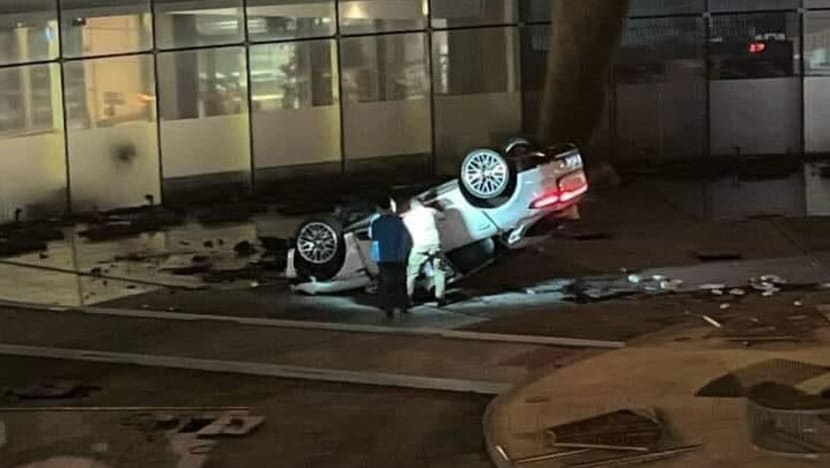
An overturned car at Suntec City's Fountain of Wealth. (Photo: Singapore Taxi Driver Facebook group/Seah Kok Yong Francis)

This audio is generated by an AI tool.


SINGAPORE: A man drank a litre of beer over six hours before crashing his Porsche through a barricade and into Suntec City's Fountain of Wealth.
Then Shing Chong, a 58-year-old Singaporean man, was sentenced to five weeks' jail and banned from driving for 30 months on Tuesday (Jul 14).
He pleaded guilty to one count of driving dangerously by failing to conform to traffic signs and driving across three lanes of the roundabout, before crashing into the fountain structures.
The defence tried to call for a report to assess Then's suitability for a mandatory treatment order, saying he had been depressed at the time.
However, the judge declined to do so, saying alcohol impairment other than impairment by any psychiatric illness was a stronger claim based on the facts.
THE CASE
The court heard that Then left his home at about 5pm on Jul 12, 2024 and drove to Suntec City to meet his friend to drink alcohol.
He met his friend at a bar where they ate food and drank alcohol. More friends arrived and they shared bottles of beer.
Between 6.15pm and 12am, Then drank about 1 litre of beer.
He sent a valet a message at 8.51pm but did not reply when the valet responded.
At midnight, he left the bar, retrieved his Porsche and drove off.
In-car camera footage showed that he did not move for nine to 10 seconds even when the gantry barrier had lifted for his vehicle to pass.
While driving along Temasek Boulevard, he lost focus of the road and continued going straight even when the directional signs indicated that he had to turn left into a roundabout.
Instead of turning left, he drove straight through three lanes of the roundabout and crashed through the barricade at the Fountain of Wealth.
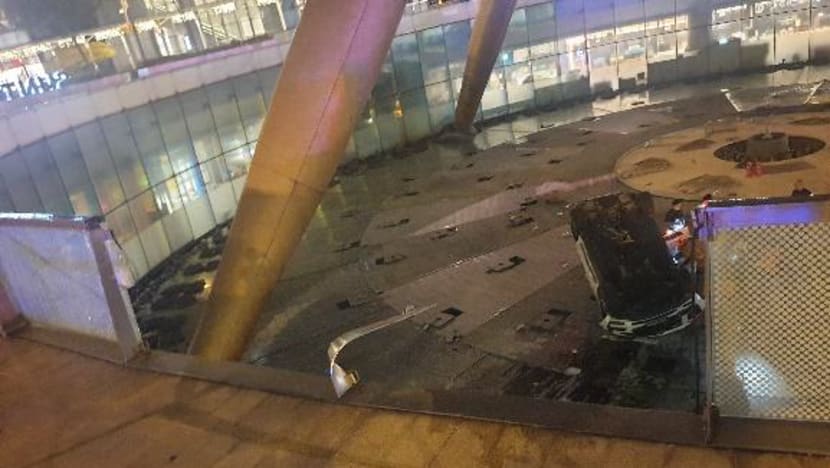
The vehicle plunged down and crashed into the basement of the fountain.
At the time, three construction workers were at the basement, two of them working near where the collision occurred.
Alarmed, they ran away to avoid any injuries.
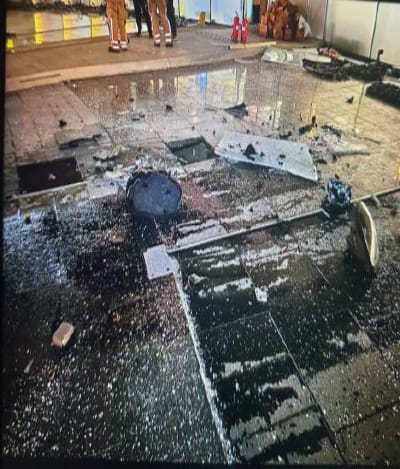
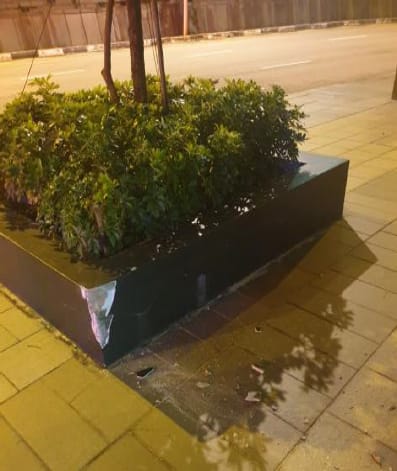
The crash caused extensive damage to the surrounding structures, including a broken barricade, damaged planter boxes and damaged flooring.
Repairs cost about S$64,580 (US$49,925) and a lorry crane had to be deployed to lift the vehicle up before it could be towed away.
Then's car was also badly damaged, with the top and engine hood crumpled and the right bumper ripped off.
Then did not undergo a test at the time to assess his level of intoxication. Shortly after the offence, he was hospitalised.
He later made full restitution of S$74,000.
SENTENCING ARGUMENTS
The prosecutor sought two to four weeks' jail with a 36 months' driving ban.
Defence lawyers Mr Josephus Tan, Mr Devlin Mohyong and Mr Cory Wong from Invictus Law tried to get the judge to call for a report assessing their client's suitability for a mandatory treatment order (MTO).
They cited a report from the Institute of Mental Health which found a contributory link between Then's major depressive disorder and the offence.
Mr Mohyong said the harm caused was ameliorated by the fact that Then made full restitution.
Then's level of alcohol intoxication at the time of the offence has not been established.
This is a "big question mark", District Judge Koo Zhi Xuan said, adding that it would continue to be unanswered no matter how many rounds of psychiatric examinations Then went through.
The court cannot clearly say that his depression outweighed his intoxication or not, because the evidence is "now gone", he said.
"Drink driving is a highly irresponsible behaviour and a scourge in our society which must be deterred," said Judge Koo.
If a person chooses to drink and drive and get into a serious accident, the court should approach any psychiatric claims with great caution, especially when the available evidence does not distinguish impairment caused by psychiatric illness from impairment caused by voluntary intoxication, he said.
A court may take psychiatric illness into account if there is available evidence supporting the inference that an offender's condition remained a substantial contributory factor over and above his involuntary intoxication.
This can be shown through various types of evidence such as documented evidence showing that the condition was present both prior and at the time of the offence, or if there was evidence that he did not consume much alcohol or was well below the legal limit or was not driving sleepily or while intoxicated.
None of these factors count in Then's factor, said Judge Koo.
He was diagnosed with major depressive disorder only after the offence.
Then also told IMH and his own psychiatrist that he had taken either an antihistamine or a sleeping pill before consuming alcohol that day.
Judge Koo said the "severe lack" of attention or awareness required for Then to drive in almost complete disregard for his own life and safety puts into doubt the claim that this offence can be adequately explained by the impaired cognitive control of someone suffering from major depressive disorder.
Alcohol impairment is a stronger claim, on the facts, he said.
As it was not in the interest of justice to delay proceedings by calling for an MTO suitability report, he declined to call for one.
For driving dangerously, Then could have been jailed for up to 12 months, fined up to S$5,000, or both.