ASEAN countries won't take sides in US-China rivalry, want region kept open and inclusive: PM Wong
While major powers may have difficulties in their own relations, Singapore wants to remain friends with all of them and it should be possible to do so, says Prime Minister Lawrence Wong.
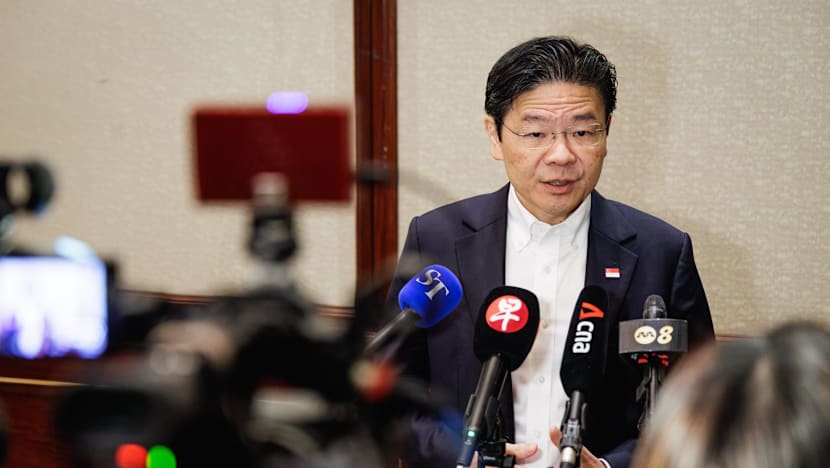
Prime Minister Lawrence Wong speaking to Singapore media in Hong Kong as he wraps up his four-day trip to China, on Mar 28, 2026. (Photo: Ministry of Digital Development and Information)

This audio is generated by an AI tool.


HONG KONG: Southeast Asian countries share a consensus not to take sides in the rivalry between China and the United States, and are united in their desire to keep the region open and inclusive, Singapore's Prime Minister Lawrence Wong said on Saturday (Mar 28).
"Singapore's approach towards open and inclusive engagements with the major powers is not unique to Singapore. This is also ASEAN’s position," said Mr Wong, during an interview with Singapore media wrapping up his four-day trip to China.
“No ASEAN country wants to choose sides. So ASEAN’s position is to have omnidirectional, active engagement with all the major powers and to build a region that's open and inclusive.”
He was responding to a CNA question on how Singapore, as incoming ASEAN chair, plans to bring fellow member states and regional partners on board with its approach of not taking sides and acting in its own best interests.





Mr Wong noted that ASEAN summits already bring together a wide range of partners, including Australia and New Zealand, and also engage China, Japan and Korea through the ASEAN Plus Three platform.
“That is the ASEAN way. We want to engage all of the major powers, even if they have challenges amongst themselves,” he said.
“We engage them in positive, constructive dialogue, engagement, and we continue to find common ground for us to deepen our cooperation,” he said, adding that convincing ASEAN members of this balanced approach should not be difficult.
He also drew a contrast between Singapore and the two stops on his China trip – Hong Kong and Hainan – noting that Singapore lacks a large hinterland. ASEAN, he said, can serve that function.
“We should work harder to integrate the wider ASEAN market, which we are doing, and we will continue to do, especially when we chair ASEAN next year,” he said.
He called on ASEAN to move faster on sub-regional arrangements, citing the proposed growth triangle linking Singapore, Malaysia’s Johor and Indonesia’s Riau Islands, as well as Singapore’s connectivity arrangements with Vietnam.
“These sub-regional arrangements allow us to move faster, even if the whole of ASEAN is not able to move at the same pace,” he said.
FRIENDS WITH ALL
Touching on Japan-China ties and the back-to-back timing of his visits to Tokyo last week and Hainan and Hong Kong this week, Mr Wong acknowledged that the two countries “are going through a difficult phase in their relations”.
“But from Singapore's point of view, we are friends with both China and Japan. For that matter, with America and other major partners,” he said.
While major powers may have difficulties in their relations with one another, Singapore's goal is to remain friends with all of them – and Mr Wong said he believes that this is possible.
“That is our approach, has always been our approach consistently, and we will continue to find ways to engage all these major powers, deepen our cooperation further and look for win-win outcomes,” he said.
On the timing of his China visit, Mr Wong said it was not pre-planned. His Japan trip had originally been set for last year but was delayed due to scheduling difficulties. Once dates were eventually agreed upon – after Japan's elections earlier this year – a March slot was confirmed.
Separately, China had already invited him to attend the Boao Forum for Asia’s annual conference, which this year marks its 25th anniversary.
Singapore is a founding member of the forum. It is also the first year that Hainan, the province where Boao is located, began operating as a full free trade port under its own independent customs regime.
“I also thought it would be useful for me to visit Hainan, given its development as a free trade port, so I decided to take up the invitation. And as it turns out, the dates were back-to-back,” said Mr Wong.
The timing worked out very well, he added, as both China and Japan are important partners for Singapore and ASEAN, and the visits offered opportunities to deepen cooperation and shape regional affairs.
UPDATE TO COME ON ENERGY ISSUE
On the Middle East conflict and its impact on Singapore, Mr Wong said the government is monitoring the situation closely and will provide an update when parliament sits in April.
Beyond immediate concerns over rising prices of daily necessities, he flagged longer-term risks to supply chains and energy markets if the conflict drags on. A prolonged blockage of the Strait of Hormuz would affect downstream supplies in a range of industries beyond just oil markets, including diesel and jet fuel, which drives the aviation sector.
“We have to prepare for all eventualities. For Asian countries, many of whom are energy importers, we don't really have good solutions, because we rely on imported energy,” Mr Wong said.
Singapore is working to diversify its energy supply sources, he said, citing Australia as one reliable supplier of liquefied natural gas.
“Our officials have already been working hard to look at how we can strengthen our supply chain resilience across all of these areas, and we will be able to provide a further update very soon,” Mr Wong said.