Law Ministry to undertake broader review of legal education: Edwin Tong
The Singapore government is also considering launching a guide that sets out professional norms and workplace behaviours, says the law minister.
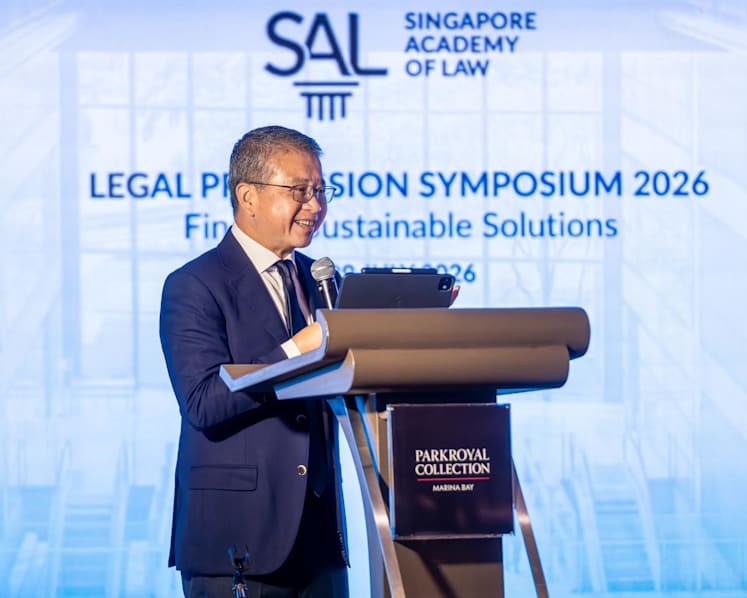
Law Minister Edwin Tong speaks at the Legal Profession Symposium on Jul 29, 2026. (Photo: Ministry of Law)

This audio is generated by an AI tool.


SINGAPORE: The Ministry of Law (Minlaw) will undertake a broader review of legal education and consider a launching a guide that sets out professional norms and workplace behaviours, said Minister for Law Edwin Tong on Wednesday (Jul 29).
Speaking at the Legal Profession Symposium, the former litigator noted that while the attrition in the industry is real, attrition figures alone do not tell the whole story.
"Lawyers have always left practice at some point in their career, usually at the earlier frame of their career," said Mr Tong, noting that attrition figures have remained broadly stable.
Between 2015 to 2024, about 60 per cent of lawyers stayed in practice after five years, and 40 per cent after 10 years.





The real question is not whether people are leaving, but why they are leaving, the minister said.
"Are they pursuing different aspirations and opportunities, or are they pushed away because legal practice has become intolerable and unsustainable when otherwise they would like to be in practice? And I think that distinction matters a lot."
Around the world, law schools are rethinking how to prepare the next generation of lawyers, and Singapore should study how these developments apply to it, said Mr Tong.
This is why the law ministry will undertake a broader review of legal education, he added.
"But no matter how well we prepare our students, the most important learning still begins after they enter practice, just as it did for my generation."
Workplace culture, good supervision, mentorship and respect matter at the workplace, said Mr Tong.
"At the same time, I do not believe the experiences described in the report is the majority of our profession. They don't define our profession," said the minister, referencing the Law Society's findings that were released in June.
The four-year study found that lawyers are leaving private practice amid toxic workplace cultures, bullying, unreasonable workloads and a profession that intrudes into their personal lives.
Those experiences probably reflect the actions of a small minority, he added. "Unfortunately, it only takes a few individuals to cast a shadow over a profession that is overwhelmingly made up of decent, committed people who want to see their juniors succeed and will mentor them well."
Mr Tong stressed that nothing excuses poor supervision, inadequate training, harassment, bullying or unreasonable treatment.
For example, being screamed at, ridiculed, or expected to work unreasonably is not acceptable, he added.
Related:

While there is no single formula for a healthy and sustainable workplace, Mr Tong noted that a workplace can be demanding without being demeaning, and feedback can be candid without being disrespectful.
The law ministry is considering introducing a sustainability code or guide for the legal profession, he said.
Rather than prescribing how law firms should be run, the code would set out the professional norms and workplace behaviours that lawyers should aspire to, said Mr Tong.
For example, it could illustrate how junior lawyers should be supervised, how feedback can be given and taken, how to entrust responsibility, and how colleagues can treat one another with professionalism and respect.
Mr Tong also addressed the impact of artificial intelligence on legal work.
"For the foreseeable future, I don’t believe lawyers will be replaced by AI, but the lawyer who harnesses AI better than the next will replace that lawyer," he said.
The Future of the Legal Profession Committee will establish the Singapore Council on AI for Legal Excellence, or SCALE, announced the law minister.
The council will focus on understanding how AI is reshaping legal work, jobs and skills, and strengthening AI education and training, said Mr Tong.
It will also examine how AI is changing law firm structures and business models, he added.
"The objective is straightforward. To build a clearer, evidence-based understanding of what is changing, and then working out what our response should be to these changes."