Italian man sold 'fake' Rolex that turned out to be real in 'impossible' crime against Singapore watch shop
The offender thought his acquaintance had sold him a fake watch and wanted to offload it, selling it to a watch shop in exchange for three Rolexes before booking a late-night flight to flee.
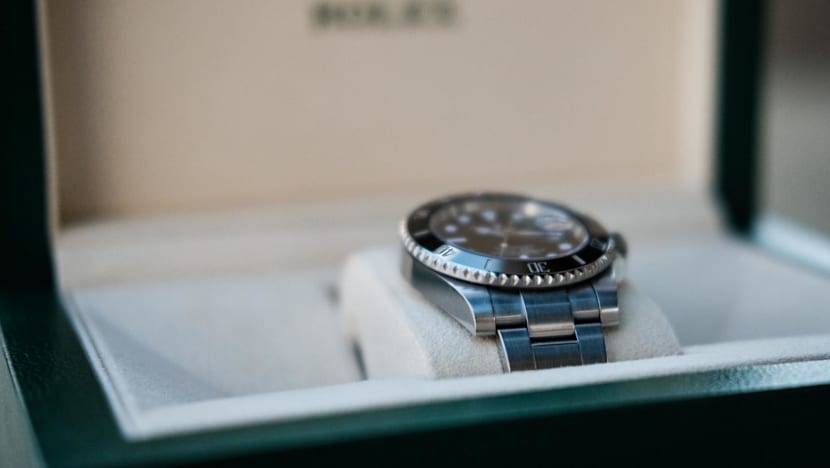
Stock photo of a generic Rolex watch. (Photo: iStock)

This audio is generated by an AI tool.


SINGAPORE: An Italian man who bought a Rolex watch from an acquaintance later thought it was fake and took it to a shop in Singapore where he sold the timepiece for a price of S$94,700 (US$74,446).
Instead of taking the cash, the man took three other Rolexes worth the price and booked a late-night flight attempting to evade arrest.
However, in a twist, the watch turned out to be genuine, making this what is known as an "impossible attempt".
An impossible attempt or crime occurs when a person intends to commit a crime and takes steps towards it, but the offence cannot be completed due to physical impossibilities - such as picking an empty pocket.
Deepak Singh, 24, was sentenced to seven months' jail on Monday (Apr 20).
He pleaded guilty to one count of attempting to cheat, where harm would have been caused to the victim had the watch been fake. A second charge of using an edited photo of his passport during the sale was taken into consideration.
THE CASE
The court heard that Singh bought a Rolex GMT Saru sometime in February or March 2025 from an acquaintance he knew as "Matteo".
He bought the watch in exchange for 55,000 euros (S$82,295) and a Cartier bracelet valued at about 5,000 euros.
Singh thought he had gotten a good deal as he believed the watch was valued at about 90,000 euros in the resale watch market and he could make a profit.
There are purportedly only about 20 authentic pieces of this watch in circulation, so Singh's friends advised him to conduct further checks.
A watch shop told Singh that the watch case may have been swapped out and that the serial number of a genuine Rolex GMT Saru may have been laser-engraved onto the watch.
Singh thought he may have been cheated and that the watch was fake, so he decided to sell it.
On Nov 27, 2025, Singh flew to Singapore with his friends, intending to sell the watch and buy other luxury watches to resell in Europe for a profit.
At about 2pm the next day, Singh went to a mall in Bencoolen and entered a shop called The Watch Room. He showed the director of the watch retailer, a 32-year-old Singaporean, the watch along with its warranty card.
The victim recognised the watch as an off-catalogue Rolex valued at about S$120,000 and expressed interest in buying it.
The pair negotiated and agreed on a price of S$94,700. Instead of paying via bank transfer as suggested by the victim, Singh said he did not want cash and instead asked for three watches.
These were a Rolex Daytona valued at S$25,200, a Rolex GMT valued at S$25,400, and a Rolex Submariner valued at S$44,000.
The victim agreed and asked Singh to leave the warranty card with him to run some checks and return after 30 minutes.
The victim used an ultraviolet torchlight to check the lettering on the warranty card and was satisfied that it was authentic.
Together with his friend, the victim inspected the watch and was satisfied with its condition.
When Singh returned, they exchanged the watches as agreed and Singh was given an additional S$300 since he did not get any Rolex boxes for his three pieces.
The victim issued invoices for the exchange and Singh presented a forged soft copy of his passport for registration. He had altered the picture of his passport, changing his name to "Sinsi Deepak" and changing the passport number.
Singh had done so to escape criminal liability and any possible taxes which may be incurred in the sale.
Throughout these events, Singh thought that the watch he was selling was fake and perceived that he was cheating the victim.
POST-SALE EVENTS
After Singh left the shop, the victim and his friend went to neighbouring watch shops and asked other retailers to examine the Rolex GMT Saru.
On the advice of another shop owner, the victim used a loupe - a kind of magnifying device - to scrutinise the serial number engraved on the watch and discovered that the number had been washed off and later laser-engraved.
The victim did further checks and felt that the watch was fake. He called Singh multiple times on his phone.
Eventually, Singh picked up and said he would return to the shop. However, he never intended to do so. The victim reported the matter to the police.
Meanwhile, Singh ignored all further calls and booked a flight to leave Singapore for Rome with a layover in Helsinki, Finland. It was set to leave that night at about 10pm.
He wanted to avoid arrest. However, he was arrested at Changi Airport shortly before the flight.
The police later took the Rolex GMT Saru to the Rolex Service Centre, where a watch technician assessed the watch for authenticity.
He certified that all parts of the timepiece were authentic and original.
The prosecutor said Singh's acts were "substantial steps taken towards the commission of a cheating offence and are strongly corroborative of his intention to cheat the victim".
Quoting Section 511(3) of the Penal Code, Deputy Public Prosecutor Sean Teh said Singh had attempted to cheat the victim, despite the existence of facts of which he was unaware, which made the cheating of the victim impossible.
This refers to the fact that the watch was genuine.
Mr Teh sought 12 months' jail for Singh, saying that although no actual loss was caused, the value of the item attempted to be used for cheating was high.
He said the Court of Appeal had recognised two types of impossible attempts. The first is a scenario where an accused person has not completed his intended course of action. The second involves an accused person who has done all he had intended to do, but the primary offence has not been consummated for some reason.
Mr Teh said this case falls squarely in the second category.
"This was not a case where the accused had voluntarily desisted from cheating the victim at a late stage; rather, this was an accused who followed through with his attempt to cheat the victim to completion, and subsequently booked the first flight out of Singapore to evade arrest," he said.
For attempting to cheat, Singh could have been jailed for up to three years, fined, or both.