IMDA suspends review of Simba's proposed acquisition of M1 amid probe into potential regulatory breach
During its review of the deal, IMDA learned that Simba may have been using radio frequency bands that had not been assigned to it to provide mobile services.
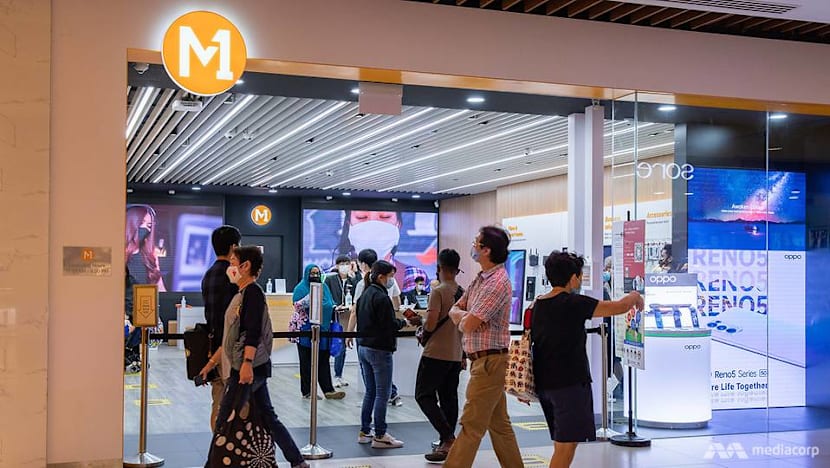
An M1 outlet in Singapore. (Photo: TODAY/Ili Nadhirah Mansor)

This audio is generated by an AI tool.
SINGAPORE: The Infocomm Media Development Authority (IMDA) has suspended its assessment of telco Simba's proposed acquisition of M1 after uncovering a potential regulatory breach during its review process.
In a media release on Monday (May 18), the regulator said it would suspend its evaluation of the deal "until further notice", citing an ongoing investigation into whether Simba had been using radio frequency bands that were not assigned to it to provide mobile services.
"This would constitute unauthorised use of frequency spectrum, which is a breach of the Telecommunications Act 1999 and the conditions of Simba’s Facilities-Based Operations Licence," said the IMDA, adding that it is investigating the matter and will take the appropriate enforcement actions if needed.
"As the investigation findings may be material to IMDA’s assessment of the proposed consolidation, IMDA has decided to suspend its review of the proposed consolidation until the investigation has been concluded.”





Under the Telecommunications Act 1999, IMDA can impose a financial penalty of S$1 million (US$780,700) or up to 10 per cent of the licensee’s annual turnover, whichever is higher, if there are breaches.
The share price of Keppel, which owns M1, fell by about 2 per cent in early morning trade on Monday, before widening losses to more than 4 per cent. Shares of Australia's Tuas, which owns Simba, fell 60 per cent to A$2.46 (S$2.25) as at 12.45am GMT (8.45am, Singapore time).
Keppel announced its intention last August to sell its subsidiary M1 to Simba for S$1.43 billion (US$1.11 billion). M1 and Simba then filed the application in September, with IMDA issuing a consultation paper the following month.
Keppel later extended the deadline for completion of the deal in March, setting the date as May 21. This means the deal must be completed in three days, failing which, the sale and purchase agreement will be cancelled.
The deal is subject to regulatory approval by IMDA, which has been assessing it under the Telecom and Media Competition Code, which requires authorities to determine whether such a deal could substantially lessen competition or raise broader public interest concerns.
This includes scrutiny of how critical telecommunications infrastructure would be operated, particularly in light of heightened cybersecurity risks
IMDA noted that because M1 operates extensive mobile and broadband networks in Singapore, its review has been "detailed and thorough".
Keppel chief executive officer Loh Chin Hua on Monday said the company will allow the sale and purchase agreement with Simba to lapse on its May 21 deadline in view of IMDA's announcement.
"There is a long stop date and it is on Thursday this week. There is no discussion to extend the long stop date, which means that at the passing of the long stop date, the existing agreement will lapse," said Mr Loh, adding that Keppel has been working on alternative plans.
Keppel said in a separate statement earlier that it understands the authority's considerations and respects its decision.
"While awaiting the outcome of IMDA’s assessment, we have also been working on a Plan B, in case Keppel retains majority ownership of M1, which we will now start executing," it said in a media release.
"In response to the significant challenges facing the telecommunication industry in Singapore, our focus will be on enhancing M1’s efficiency to improve its run rate EBITDA, through rightsizing the company and reducing costs, without adversely affecting customer experience."
Keppel said that it has a 90-day plan to drive M1’s efficiency, which it will activate with immediate effect.
This includes reducing technology platform costs and network costs, using AI for automation, as well as product rationalisation, it said, adding that further details will be shared during its 1H 2026 results announcement.
"Even as we undertake the efficiency drive at M1, we believe that the telecommunication industry in Singapore is in need of and will benefit from consolidation and Keppel remains open to opportunities for divestment," it added.
Keppel said its target to monetise between S$2 billion and S$3 billion of non-core assets in 2026 remains unchanged.
"The proposed divestment of our stake in M1’s telecommunication business will be removed from Keppel’s announced monetisation for 2025," it added.