



No need for more PM2.5 forecasts as too many indicators may confuse public: Grace Fu
The minister for sustainability and the environment also answered parliamentary questions on mask distribution and indoor air quality.
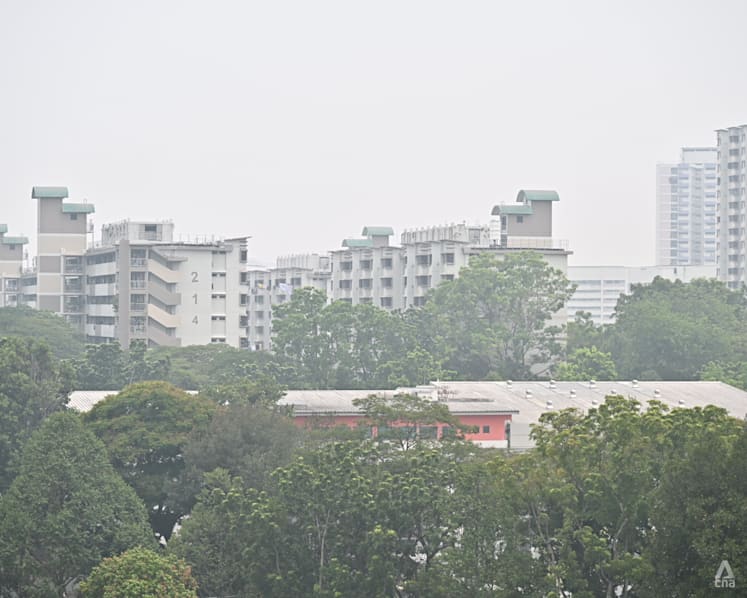
View of the haze in the Boon Lay neighbourhood on Oct 12, 2026. (Photo: CNA/Raydza Rahman)

This audio is generated by an AI tool.


SINGAPORE: Singapore does not need additional PM2.5 forecasts as too many indicators may confuse the public, Minister for Sustainability and the Environment Grace Fu said on Tuesday (Nov 3).
She was responding to questions from Members of Parliament on air quality readings, N95 masks and other haze issues. The questions followed more than a week of unhealthy air quality in Singapore, sending residents scrambling for masks and air purifiers.
Ms Fu said the 24-hour Pollutant Standards Index (PSI) and hourly readings of fine particulate matter (PM2.5) have worked well in guiding decisions.
“We don’t think there is a need to include 12-hour, 24-hour or 48-hour PM2.5 forecasts as having too many indicators may complicate our public messages,” she said.
MP Fadli Fawzi (WP-Aljunied) had asked why the National Environment Agency (NEA) cannot provide such forecasts, which are similar to those issued by the US National Weather Service.
Ms Fu said the daily PSI forecast helps the public plan activities for the next day, while hourly PM2.5 readings can guide immediate outdoor activities. NEA draws region-specific hourly readings from its 23 air quality monitoring stations across the country.
In response to Mr Fadli's supplementary questions on whether the government can provide PM2.5 forecasts or qualitative trend indicators, Ms Fu said the current system is the right one.
She said the NEA does give qualitative explanations and releases fortnightly weather outlooks.
"But as with all forecasts, the longer the horizon, the less accurate it becomes," she said, reiterating that the hourly PM2.5 is the most accurate for planning immediate activities.
Ms Fu said there has already been some confusion on the ground even with two indicators.
"The more that our forecast and advisory are clean, succinct, giving people an easy handle to manage activities, the more effective the advisories would be," she said.
MASK DISTRIBUTION
Close to 30 per cent of eligible Singaporeans had collected their masks as of Oct 29, Ms Fu said.
Masks were distributed in two rounds as haze conditions worsened. The second round was open to all Singaporeans aged 60 and above, instead of only those 67 and above, in response to public feedback.
Pregnant women, children aged seven to 16 and holders of Community Health Assist Scheme (CHAS) Orange and Blue cards were also eligible, with the government prioritising those who are more vulnerable to the health effects of haze and those who may have limited means.
N95 or equivalent masks are generally not required for short periods outdoors, such as commuting, Ms Fu said, adding that the most important first response is to reduce prolonged or strenuous outdoor activity.
When activating mask distribution, the government weighs the severity and expected duration of the haze, the prevailing public-health risk and the needs of vulnerable groups, she said.
“In the case of haze, there is no risk of people-to-people transmission which would have required all Singaporeans to be masked up as soon as possible,” she said.
Ms Fu said the government will continue to review the scale and eligibility of distribution as conditions evolve, and is prepared to expand support if necessary.





MANAGING INDOOR AIR QUALITY, FOOD SUPPLY
On indoor air quality, Ms Fu said this is managed through standards, guidelines, advisories and sector-specific measures by building owners and relevant agencies.
“Ensuring good indoor quality is important during haze periods, particularly in facilities serving vulnerable groups,” she said.
Larger air-conditioned buildings fall under the Code of Practice for Indoor Air Quality for Air-Conditioned Buildings, which sets recommended indoor air-quality parameters and measures, including enhanced air filtration during haze episodes.
Schools, preschools, healthcare institutions and community care providers also have sector-specific haze measures. These include closing windows, deploying air purifiers where needed, adjusting outdoor activities and monitoring vulnerable individuals.
Employers of personnel supporting essential services should implement business-continuity and workplace measures according to operational needs and severity of the haze, she said.
Ms Fu also said the haze did not affect Singapore’s food supply because food is sourced from more than 180 countries and regions.
Wholesalers had informed her ministry that prolonged haze may affect vegetable growth, but local farms have seen minimal impact, with operations returning to normal following recent improvement in air quality.
Hawkers saw a drop in footfall when the haze worsened, she said. Some of that was offset by an increase in takeaway orders.
The government will continue to monitor the impact of air quality conditions on hawkers, but has no plans for additional haze-specific financial assistance, Ms Fu said.
“While the haze situation has improved with the onset of the north-east monsoon, we are prepared to take appropriate measures should circumstances change,” she said.