Two Singapore residents who were on hantavirus-hit cruise ship complete quarantine
“Both of them are well, and have tested negative for hantavirus, including the Andes virus, before release from quarantine,” said the Communicable Diseases Agency.


This audio is generated by an AI tool.


SINGAPORE: The two Singapore residents who were on board the hantavirus-hit cruise ship MV Hondius have been released from quarantine after testing negative.
The Communicable Diseases Agency (CDA) on Sunday (Jun 7) said the men completed their quarantine on Saturday.
"Both of them are well, and have tested negative for hantavirus, including the Andes virus, before release from quarantine."
The 67-year-old Singaporean and 65-year-old Singapore permanent resident were on MV Hondius when it departed from the Argentinian port of Ushuaia on Apr 1. The ship later reported an outbreak of Andes hantavirus.
Both men later disembarked from the ship and were also on the same flight as a confirmed hantavirus case from St Helena to Johannesburg on Apr 25. That victim did not travel to Singapore and later died in South Africa.
The men arrived in Singapore on May 2 and May 6 respectively and were isolated at the National Centre for Infectious Diseases (NCID) where they tested negative for hantavirus.
CDA said at the time that they will be quarantined for 30 days from the date of last exposure, with testing conducted again before their release from quarantine. They will then undergo phone surveillance for the remaining monitoring period of 45 days from the date of last exposure, which is the maximum incubation period for hantavirus exposure.





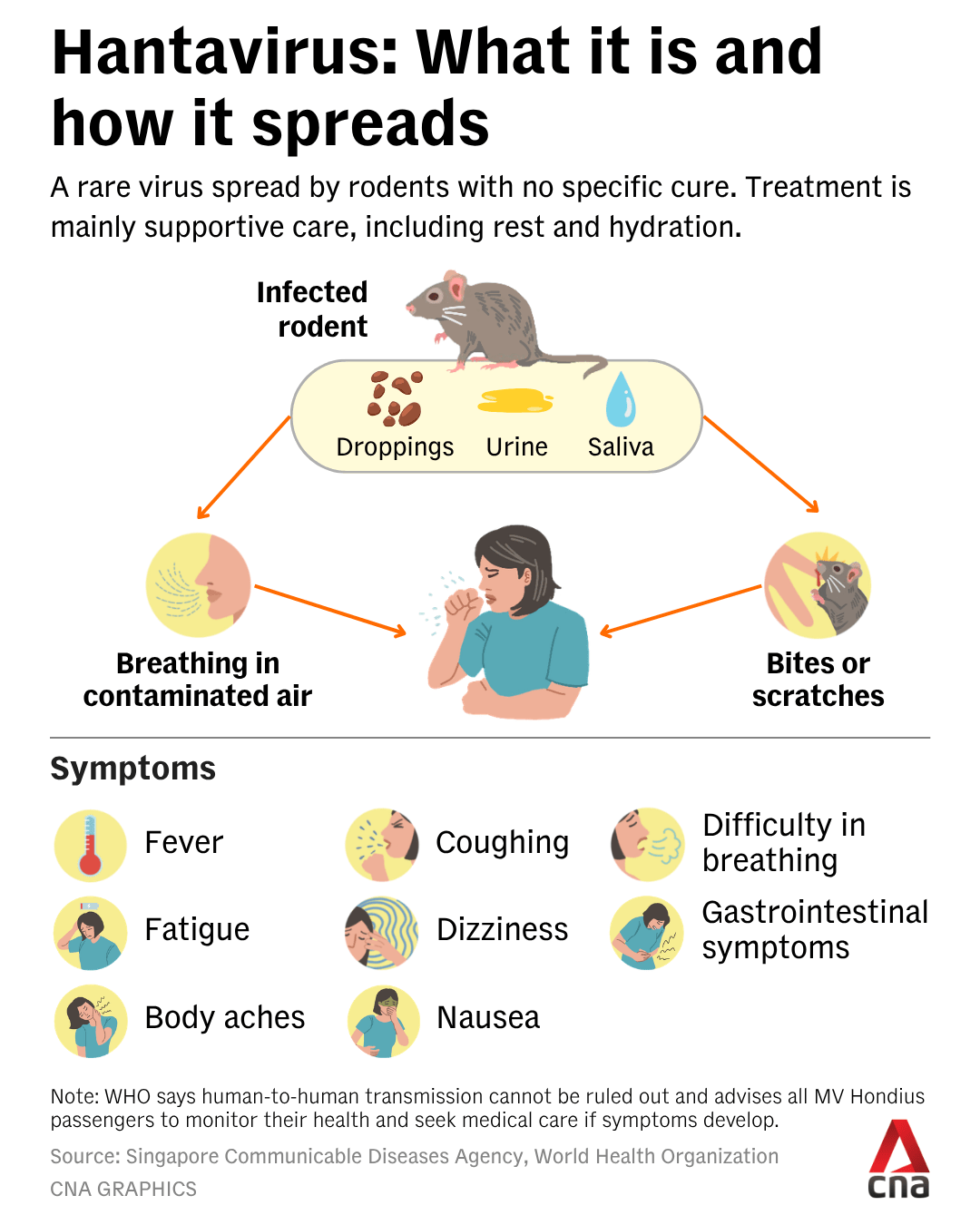
WHAT IS HANTAVIRUS?
Hantaviruses are viruses carried by some rodents. People can become infected when they breathe in dust contaminated with urine, droppings or saliva from infected rodents, especially when cleaning or disturbing areas with rodent activity.
Infections are uncommon, but illness can range from mild to severe.
CDA previously said that while hantaviruses do not usually spread from person to person, one species, the Andes virus found in parts of South America, has been associated with human-to-human transmission.
Symptoms of infection with the Andes virus typically include fever, body aches, fatigue, gastrointestinal symptoms and difficulty breathing, and progress rapidly to shock and death.
Treatment consists of supportive care and management in hospital if required.
There is no specific antiviral treatment or vaccination.