Court tackles definition of emotional abuse under newly expanded laws in granting woman protection order
The woman had left home with her five-month-old son after a series of incidents with her new husband.
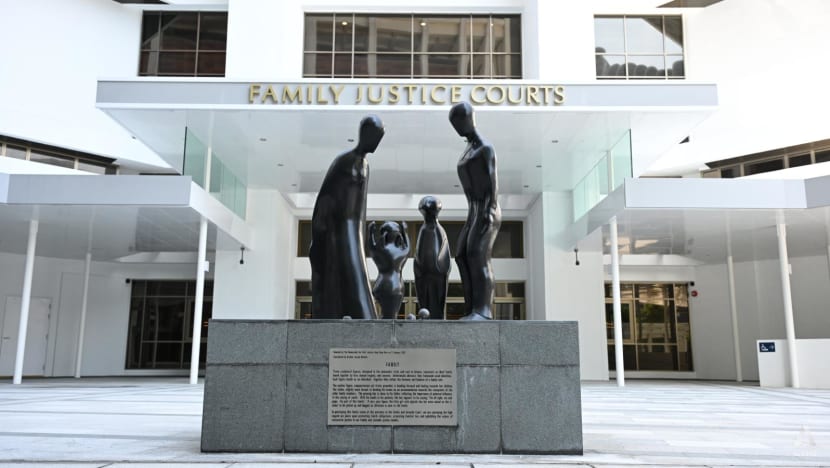
The Family Justice Courts - comprising the Family Courts, Youth Courts and Family Division of the High Court - as seen on Nov 1, 2024. (File photo: CNA/Raydza Rahman)

This audio is generated by an AI tool.


SINGAPORE: A family court has tackled the definition of emotional and psychological abuse in granting a personal protection order to a woman who left her matrimonial home with her baby due to conflict with her husband.
This case was among the first arising under newly expanded laws that include emotional or psychological abuse under the definition of domestic violence. Before January 2025, such violence was limited mostly to physical harm, with no express reference to emotional or psychological abuse.
In a judgment made available on Sunday (Apr 19), Magistrate Allen Chong said the conduct must be more than ordinary friction and unhappiness in a close relationship and that the intention to inflict emotional harm need not be proven, only that such harm was done.
"How should the law respond to conduct of this kind? The kind of conduct which leaves no bruises, that a man on the street might not recognise as family violence, but that a person living within it may experience as a slow intrusion into her sense of safety. This is the question at the heart of this judgment," said Mr Chong.
THE CASE
The woman married her husband in July 2024 and gave birth to a son in April 2025. After their wedding, they moved into the man's family home shared with his parents, his brother and a maid.
On Sep 30, 2025, she took her five-month-old son and left for her mother's home, subsequently filing a police report.
Mr Chong noted that this case started not with a dramatic incident but with a "slow accumulation of smaller ones".
The woman filed a personal protection order against her husband citing three incidents in the first year of marriage.
First, her husband allegedly shouted at her when she was seven months pregnant over sleeping arrangements.
Second, her husband allegedly kicked aside a footrest, snatched and threw her phone and shouted at her during an argument about formula milk preparation.
Third, her husband kicked her in the abdomen while she was holding their five-month-old son.
THE LAW
Mr Chong said the amendments to the Women's Charter which came into force on Jan 2, 2025 brought about the most significant reform to the family violence regime since the Charter was enacted.
The amendments in turn came on the back of recommendations in a report of a taskforce on family violence released in September 2021, with the aim of better protecting survivors and enhancing the rehabilitation and accountability of perpetrators.
Previously, family violence contained four limbs: Placing a family member in fear of hurt, causing hurt, wrongful confinement and causing continual harassment with intent to cause anguish. There was no express reference to emotional or psychological abuse.
The new provisions reconstitute family violence in three categories of abuse: Physical, sexual and emotional or psychological abuse.
Emotional or psychological abuse refers to conduct or behaviour that either: torments, intimidates, harasses or distresses a person, or causes or may reasonably be expected to cause mental harm to a person. This includes thoughts of suicide or inflicting self-harm.
The new law also states that abuse may take the form of a single instance of conduct or behaviour, or a course of conduct or behaviour. The definition of abuse also extends to conduct not directly targeted at the family member, provided the person can see, hear or perceive the conduct.
Mr Chong noted that the provision is "harm-focused, not intention-focused". He cited a parliamentary speech stating that the definition of family violence "looks to the harm caused by the perpetrator, rather than the intention of the perpetrator".
"The consequence is that proof of the respondent’s subjective intention to cause distress, harassment, intimidation, or torment is not required," said Mr Chong. "The question is what the conduct did to the complainant or would objectively do to someone in their position."
Mr Chong said emotional and psychological abuse is a concept whose character is "inherently relational and contextual".
"It is concerned with the human experience of harm within intimate relationships. These are harm that, as parliament recognised, does not reduce neatly to fixed categories or enumerable features except by way of illustration," he said.
APPLYING THE APPROACH TO THE CASE
Turning to the case, he asked whether the woman herself was intimidated and distressed, and whether a reasonable person in her position would have experienced what she did.
For the kicking incident on Sep 30, 2025, the man had admitted using his foot to push his wife away. When cross-examined, he did not deny the physical contact but said it was defensive rather than aggressive.
The woman testified that her son had been crying inconsolably for over an hour in a warm room with the air-conditioning switched off.
She felt the baby needed the air-conditioning but her husband felt this would worsen his illness as the baby was wheezing from a flu.
When the woman put on a baby carrier and tried to take her son from her husband, the man dodged her repeatedly before kicking her. The baby carrier absorbed the impact.
The magistrate gave considerable weight to a message the man sent to his wife after the incident, saying "sorry for kicking you and making you feel unsafe and in danger".
Mr Chong said these were "the words of a man who knew he had crossed a line". At trial, the man attempted "to explain away the apology as an attempt to salvage the marriage rather than an acknowledgement of wrongdoing", said Mr Chong.
He found that the man could not rely on the argument of self-defence in kicking his wife.
THE PHONE-SNATCHING INCIDENT
In the phone-snatching incident that occurred in May 2025 when the baby was less than a month old, the woman had felt that warm water should be used when preparing milk while her husband said room temperature water was correct.
On May 6, 2025, the woman reminded her husband to use warm water. Their accounts diverge after this, with the woman claiming that her husband had entered the living room angrily.
She said he kicked the footrest of an armchair aside, snatched her phone from her hand and threw it onto the sofa, before shouting at her.
According to the woman, her husband said: "You enough or not? I already told you warm water is room temperature and even found the definition. You only want to listen to what your friends say."
The woman claimed the shouting woke the baby, who began crying, and her husband refused to pass the child to her. She said she was so concerned she messaged her mother-in-law for help before leaving and later asked her husband if he could commit to stopping violence within the family. She claimed he replied that he could not guarantee that.
The man's account was that they had an argument as couples sometimes do, but denied behaving violently at any point. He denied making the statement about not guaranteeing family violence, and said his wife leaving the apartment was inconsistent with any fear of him harming the boy.
Mr Chong found that the woman had felt fear from this incident, as shown by her immediate act of messaging her mother-in-law for help. He also found that a reasonable person in her position would have been objectively intimidated and distressed.
Mr Chong made no finding of family violence for the third incident in February 2025, where the couple fought about sleeping arrangements, as the woman had not proven her case.
Overall, he found that a personal protection order was necessary, as the incidents revealed "a cumulation of conduct across the first year of the marriage" that justified the court in restraining the man's conduct to protect his wife.
"In May 2025, within the first month of their infant's life, the respondent resorted to taking out his anger on an object and directly invaded the applicant's space to intimidate her. In September 2025, four months later, he progressed to resort to not just direct physical contact but by kicking the applicant who was at the time holding their infant son," said Mr Chong.
He said the two incidents formed part of a course of conduct showing the man's "increasing willingness to resort to force".
Factoring strongly in the magistrate's decision was his finding that the man had "not even begun to acknowledge the seriousness of his conduct".
Throughout proceedings, the man had characterised the kick as defensive and the other incident as an ordinary marital argument, attributing the cause of the conflict to his wife's "emotional manipulation".
The man had relied on his clinical psychologist's opinion to argue that no family violence had occurred, even though the expert's letter identified the kicking incident as "unacceptable behaviour".
"The respondent's own records undermine his position," said Mr Chong. "His inability to acknowledge the impact of his conduct on the applicant confounded me at trial and on reflection remains puzzling to me."
He said this was a risk factor for future family violence, and that a respondent who does not recognise his conduct as harmful is one who has not confronted the cause of it.
Mr Chong noted that the man's own mother had urged him to seek professional help because she was worried about his "outbursts".
He granted a personal protection order restraining the man from committing family violence against his wife. He also ordered the couple to attend counselling.
The man has lodged an appeal to the High Court against the family court's orders.