Around 100 businesses caught buying fake reviews in largest probe by Singapore's competition watchdog
In the first phase of the investigation, 45 businesses that admitted to purchasing bogus reviews from the sole director of digital marketing firm Reputifly will have to apologise publicly and commit to removing such reviews.
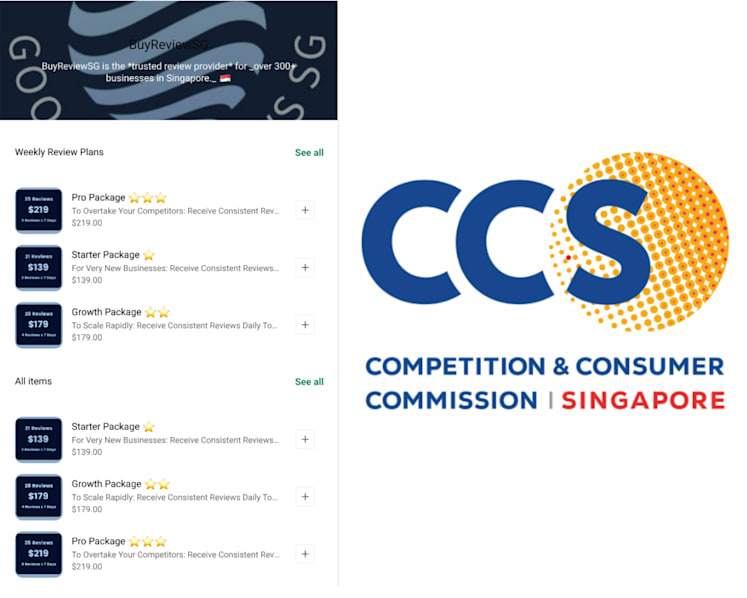
The businesses that bought fake reviews range from restaurants to doctors and lawyers. (Images: Competition and Consumer Commission of Singapore)

This audio is generated by an AI tool.


SINGAPORE: Ranging from restaurants to hair salons, 45 businesses will be required to apologise publicly after admitting to purchasing bogus reviews from a supplier to boost their online ratings, Singapore’s competition watchdog said on Wednesday (Sep 30).
These companies have committed to stop using fake reviews, and will be required to remove existing ones and report their progress in doing so, along with other measures, the Competition and Consumer Commission of Singapore (CCS) said.
These 45 companies are part of a larger group of around 100 businesses caught up in the competition watchdog’s investigation.
Calling the probe its largest one concerning fake reviews to date, CCS said these businesses were found to have bought fabricated reviews from Mr Julian Tung Yan Kai, who is the director of digital marketing firm Reputifly.





Mr Tung also owns and operates BuyReviewSG and GetReviewSG, which offered fake review services to businesses.
The fabricated reviews were posted on platforms such as Google, Facebook, Tripadvisor, Carousell, Yelp and Trustpilot, said the commission.
Given the scale of the case, CCS is conducting its investigation in two phases.
The first phase covered 47 of these companies, 45 of which admitted that they had purchased fake reviews from Reputifly. The remaining two declined to provide undertakings to the commission.
Companies that have purchased fake reviews
- Apax Medical Kovan Pte Ltd
- Apax Medical Pte Ltd
- Aqua Luxe Pte Ltd
- Atop Aesthetic Pte Ltd
- Bavarian Capital Pte Ltd
- BrandLoom Digital Private Limited
- Certified Translation Services
- Chrysalis Spa Pte Ltd
- Data Savers Pte Ltd
- Dots 'n' Tots Interior Pte Ltd
- FAS Auto Services Pte Ltd
- First Security & Private Investigation (S) Pte Ltd
- For the Love of Laundry Pte Ltd
- Forest Darts Bishan Pte Ltd
- Groupasia Hospitality Pte Ltd
- Harmony Essentials Pte Ltd
- Harmony Funeral Care Pte Ltd
- Haven Enterprises Pte Ltd
- Haven Tech Pte Ltd
- Hiremop Pte Ltd
- Integral Facilities Management (IFM) Pte Ltd
- J & S Management Pte Ltd
- Kuisine Koncepts Pte Ltd
- L E Autoshop Pte Ltd
- Label-Line Corporation Pte Ltd
- Le Wave Art of Hair Pte Ltd
- Le Wave Hair Pte Ltd
- Le Wave Hair Studio Pte Ltd
- Martin Luxury Pte Ltd
- MB Karaoke Solution Pte Ltd
- Meso Ceramics
- Nails In Dulge Pte Ltd
- Nanyang Brew Coffee
- Picasso Hair Boutique Pte Ltd
- Play! Ball Pte Ltd
- Play! Tennis Now LLP
- Print Scream Pte Ltd
- Sanook Group Pte Ltd
- SBLab Beauty Pte Ltd
- The Hamper Story Pte Ltd
- TM Designers Pte Ltd
- Torio Japanese Restaurant Pte Ltd
- TT8 Logistics Pte Ltd
- UniWise Admissions Consulting Pte Ltd
- Yeo & Associates LLC
The second phase of the investigation will extend beyond the remaining businesses to include other companies that may have procured fake reviews from the provider, CCS said.
“They are not limited to any particular sector,” said Mr Kho Qin Yao, director of fair trading practices at CCS, in an exclusive interview with CNA.
“They range from doctors, lawyers, tuition agencies, restaurants,” said Mr Kho, who served as the supervising director of the investigation team.
The issue of phony online reviews in Singapore has been a longstanding one, with CCS first taking action against a furniture retailer in 2024.
On Tuesday, CNA reported that listings on Carousell are looking for people to post fake reviews or offering to post false endorsements for between S$1 (US$0.78) and S$5 on platforms like Google Maps to boost their online profile.
Under the Consumer Protection (Fair Trading) Act, it is an unfair trade practice for businesses to post false reviews to deceive or mislead a consumer.
If a court finds that a supplier has engaged in an unfair practice, it can order restitution or award the consumer damages, among other consequences.

In its statement on Wednesday, CCS called on other fake review providers and businesses who have used such services to come forward voluntarily.
“Those who do so before CCS commences formal investigations against them will have their cooperation viewed favourably,” the commission said in a statement, adding that they may provide information at https://go.gov.sg/ccsresponse.
ACTIONS TAKEN
The 45 companies that have already admitted wrongdoing and made undertakings to CCS have promised to stop using fake reviews.
They must also identify and remove fake reviews relating to their businesses, report their progress to CCS, strengthen their compliance measures and post a public apology.
The apology must be prominent and maintained for six months on their websites, official social media accounts and at their physical premises or outlets.
The provider, Reputifly, has admitted to aiding and abetting unfair trade practices. It has also committed to stop offering fake review services, issue a public apology on its website for six months, and donate proceeds from its fake review service to a registered charity.
Reputifly will not claim any tax deductions arising from the donation to an institution of a public character.
If there is evidence that unfair practices have continued, CCS will not hesitate to take appropriate enforcement actions, including applying to court for an injunction order against such businesses, said Mr Kho.
For the two businesses that declined to provide undertakings, CCS said investigations will continue and firmer enforcement action will be taken if the facts support the case. The commission did not identify these two companies.
HOW REPUTIFLY PROVIDED FAKE REVIEW SERVICES
Reputifly is a digital marketing business that specialises in web design, search engine optimisation and paid advertisement management.
But Mr Tung also offered fake review services as an “add on”, said Mr Kho. That started sometime in or before 2023, CCS said.
The two websites, BuyReviewSG and GetReviewSG, facilitated the posting of these reviews on online platforms.
Companies could purchase packages from these sites, which later posted fake reviews at periodic intervals. For example, BuyReviewSG offered 35 five-star reviews over seven days for S$219, and promoted its ability to help companies overtake their competitors.
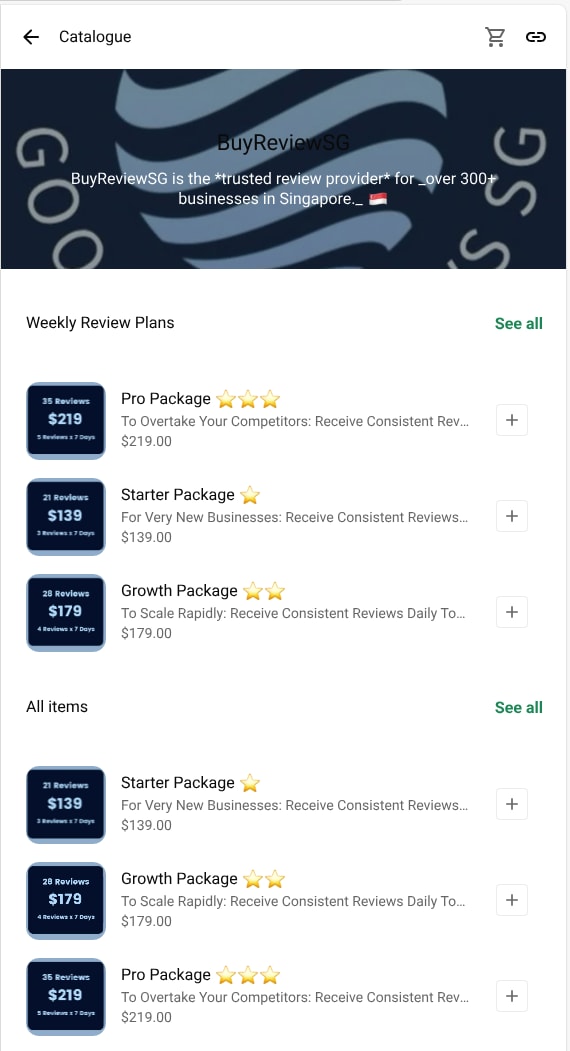
BuyReviewSG also developed a review rating calculator for companies to determine how many five-star reviews they would need to reach their desired rating.
Reputifly’s terms and conditions stated that if reviews were removed by Google, the provider would replace up to 30 per cent of the reviews purchased.
After a company bought fake reviews, the provider would use generative artificial intelligence to create reviews “designed to resemble genuine customer experiences”, said CCS.
Generative AI was used to vary writing styles and sentence structures, include the Singapore context and introduce natural imperfections. Clients could edit the reviews before they were published.
The fake review provider later came up with a dashboard that generated, managed and tracked fake reviews. It drew from existing four- and five-star Google reviews to generate new reviews containing relevant details.
“Some fake reviews deliberately described initial reservations before recounting a positive experience, creating an illusion of authenticity,” added CCS.
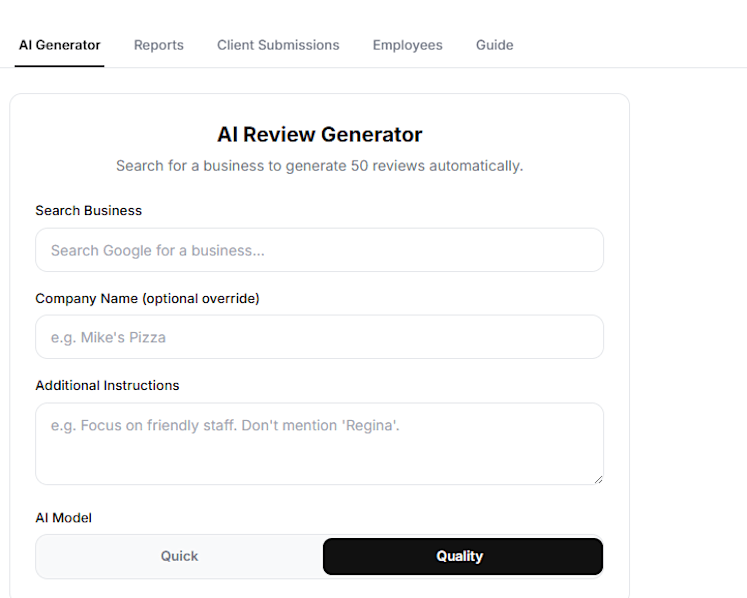
The advent of AI has certainly made it easier for people to generate fake reviews, said Mr Kho.
The provider used Telegram accounts and channels to recruit people to post the fake reviews, offering payment to people willing to use their accounts to post the fabricated endorsements.
INVESTIGATING THE FAKE REVIEWS
Mr Kho said CCS usually begins investigations if it has reasonable grounds to believe that suppliers have engaged in unfair practices.
These can be because of complaints or from CCS’s horizon scanning to look for leads and actionable intel.
“For this particular case, it was a mix of both.”
After discovering the Telegram channels and websites, CCS was able to quickly identify the main operator behind them, said Mr Kho.
He said under the Consumer Protection (Fair Trading) Act, CCS has the power to compel the production of documents.
“We approached him, and we managed to get the information that we need from him, and more critically, we managed to get hold of his database,” he said.

Mr Kho said businesses that buy fake reviews are in the minority, and that is why CCS is taking action.
“We do not want businesses to then feel forced to compete in such things by either engaging in unfair practices or posting fake reviews in order to keep up with those that have been doing so,” he said.
Besides fake review suppliers and businesses, Mr Kho said consumers also play an important role in ensuring the reviews they write and post are genuine, and reflect their own personal experiences.
If approached to post a fake review for a fee, consumers should not participate because they would be “poisoning the ecosystem”, he said.
CCS chief executive Alvin Koh said consumers increasingly rely on online reviews. Fake reviews deceive them, distort competition and disadvantage businesses that compete honestly, he said.
“Businesses should be under no illusion that paying for fake reviews is acceptable. Nor is it acceptable to profit from facilitating the creation or purchase of fake reviews; fake reviews are not a legitimate business,” he said.
“CCS will pursue not only those who buy them, but also those who profit from supplying them,” Mr Koh added.