Singapore raises 2026 GDP growth forecast to 4.5%-5.5%; economy grew 5.9% in Q2
The Ministry of Trade and Industry said the outlook for the rest of the year has improved due to stronger AI-related spending and a less severe-than-feared impact from the Middle East conflict.
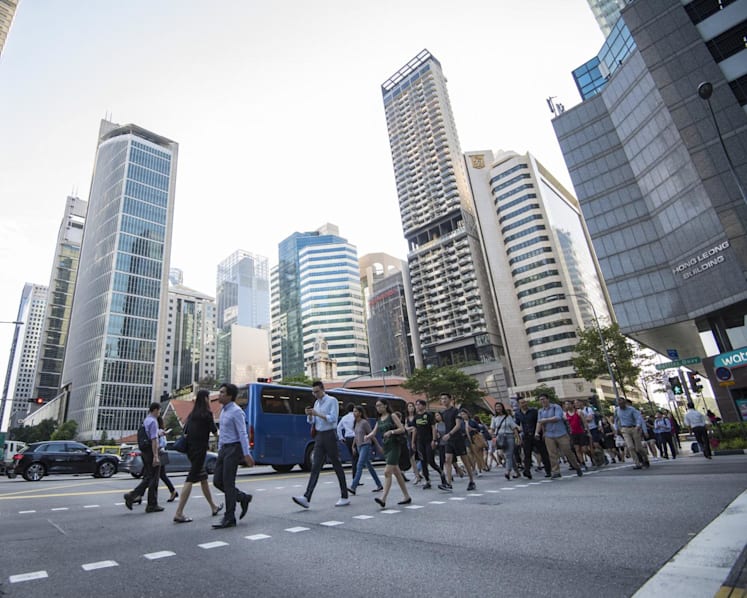
Office workers walking on the streets of the Central Business District in Singapore. (File photo: iStock)

This audio is generated by an AI tool.


SINGAPORE: The Ministry of Trade and Industry (MTI) on Tuesday (Aug 11) raised Singapore’s economic growth forecast for the year, citing a “better-than-expected performance” in the first six months of 2026 and an improved outlook for the rest of the year.
MTI now expects the economy to grow by 4.5 per cent to 5.5 per cent this year, up from its previous forecast of 2 per cent to 4 per cent.
The economy grew 5.9 per cent in the second quarter of 2026, slightly higher than the advance estimate of 5.7 per cent, but easing from the 6.3 per cent growth reported in the first quarter.
MTI previously upgraded Singapore's growth forecast in February, from an earlier forecast of 1 per cent to 3 per cent. Growth for the rest of the year is expected to be supported by an acceleration in global AI-related capital expenditure, the ministry said.





On a quarter-on-quarter seasonally adjusted basis, Singapore's economy expanded by 1.4 per cent, extending the 1.2 per cent growth in the first quarter. For the first half of the year, GDP grew 6.1 per cent year-on-year.
Growth in the second quarter was driven by the strong performance of the manufacturing, wholesale trade and finance and insurance sectors, said MTI.
"In particular, robust global AI-related demand boosted growth in the electronics and precision engineering clusters of the manufacturing sector, as well as the machinery, equipment and supplies segment of the wholesale trade sector," the ministry said in a press release.
It added that growth in the finance and insurance sector was driven by the banking segment, supported by strong credit growth and fee-generating activities.
However, the food and beverage services sector contracted, partly due to a sustained increase in outbound travel by locals and a decline in visitor arrivals in the second quarter.
OUTLOOK FOR 2026
MTI said Singapore's external demand outlook has improved compared with its assessment of the economy in May.
The global AI investment boom has been stronger than expected, providing significant tailwinds to AI-related production and exports. A further acceleration in AI-related capital expenditure is expected to lift the growth prospects of economies plugged into the global technology value chain, MTI said.
Meanwhile, the economic impact of the Middle East conflict has been less severe than initially feared. The drawdown in oil inventories and substitution to alternative energy sources have capped the rise in global energy prices, although continuing tensions are expected to keep prices higher in the second half of the year.
That will put upward pressure on global inflation and weigh on global economic activity, while US tariffs could also weigh on the exports of affected economies.
Looking to Singapore's trading partners, GDP growth in the US is expected to remain resilient, supported in part by rising AI-related investment, although growth could moderate in the second half of the year as consumption softens amid persistent inflationary pressures.
The Eurozone's outlook for the rest of the year has weakened because elevated energy prices could prompt further rate hikes and pose a drag on domestic demand.
For China, growth is expected to be slower in the second half of the year due to easing export growth and subdued domestic consumption. GDP growth forecasts for Taiwan and South Korea have been upgraded, with the stronger-than-expected AI investment boom expected to continue boosting their exports.
Growth forecasts for most key Southeast Asian economies have also been upgraded on expectations of strong AI-related exports, although weaker consumer demand amid elevated inflation could weigh on growth in the second half of the year.
For Singapore, the outlook has improved for sectors linked to the AI-driven technology cycle, but it remains weak for those affected by supply disruptions from the Middle East conflict.
The chemicals cluster of the manufacturing sector is expected to be the most adversely affected, with firms in the petroleum and petrochemicals segments continuing to cut back on production due to disruptions to crude oil and feedstock supplies.
Elevated fuel costs will also dampen demand in the water and air transport segments of the transportation and storage sector.
Growth in the accommodation sector is expected to remain subdued, in part because of elevated travel costs, though resilient demand in the luxury segment and a strong event calendar in the second half of the year will provide some support, said MTI.
On the other hand, the electronics and precision engineering clusters of the manufacturing sector should receive a boost, as demand for AI-related semiconductors is expected to remain strong as agentic AI is rolled out across industries.
"Strong activity in these clusters will generate positive spillovers to the machinery, equipment and supplies segment of the wholesale trade sector," said the ministry.
The information and communications sector is expected to see firm growth, boosted by strong AI-linked enterprise demand, and finance and insurance sector is expected to be supported by firm credit growth. Efforts to deepen Singapore's capital markets and broaden investor access to international listings are expected to sustain demand for wealth management services.
For domestically oriented sectors, construction will be supported by a pipeline of public and private projects, but dampened consumer sentiments could weigh on retail trade and food and beverage services sectors, though government support measures should cushion the impact, MTI said.
ARTIFICIAL INTELLIGENCE
A separate study on AI released as part of the latest Economic Survey of Singapore report found that initial AI use is associated with an increase in revenue and total employment, and the gains continue to rise as AI capabilities deepen.
The study also found that AI use is "not a stand-alone leap" for companies, but tends to build on prior efforts to adopt foundational and complementary digital technologies, and that companies in digital and data-intensive sectors as well as larger firms are more likely to use AI.
It used 2018 to 2024 job data from government portal MyCareersFuture to measure firm-level AI use, with the study noting that it does not capture the effects of more recent advances in AI capabilities such as agentic AI.
In terms of policy implications, the study suggested that firms should strengthen their foundational digital capabilities to help AI adoption.
Support for AI use should also be differentiated by sector and firm size, with workforce policies focusing on job transformation and worker training, helping workers move toward AI-complementary tasks even as automation increases.
Asked during a media briefing on Tuesday about MTI's report about whether Singapore's economy is too reliant on AI, the ministry's permanent secretary Beh Swan Gin disagreed with the idea.
"I wouldn't characterise our growth as being quite narrow and only dependent on AI, although it is a major contributor to the growth, but other sectors are also benefitting from that," he told reporters.
The finance, infocomms and construction sectors are resilient, he said. On the other hand, the sectors that are doing less well are those affected by feedstock issues and the food and beverage sector, which is affected by travel trends and higher cost structures in Singapore.
Asked about the pullback in share prices of AI-related stocks, Dr Beh said share price movement should be differentiated from the actual production in the real economy, where growth has accelerated.