analysis Singapore
Proposed COE changes could better separate luxury, mass-market models but may not lower prices
Academics also weigh in on how some other ideas in the consultation, including a surcharge on multiple-car ownership, might work in practice.
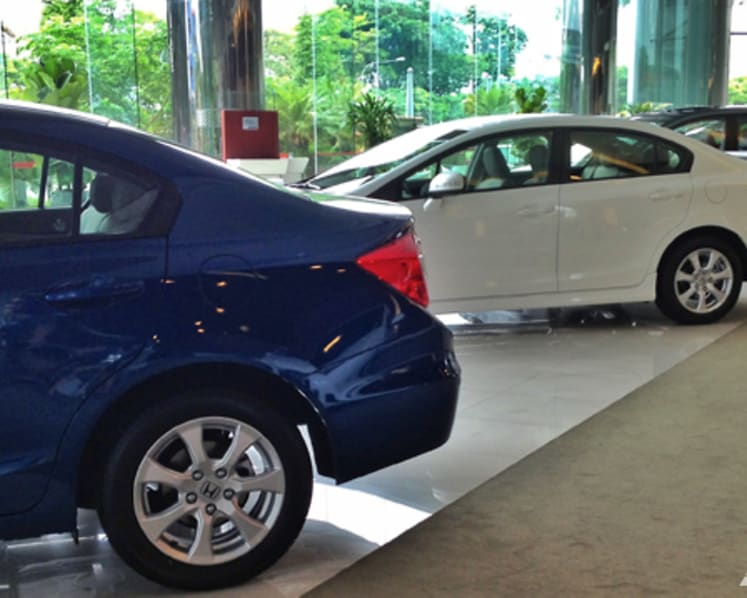
File photo of cars in a showroom in Singapore.

This audio is generated by an AI tool.




SINGAPORE: Merging the two car Certificate of Entitlement (COE) categories that are now differentiated based on engine capacity and power, and introducing a fee-and-rebate system to distinguish between luxury and mass-market cars could widen the price gap between models but may not lower premiums, transport experts said.
The Land Transport Authority (LTA) on Thursday (Oct 8) launched a public consultation on a proposal to merge categories A and B into a single pool of COEs. A rebate or surcharge would then apply to the prevailing premium based on each model's median open market value (OMV).
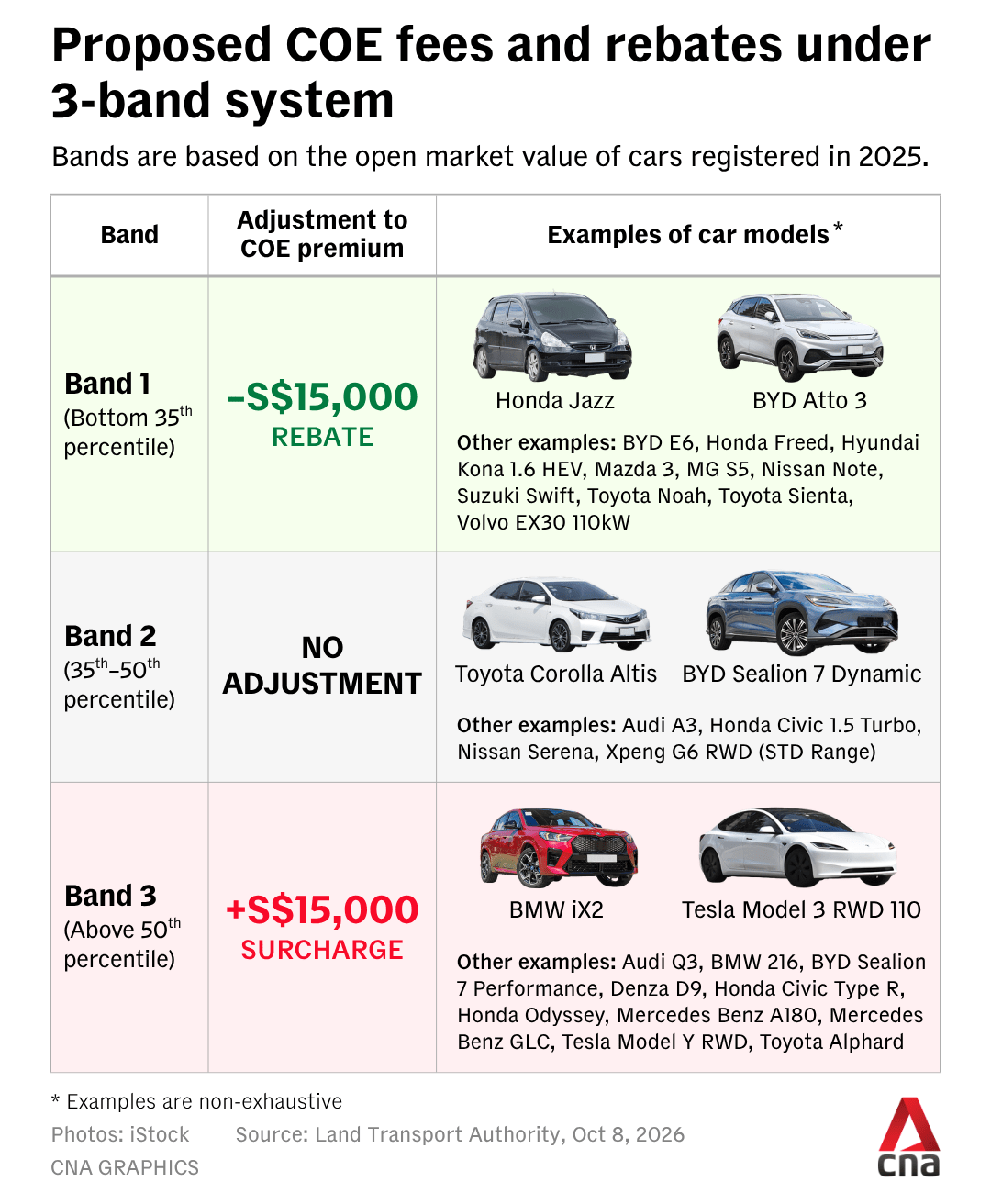
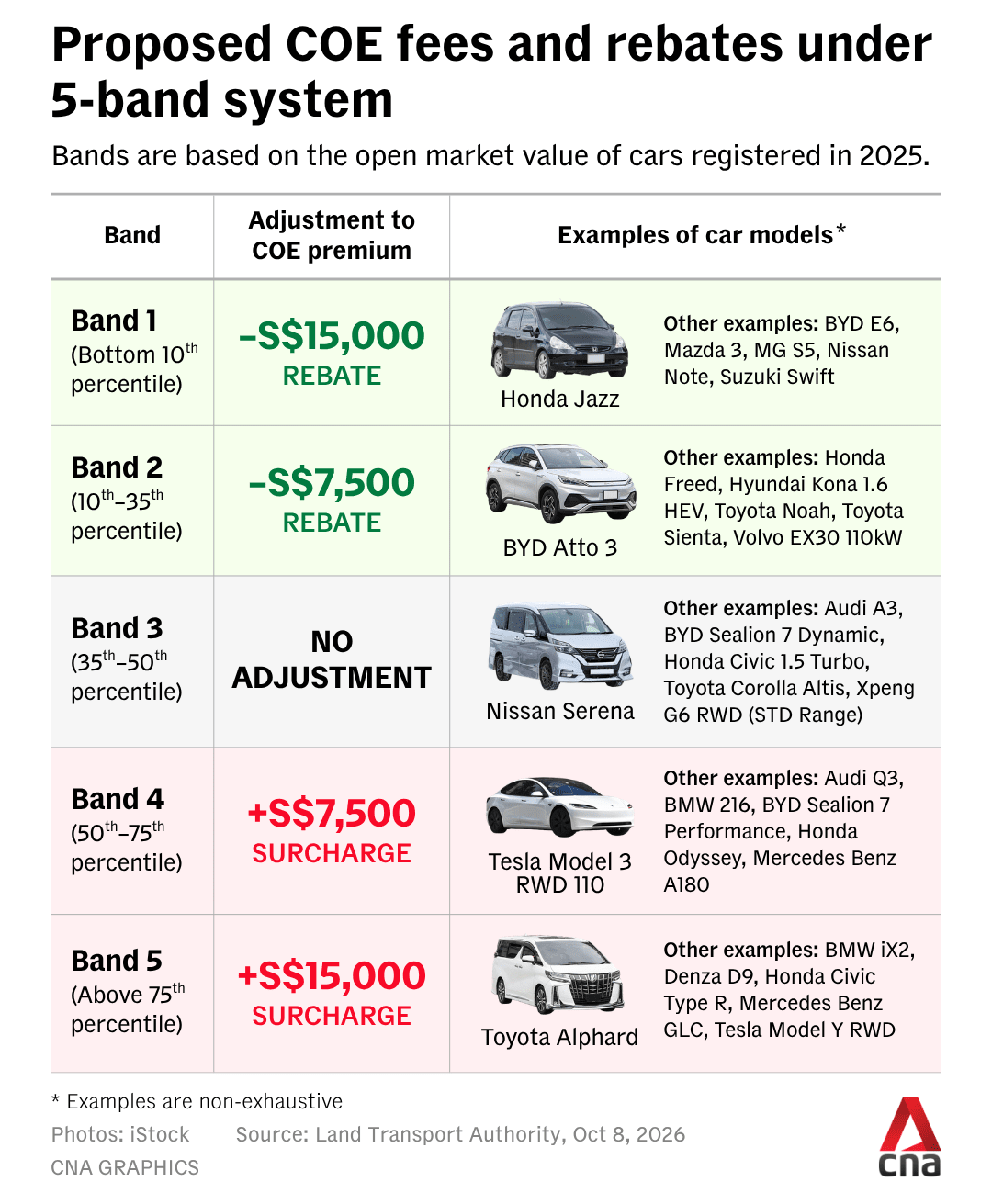
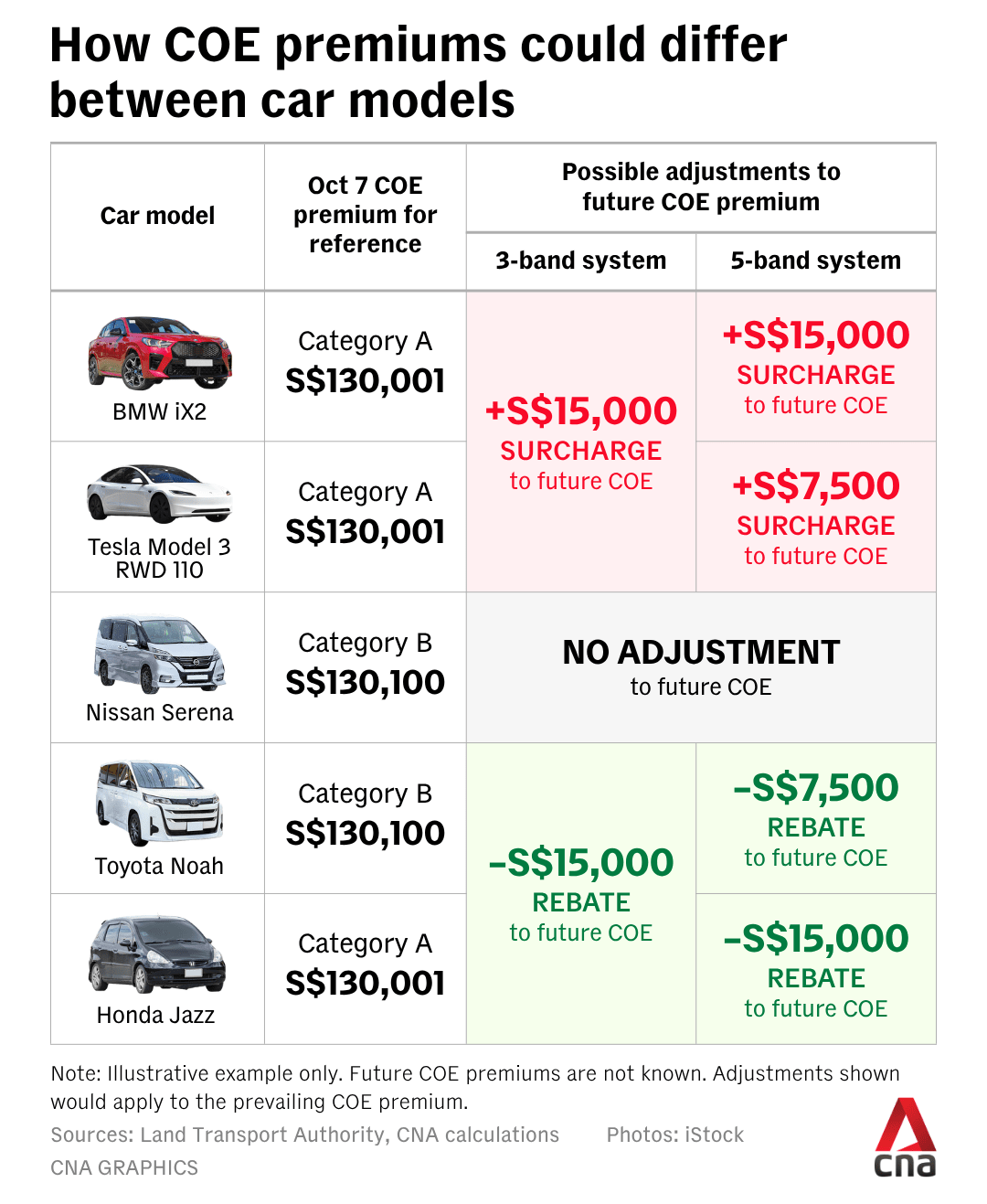
The authority is seeking views on two fee-and-rebate structures, with either three or five bands pegged to cars' open market value. Both would cap the rebate for lower-value cars and the surcharge for higher-end ones at S$15,000 each, creating a difference of up to S$30,000 in the COE price paid at opposite ends of the bands.
Using a car's value to determine the COE surcharge or rebate would separate luxury and mass-market models more directly than the current Category A and B criteria based on engine capacity and power, said Associate Professor in Practice Terence Ho from the National University of Singapore (NUS).
Advances in technology have allowed higher-end manufacturers to adjust the specifications of some models to fit within Category A, he said.
Assistant Professor Samuel Chng from the Singapore University of Technology and Design said using the median OMV would also treat cars of the same model more consistently and reduce the effect of fluctuations in individual import values.





NO GUARANTEE OF LOWER PRICES
The merger would not create more COEs, the experts noted. Assoc Prof Ho said supply depends on the permitted growth rate of the car population, deregistrations and special adjustments.
Associate Professor Raymond Ong from NUS described the changes as "really about an equity check between mass market and higher-end car ownership", rather than the availability of COE quota.
Associate Professor Walter Theseira from the Singapore University of Social Sciences said the system could guarantee a price gap between mass-market and luxury cars, but not a lower average premium.
If the common premium were S$100,000, a lower-value car with the maximum S$15,000 rebate would carry a COE cost of S$85,000, while a higher-value car with the maximum S$15,000 surcharge would cost S$115,000.
Both buyers would have competed in the same COE pool, but the fee-and-rebate system would create a S$30,000 difference in what they ultimately pay.
The common premium would still be set by the marginal buyer, Assoc Prof Theseira said. If that buyer is shopping for a higher-end car or can pay more, the premium could be closer to what Category B buyers are willing to pay today.
Some buyers may also put part of their savings from a rebate back into their COE bids to improve their chances, he said.
"At the end of the day, this policy can deliver you the price difference between mass-market and luxury cars, but it cannot deliver you lower COE prices," he said.
Whether rebates push premiums up would depend on how buyers respond, said Asst Prof Chng.
If existing buyers simply switch to lower-OMV models, the number of bidders would not necessarily rise. But if rebates attract additional buyers or give existing ones more room to bid, a higher common premium could offset some of the benefit, he said.
Unlike Category A today, lower-OMV cars would not have their own COE pool, so greater demand for them would feed into the same common premium, Asst Prof Chng said.
Some Category A buyers may still feel they have lost a degree of protection from higher-value buyers, although premium models in Category A have already weakened that perception, he added.
Assoc Prof Ong also flagged a possible rush to buy cars before the new bands take effect, as buyers weigh the certainty of the existing system against the unknowns of the new one.
He said COE prices should be watched ahead of implementation, although longer-term trends would still be driven by supply and demand.
SHIFTS IN WHAT'S ON OFFER
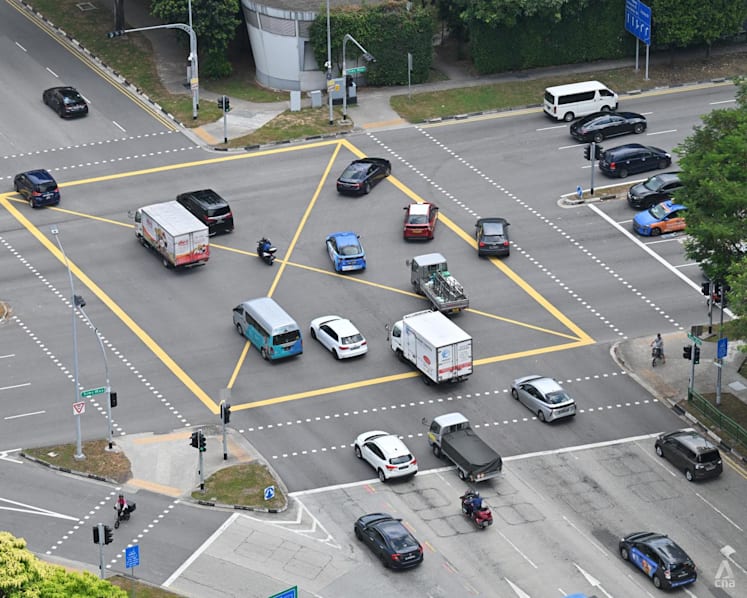
The range of cars sold in Singapore could change, the experts said.
Associate Professor Timothy Wong from NUS said Singapore is a small market where models are offered based on profitability. A new way of determining COE costs could make lower-OMV cars that qualify for rebates more appealing to bring in, he said.
Dealers could also adjust their offerings, particularly for cars just above the cut-off for a more favourable band, said Assoc Prof Theseira. This could include removing certain features or making them available only through subscriptions.
Buyers may make similar trade-offs. Assoc Prof Theseira said rebates could sway someone towards a less premium version of the same model, though he did not expect a buyer seeking an ultra-luxury car to switch to a cheaper model for the rebate alone.
THREE BANDS OR FIVE
Several experts favoured the five-band option, which would have S$7,500 adjustments between adjacent bands, compared with S$15,000 under the three-band option.
More bands would reduce what Assoc Prof Theseira called "cliff effects", where a car just above a cut-off attracts a significantly higher fee than one just below.
Smaller steps could also reduce the incentive to change a car's characteristics to land in a more favourable band, although such behaviour could not be eliminated as long as bands are used, he said.
Assoc Prof Ho also preferred five bands because cliff effects would be less pronounced, though this would come at the cost of greater complexity. Assoc Prof Wong said five bands would reduce the trade-offs over which cars to bring in.
OTHER IDEAS IN THE CONSULTATION
Experts were more cautious about other ideas raised in the consultation, including allocating COEs based on family needs, creating a separate category for private-hire cars and imposing a surcharge on multiple-car ownership.
On family needs, Assoc Prof Theseira questioned whether help should be tied specifically to buying a car.
"If we're going to give them a discount, then I think the question is: What is the best way of doing this?" he said. Broader financial support would let families decide whether to spend the money on a car or other needs, he added.
Assoc Prof Ong said COEs set aside for families may not end up more affordable than those in the common pool after bidding. He favoured a rebate for families meeting certain socio-economic criteria who successfully bid for a car.
Even deciding who qualifies would be difficult, said Asst Prof Chng. Family size alone would not necessarily reflect transport need, as smaller households caring for someone with a disability could face greater challenges than larger ones with better access to public transport or family support.
Needs could also change over a COE's 10-year life, complicating when households should qualify or be reassessed, he said.
Creating a separate COE category for private-hire cars would involve another balancing act, the experts said.
If the quota were set too low, commuters could face higher fares or find it harder to get a ride as operators deal with higher rental costs and tighter supply, said Asst Prof Chng.
An incorrect quota could also affect demand for private cars, said Assoc Prof Theseira. Some people who can afford a car choose not to own one because taxis and private-hire services meet their needs.
"The moment you do something to harm the viability of the industry, some of them are going to start buying private cars for their own use instead, and they will be competing with everyone else," he said.
On multiple-car ownership, experts said that enforcing a surcharge would be difficult. Assoc Prof Wong said second or third cars could be registered under different names, limiting the measure's effect on demand.
Wealthier households have more ways around such rules, including registering cars at different properties or under a company, said Assoc Prof Theseira. A large enough surcharge could even encourage businesses to help buyers restructure vehicle ownership, he added.
Closing such loopholes could require more intrusive enforcement, such as monitoring where cars are regularly kept. The more tightly rules were enforced, the more intrusive the system could become for car owners, he said.
_1.jpg?itok=Pt4lopXb)