Woman seeking S$1 million in child support from alleged father fails to get court-ordered DNA test
The judge said that a court can order a DNA paternity test, but there must be enough evidence to justify compelling the man to do so, and not just based on bare allegations.
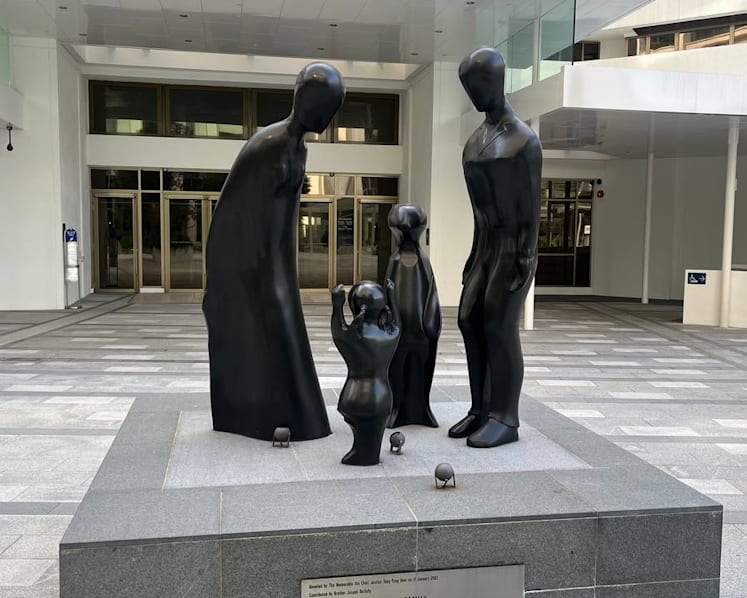
A sculpture titled Family is seen outside the Family Justice Courts in Singapore. (Photo: CNA/Lydia Lam)

This audio is generated by an AI tool.


SINGAPORE: A woman failed in her bid to get the court to order a DNA paternity test from a man she claims to be the father of her child, setting back her attempt to seek up to S$1 million (around US$780,000) in lump-sum maintenance from him.
In a judgment on Jul 30, District Judge Phang Hsiao Chung said that although the family court has the power to order a DNA test, this should be exercised sparingly in light of legitimate privacy concerns.
He added that in this case, the woman did not present enough evidence to obtain such an order.
Judge Phang also said that it was not enough for parties to know each other and have sexual relations.
"Otherwise, a promiscuous woman who conceives a child can, on the pretext of seeking maintenance for the child, apply to the court to order any man whom she has ever had sexual relations with to submit to DNA paternity testing, simply by making a bare allegation that she had sexual intercourse with that man around the time the child was conceived."
He added that the court must be satisfied that the woman and the man did in fact engage in sexual intercourse around the time the child was conceived before ordering the man to go for a DNA paternity test.
The woman, who was not named in the judgment as is usual for a family court ruling, gave birth to the child in May 2014.
She had married another man known only as "M" the year before, and he was listed as the father on the child's birth certificate.
In 2020, the woman and M obtained an interim judgment for divorce. They were granted joint custody of the child and a second child.
M was solely responsible for maintaining both children.
The woman then turned to the court to get what she claims is the real father of her child to pay child maintenance of S$8,926 a month, or a lump sum of S$1.07 million.
THE WOMAN'S ARGUMENTS
The woman, represented by Ms Diana Foo from law firm Legal Eagles, submitted to the court two slightly different accounts of what happened.
First, she said that she met the child's birth father around 2013 through a marriage-and-friendship introduction agency.
They developed a relationship and had sex at his home. The woman claimed that she had agreed to have premarital sex with the man because he said he was unmarried.
She also claimed that he was her only boyfriend at the time.
When she told the man about her pregnancy, expecting him to support her and the child, he denied responsibility, saying it was not possible that the child was his.
He later cut off all contact with her, she said. However, during her first trimester, the woman said that M supported her and she married him in August 2013.
She then put M as the father on the child's birth certificate because she could not put the real father's name, since he refused to acknowledge he was the biological father.
She added that she was in a state of emotional distress at the time, struggling with pregnancy and forming a rapport with M to get him to agree to being named as the father.
In the woman's second account of the events, she claimed that she met the father of her child in late 2012 instead, after she had broken up with M, whom she had known earlier.
She said they had sex about four times in 2013 at the man's home, with the last time being in August 2013.
She agreed to have sex with the man because he gave her the impression that he was serious about marrying and settling down with her.
After she got pregnant and the man cut off contact with her, she got back together with M.
In her second account, the woman said that even though M was responsible for solely maintaining the child after their divorce, she had been the child's primary caregiver and bore the costs of the child's upbringing.
She claimed that M was not the biological father of the child, providing a DNA paternity report that stated so.
However, she admitted that the samples were not collected under a strict chain of custody. This means there was no documented record showing who handled the samples from collection to testing.
The report itself stated that it could not verify patient names and sample origins.
THE MAN'S ARGUMENTS
The man denied being the father of the child and that he had not been in a relationship with the woman.
He claimed that he had sex with the woman on a single occasion in a one-night stand in the first quarter of 2013.
The day they had sex, the woman told him that she had just quarrelled with her then-boyfriend.
She suggested going to his house for tea and they had protected sex there.
After the encounter, the man claimed that the woman sought payment for the sex. Since he was uncertain about her intentions and was concerned she might make false allegations against him, he gave her S$150.
He said that the focus on money reinforced his decision not to maintain any further contact with her, and they did not communicate after that. He also said that he was never informed of the pregnancy.
Since the child was born in late May 2014, the child should have been conceived in early September 2013, after the woman married M, the man's lawyers argued.
He was represented by Mr Clement Yap and Ms Urmi Nag from Harry Elias Partnership.
They argued based on the Evidence Act that a child born during a valid marriage would be presumed to be the legitimate child of the man in the marriage, unless proven otherwise.
The lawyers also argued that the court does not have the power to compel a person to take a paternity test. They said that the woman had not established any case that the man was the father, so there was no basis to compel him to take one.
JUDGE'S FINDINGS
Elaborating on the family court's power to order a man to submit to DNA paternity testing, Judge Phang said that there are two possible bases for this power.
First, in a section of the Family Justice Act, and second, in the inherent power of the court to "do whatever it considers necessary on the facts of the case before it to ensure that justice is done or to prevent an abuse of the process of the court".
However, even though the court has the power to compel DNA paternity testing, this should be exercised sparingly, he added.
If a man agrees to submit to such testing, the court may readily make the order with consent.
However, if he does not, the court must first be satisfied that there is credible evidence that he may be the child's biological father.
"In particular, at the very least, the court must be satisfied on a balance of probabilities that the parties had sexual intercourse during a period when the child concerned may have been conceived," Judge Phang said.
"In my view, this strikes an appropriate balance between the interests of justice, in obtaining evidence relevant to the issue of paternity before the court, and any legitimate privacy concerns that the person asked to provide a body sample for DNA analysis may have."
In this particular case, he found that the woman had not met the "evidential threshold" to obtain such an order, adding that he had "serious reservations" about her credibility.
He found her narrative improbable and her explanation for how M came to be named the child's father "clearly contrived".
Her evidence that M was not the child's father was also inadmissible.
Judge Phang therefore dismissed the woman's bid to compel the man to undergo DNA paternity testing and ordered her to pay the man costs of S$1,800.
The woman is appealing against the decision. Her application to seek S$1 million is stayed until the appeal is concluded.