



ASEAN countries sign world's first region-wide digital economy pact, laying foundation for collaboration
Singapore Deputy Prime Minister Gan Kim Yong said the pact took several years to negotiate and reflects the diverse state of readiness among member countries.
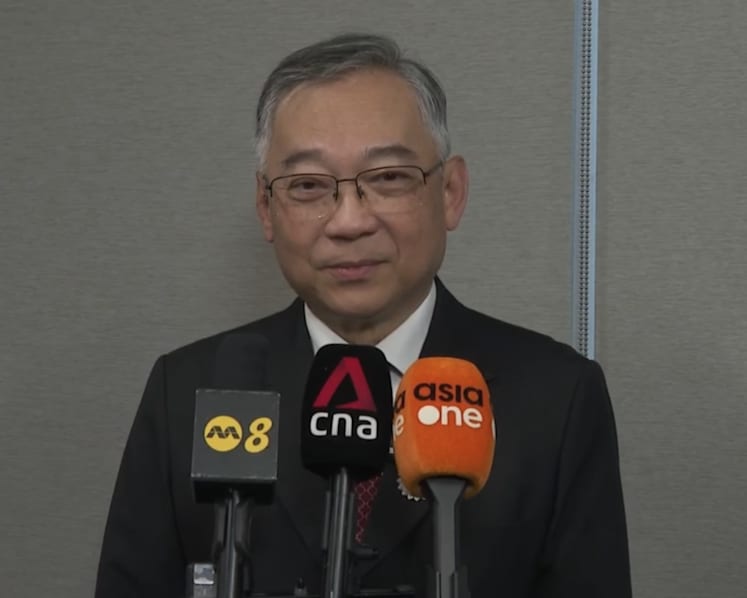
Deputy Prime Minister Gan Kim Yong speaking to Singapore media after ASEAN nations inked the bloc's first Digital Economy Framework Agreement in the Philippine capital of Manila on Nov 14, 2026.

This audio is generated by an AI tool.


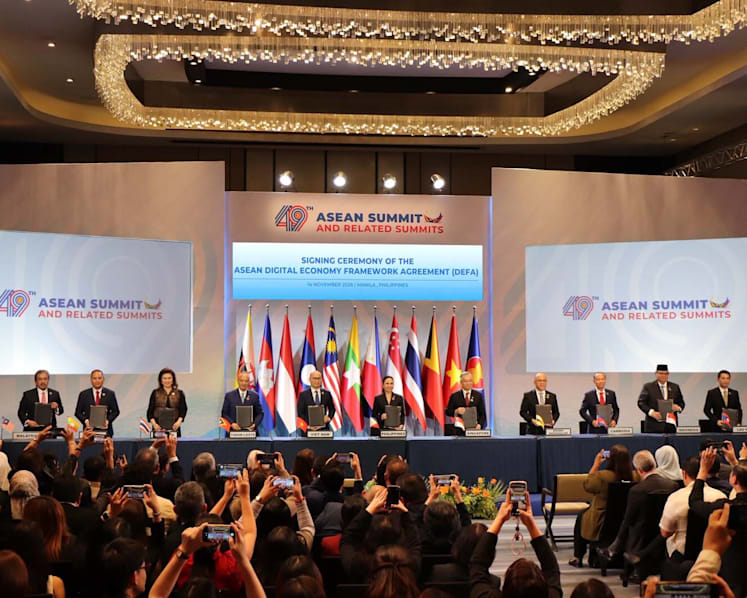
MANILA: Association of Southeast Asian Nations (ASEAN) member states on Saturday (Nov 14) signed the world's first region-wide, legally binding Digital Economy Framework Agreement (DEFA), with Deputy Prime Minister Gan Kim Yong describing the pact as reflecting the diverse state of readiness among member countries.
Noting that it has taken the bloc “several years” to negotiate the deal, Mr Gan said: “To be able to negotiate an agreement that is on one hand sufficiently ambitious and at the same time acceptable to all member countries, is not easy.”
The agreement will hopefully come into force "sometime early next year", he added.
The DEFA is ASEAN’s first standalone digital economy agreement, said the Ministry of Energy, Trade and Industry (METI) in a press release.





The deal lays the foundation for closer digital economic integration and opens up opportunities for businesses in ASEAN's growing digital market, said the ministry.
The agreement covers cross-border data flows, end-to-end digital trade, protection of source code, cybersecurity and artificial intelligence.
It aims to promote greater interoperability across digitally enabled sectors, such as technology, e-commerce, payments, logistics and supply chains, letting businesses of all sizes expand and scale across the ASEAN region.
COLLABORATION AMID FLEXIBILITY
Mr Gan, who is also Minister for Energy, Trade and Industry (Trade), said DEFA provides ASEAN with a basic framework for digital rules, including cross-border data flows.
“But each country has its own specific concerns. Some may relate to privacy laws, some may relate to business confidentiality, some may relate to national security,” he said.
“So there are exceptions that will be allowed under this framework agreement. But what is important is that it sets out the basic cross-border data flow rules to allow data to be able to be transferable, subject to some of these reservations and concerns.”
Mr Gan said that DEFA is designed to be flexible and evolve with time, so that the bloc is not restricted to progressing at the pace of its slowest member.
“The important thing is we keep the door open for other countries who are not quite ready today, to be able to join in any time when they are ready, he said.
“I think this is inclusive, but yet at the same time allows us to progress at a much faster pace.”
Mr Gan said the topic of an agreement on the green economy also came up during Saturday's ASEAN Economic Community Council meeting.
“Even before we signed the Digital Economy Framework Agreement, we had started thinking about the Green Economy Framework Agreement (GEFA), and therefore we had embarked on the feasibility study,” he said.
“Today we received an update, and we hope to be able to complete the study soon and launch the GEFA discussion next year.”
HOW BUSINESSES BENEFIT
On how businesses can benefit from DEFA, Mr Gan said governments can negotiate agreements with each other but it will be up to the firms to make use of it.
“We hope to reach out to engage the private sector, share with them what DEFA is about, what the digital economy framework is all about, and how they can tap on it to benefit themselves,” he said of efforts to raise awareness about the new DEFA.
He said that DEFA provides a framework for interoperability within ASEAN’s digital economy and lets the bloc grow together in the area.
It provides the rules for things such as using electronic documentation instead of paper documents, which will help to facilitate trade, speed things up and reduce costs.
Another area is payment systems, said Mr Gan.
Noting that payment systems are no longer used just at the retail level, but also at the business-to-business wholesale level, Mr Gan said these transactions can make use of digital payments instead of traditional bank transfers.
Digital identification is also another area that has to be developed, he added.
“It's important that if you want to embark on digital trade, you need to know who you are trading with, and therefore digital identity for businesses is very important,” said Mr Gan, citing the possibility of an ASEAN-wide digital identification system.
Artificial intelligence and cybersecurity are two other aspects that DEFA would allow cooperation in, as they require collective effort to be able to make advancement, said Mr Gan.
FACING COMPETITION
When asked if Singapore businesses may be exposed to more competitors in the region with the introduction of the DEFA, Mr Gan acknowledged that it is an issue on the minds of many, especially small‑ and medium‑sized enterprises (SMEs).
However, while ASEAN enterprises and businesses face competition from each other, they also face “a lot more competition” from outside the region.
“Because within ASEAN, I think you would appreciate that our economies are very complementary in nature. We compete in some areas of course, but in many areas, we are complementary to each other,” said Mr Gan.
With the digital economy, Singapore can import goods more quickly and easily and at a lower cost, he said.
As such, Singapore businesses can become more competitive, while ASEAN countries can be more integrated physically and digitally too, he said.
“So I think the key is how we can help the SMEs tap on this facility, this capability, help them to develop their skills, their ability and their systems, so that they can benefit and leverage on this DEFA and benefit from the provisions of DEFA,” said Mr Gan.
ASEAN is also looking at engaging its partners to see how it can expand its cooperation and integration with economies outside the region, said Mr Gan.
He shared that progress on the ASEAN-Canada Free Trade Agreement is being made towards a “substantial conclusion”.
“I think we are making progress towards a substantial conclusion and for it to be announced by our leaders in time to come. So I think we are confident and we hope to see further progress in this area,” said Mr Gan.
He added that ASEAN is also discussing several other potential FTAs with its partners.