Woman wins appeal in 99-to-1 property purchase dispute with ex-boyfriend, owns majority of condo unit despite paying less
The woman said her ex-boyfriend had promised to give her 99 per cent ownership of the unit "to assure her that he wanted to settle down with her and would not cheat on her".
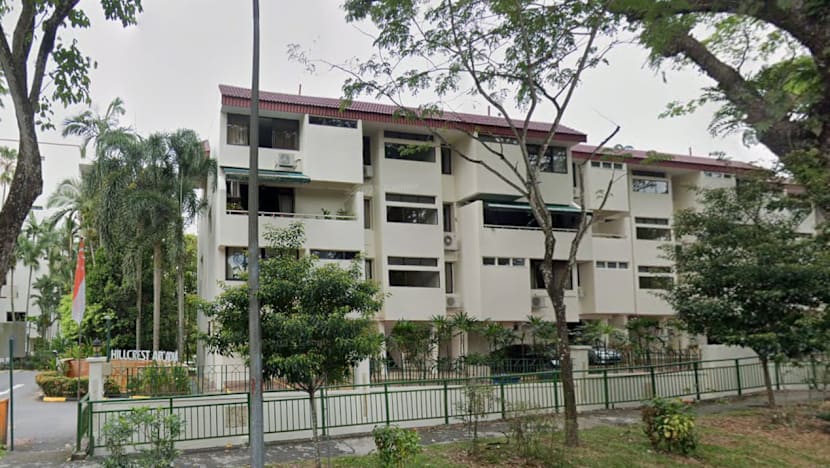
The exterior of Hillcrest Arcadia. (Image: Google Maps)

This audio is generated by an AI tool.


SINGAPORE: A woman has won her appeal in a 99-to-1 property dispute with her ex-boyfriend over a condominium unit the pair bought in Bukit Timah for about S$1.87 million (US$1.46 million) in 2019.
The Court of Appeal found that the man had contemplated tax evasion, as he could later transfer 1 per cent of the property to his girlfriend so he could buy a second property without paying additional buyer’s stamp duty (ABSD).
The High Court had initially found that Ms Millie Wong Mei Lee held part of her share in the Hillcrest Arcadia unit on resulting trust – where a property is transferred to someone, but he or she is not intended to be the beneficial owner – for her former boyfriend, Mr Jake Ngor Shing Rong, as he had paid more for it.
The High Court had found that Mr Ngor owned a 54.22 per cent beneficial interest in the property, after considering their respective financial contributions.
In a judgment released on Wednesday (May 20), the Court of Appeal disagreed. It found that the 99-to-1 ratio the pair had agreed on reflected both their legal and beneficial interests in the property, and that Mr Ngor had failed to prove that he did not intend to benefit Ms Wong with his financial contributions to the property.
The Court of Appeal found that the illegal purpose of evading ABSD "tainted the resulting trust the moment it crystallised".
The court, comprising Chief Justice Sundaresh Menon and Justices Steven Chong and Hri Kumar Nair, allowed Ms Wong's appeal and granted her S$50,000 in costs.
The Singapore government introduced ABSD as a tax in 2011 to manage demand for property. Singaporeans who buy a second or subsequent residential property must pay 20 to 30 per cent of the purchase price or the market value of the property in ABSD.
In 2024, then Deputy Prime Minister Lawrence Wong referred to the 99-to-1 arrangement as a "tax avoidance arrangement" which some property owners undertake.
THE CASE
Ms Wong and Mr Ngor began their romantic relationship in mid-2018. In December 2019, they exercised an option to purchase the condominium unit in Hillcrest Arcadia for S$1.865 million.
On the same day, they signed a document stating that they would hold the property as tenants-in-common in a 99-to-1 ratio, with Ms Wong holding the larger stake.
The purchase was completed on Mar 20, 2020. Ms Wong paid S$159,678 while Mr Ngor contributed S$359,949.42 towards the purchase price. The remainder was financed with a mortgage loan, with payments made primarily through funds in their Central Provident Fund (CPF) accounts and proceeds from renting the unit.
The pair's relationship subsequently broke down, and they separated about eight months later in November 2020. A dispute then arose over the unit's ownership, with Mr Ngor claiming he held 71 per cent of beneficial interest in the property despite holding 1 per cent on paper.
Ms Wong refuted this, stating she holds her registered 99 per cent share both legally and beneficially.
The matter was then brought to the High Court. Mr Ngor's case was that he agreed to Ms Wong's terms that a property they purchase together should be registered legally in her name as a form of assurance and security of his fidelity, and that she would be entitled to the entire property only if he cheated on her.
He also said that if they bought another property, he would transfer his ownership of the condominium unit to Ms Wong and have the second property registered solely in his name so they would not have to pay any ABSD.
Ms Wong denied this, stating that she was insecure about her relationship with Mr Ngor, given his history of infidelity and that he had promised to give her 99 per cent ownership of the property "to assure her that he wanted to settle down with her and would not cheat on her".
She argued that her share of the property did not depend on whether he cheated on her.
The High Court found that Mr Ngor did not intend to immediately and unconditionally benefit Ms Wong with his financial contributions to the property, but only if he cheated on her.
It ruled that Ms Wong held 54.22 per cent of the property on a resulting trust for Mr Ngor. This was based on their respective financial contributions, which were found to be 55.22 per cent for Mr Ngor and 44.78 per cent for Ms Wong, and that the former held a 1 per cent legal share of the property.
She also said the High Court judge had erred in characterising the illegality Mr Ngor contemplated in the 99-to-1 property arrangement as under-stamping when evidence pointed to avoiding ABSD.
She filed an appeal, and was represented by lawyers Terence Tan Wee Kio and Zachary Tong Yi Keat from Drew & Napier. Mr Ngor was represented by Mr Tito Isaac and Ms Soh Lisha from Tito Isaac & Co.
THE APEX COURT'S FINDINGS
The Court of Appeal disagreed with the High Court's assessment of the evidence.
Delivering the judgment, Justice Nair said: "In our view, the evidence shows that the parties intended for the 99-to-1 ratio to reflect their legal and beneficial ownership of the property."
He said that Mr Ngor did intend to benefit Ms Wong with his financial contributions, and a resulting trust did not arise over the property.
"The (High Court) judge's evaluation of the evidence was, with respect, incorrect because he did not properly address the numerous difficulties and inconsistencies in Jake's case, and appears not to have considered or given weight to Millie's evidence without explaining why that evidence was not credible."
Analysing these points, the Court of Appeal found that the parties did not understand the distinction between legal and beneficial ownership when they bought the property.
This meant that when they signed the document reflecting the 99-to-1 split, they could not have contemplated owning the property in a different ratio. This was even though they knew that Mr Ngor would be paying for most of the purchase price.
The Court of Appeal also rejected Mr Ngor’s argument that Ms Wong's 99 per cent ownership was conditional on him cheating on her.
It found that his explanation of the supposed "cheating condition" was inconsistent and unreliable, and unsupported by the couple's messages that were used as evidence.
"We observe that while the parties spoke at length about Millie's insecurities and her having a 99 per cent registered interest in the property, at no point did they mention the cheating condition or allude to the notion that Millie would only fully own or own 99 per cent of the property if Jake cheated on her," Justice Nair said.
The Court of Appeal also rejected Mr Ngor's claim that the couple had initially agreed to own the property equally before changing to the 99-to-1 ratio. They found there was no evidence of such a 50-50 agreement, but there was instead proof suggesting that this was "entirely contrived" by Mr Ngor.
Concluding on both parties' intentions, the Court of Appeal said Mr Ngor failed to prove that he did not intend to benefit Ms Wong with his financial contributions, and there was no room to apply the presumption of resulting trust.
The evidence had established that the pair had extensive discussions about the property being in Ms Wong's name because she was insecure about their relationship and Mr Ngor was willing to demonstrate – at his own risk and expense – that her fears were unfounded.
He repeatedly pointed out that he was trusting Ms Wong by putting the property and other assets in her name and at her disposal. He also did not at any time claim that he was interested in the property beyond his registered share.
On the other hand, the evidence showed that the parties agreed that Ms Wong would own 99 per cent of the property.
As such, Mr Ngor's claim for a resulting trust failed and Ms Wong's appeal was allowed.
The Court of Appeal also disagreed with the earlier decision that Mr Ngor's contemplated illegality in the 99-to-1 arrangement was merely under-stamping and not tax evasion.
It said that the plan had always been for Mr Ngor to transfer 1 per cent of the property to Ms Wong and subsequently purchase a second property without paying ABSD, hence evading tax.
But this did not happen as the pair ended their relationship. "In our view, the illegal purpose of evading ABSD tainted the resulting trust the moment it crystallised," the judgment noted.
"Recognising a resulting trust would effectively be endorsing that intention, and it is no answer to say that no ABSD was in fact evaded or that the parties will no longer pursue that intention."
The judgment means that Ms Wong will be entitled to 99 per cent of the sales proceeds of the condo unit if it is sold, subject to any relevant deductions such as over CPF contributions.