Chinese travellers hit by wave of Southeast Asia flight cancellations, Singapore routes affected amid fuel crisis
Chinese holidaymakers heading abroad for the Labour Day break in May are scrambling to rebook plans as several airlines cancel flights to Southeast Asia amid a fuel crisis driven by the Iran war.
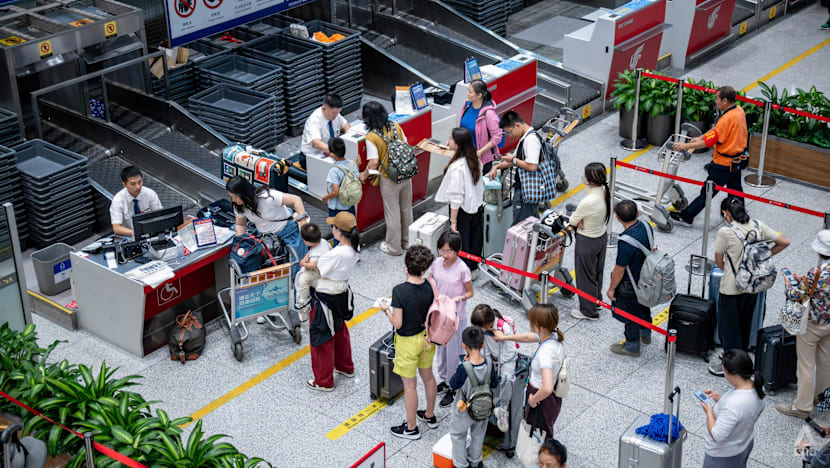
Passengers are seen at Beijing Capital International Airport in China on Oct 1, 2025. (Photo: CNA/Hu Chushi)

This audio is generated by an AI tool.


SINGAPORE: Chinese holidaymakers gearing up for the upcoming May Labour Day break are facing a wave of sudden flight cancellations on routes between China and Southeast Asia, and beyond, as airlines cut back flights amid surging fuel costs driven by the escalating US-Iran conflict.
Chinese travellers took to social media to share their dashed plans and woes.
One traveller, Wang Qiang, 29, who was set to fly to Vietnam from Qingdao in eastern China on May 1, told CNA that his flight on Shandong Airlines had been cancelled with “no explanation given”.
Wang had planned to visit Hanoi and then Bangkok before flying to Guangzhou to settle his US travel visa, but has now been rebooked on a flight to Hanoi via Shanghai.





“At least the problem is solved,” he said, adding that the new flight’s timing “was actually even better”.
However, other Chinese travellers have not been as lucky as Wang.
A Xiaohongshu user with the handle Dianzi said that his upcoming flight from Chongqing to Ho Chi Minh on China Southern Airlines, originally scheduled for Apr 30, had been cancelled with “no warning”.
His return flight back to Chongqing on May 6 had also been cancelled.
“I heard that flights to Southeast Asia were cancelled due to fuel costs,” Dianzi wrote, adding that he had booked his flights two months ago, along with accommodations in Phu Quoc island.
“That’s more losses incurred,” he said.
He added that he had been informed of the cancellations on Apr 9 and while he had been able to get a full refund, other direct flights to Ho Chi Minh during the same period had soared to more than 5,000 yuan (US$733.33) - as compared to 2,200 yuan he originally paid.
“I thought only foreign airlines were affected - I totally didn’t expect domestic (Chinese) airlines to be affected too,” Dianzi said.
KEY ROUTES AFFECTED
With the closure of the Strait of Hormuz, one of the world's most critical energy chokepoints, the war in the Middle East has become an economic crisis for Asia.
Southeast Asia is a key destination for Chinese travellers, experts said - with strong tourist flows to countries such as Thailand, Malaysia and Vietnam.
Checks by CNA showed multiple flight cancellations between China and Southeast Asian destinations since early April, including routes between Xi’an and Phuket, and Xiamen and Vientiane, the capital of Laos.
China’s flagship carrier Air China has cancelled all flights between Chengdu Fengdu International Airport and Kuala Lumpur International Airport from Apr 7 to Jun 30, according to Chinese news reports.
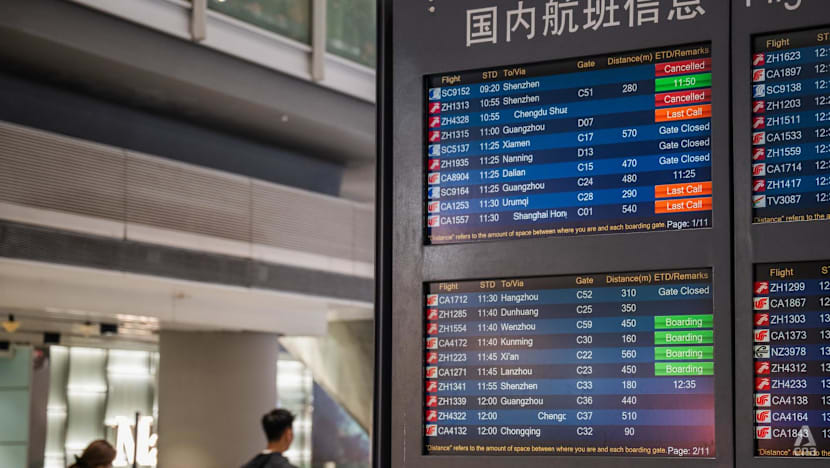
State-affiliated The Economic Daily reported that Spring Airlines, China Eastern Airlines and China Southern Airlines have cancelled some Southeast Asia-bound flights scheduled during the Labour Day holiday in May.
Malaysia’s AirAsia has suspended two routes between Bangkok and Shanghai as well as Xi’an.
A travel notice on its website stated that flights between Bangkok’s Don Mueang International Airport and Shanghai’s Pudong International Airport will be suspended from Apr 17 while flights to Xi'an Xianyang International Airport will be halted from May 11.
Some flights to Singapore have also been impacted. Juneyao Air, which operates both domestic and international flights from Shanghai, has cancelled flights between Changi Airport and Shanghai Pudong International Airport from Apr 28 to May 5.
Other cancelled routes include Sichuan Airlines flights between Singapore and Chengdu Tianfu International Airport from Apr 28 to May 5, according to Flight Master, a Chinese flight tracking and aviation data services platform.
Singapore Airlines flights between mainland Chinese cities and Southeast Asian destinations have not been impacted so far.
“Unfortunately, the airline business is very complex and influenced by many external factors like kerosene supply and operational costs being very decisive ones,” said Oliver Sedlinger, an expert on the Chinese outbound travel market.
LOW-COST CARRIERS MOST IMPACTED
Low-cost carriers are among the hardest hit as they typically do not hedge fuel costs due to their lean business models and quick turnaround times, noted Gary Bowerman, a tourism policy and consumer trends analyst.
Bigger airlines “buy futures contracts to protect against short-term spikes in fuel prices”, Bowerman said, referring to the practice of locking in jet fuel purchases at fixed prices for later.
However, that comes with risks, he said. “In some cases, over a 12-month period, fuel costs may not go up and (they may have) actually spent quite a lot of money on those contracts.”
Low-cost carriers, meanwhile, cannot take that risk, he added.
“When costs of crude oil and jet fuel go up, it hits low-cost carriers much harder because they’re not sheltered against it,” Bowerman said. “They have no protection.”
He pointed to Indonesian low-cost carrier Batik Air, where jet fuel typically accounts for about 30 per cent of its operating costs under normal conditions, but this has risen to almost 50 per cent amid the current crisis.
“With (such) narrow margins, they can't operate all their flights because they're going to lose money,” Bowerman said.
Hong Kong’s flagship carrier Cathay Pacific announced on Apr 11 that it would cancel a number of flights between May 16 and Jun 30 to “mitigate part of the increased (fuel) costs” - with mostly regional flights and a small number of Australia, South Asia and South Africa flights affected.
HK Express, its low-cost arm, will also cancel a number of its flights between May 11 and Jun 30, it said - affecting about 6 per cent of “total frequencies”.


The airline said the situation in the Middle East has “negatively impacted” jet fuel prices, which have risen significantly since the beginning of March and remain at highly elevated levels - placing significant cost pressure on airlines globally.
“Cutting back on capacity has always been our last resort,” the airline said.
OUTLOOK UNCERTAIN AS FUEL CRISIS DEEPENS
Looking ahead, experts said it remains difficult to predict whether flight disruptions will intensify in the months ahead, as much depends on how the Middle East conflict unfolds.
Sedlinger said the current wave of cancellations “very much depends on when and how the Middle East crisis can be ended”.
“Even if there was a peace agreement tomorrow, it would take many more months for infrastructure and supply chains to recover, and for travellers’ confidence to be restored,” said Sedlinger, who is also CEO of tourism consultancy Sedlinger & Associates.
He added that China may be more resilient than other countries, given its position as a kerosene exporter and state support for its airlines, but warned that “this crisis will likely affect business throughout the year”.
Bowerman said the disruption has unfolded in phases, beginning with airspace closures over major Middle Eastern hubs such as Doha, Abu Dhabi and Dubai, which are key transit points for global travel.
“The second phase has been the energy and fuel shock,” he said, noting that rising crude oil and jet fuel prices have raised concerns over whether airlines can sustain planned flight schedules.
“Even if the Strait were to reopen tomorrow, tankers would take weeks to reach Asian ports, so the jet fuel supply crunch will get worse before it gets better,” he added.
“We are likely to see more flight cuts, which will not only raise airfares but also potentially weaken demand because of the uncertainty it creates.
TRAVEL PLANS IN FLUX AMID UNCERTAINTY
Flight cancellations have prompted some Chinese travellers to reconsider upcoming trips to Southeast Asia.
A Xiaohongshu user Feng Zhu, who had planned a trip to Thailand during the May holidays, said she worried about her flight from Chengdu to Bangkok being cancelled.
“I saw many people had their flights cancelled,” she wrote.
Her biggest concern was receiving a cancellation notice after booking everything, including accommodation.
“The losses would be too great,” she said. “Does anyone have any advice?”
The disruption to Gulf oil supplies has sent jet fuel costs up, adding pressure on airlines already operating on thin margins. International Air Transport Association (IATA) chief Willie Walsh believes it's inevitable that ticket prices will take a hit. This, as fuel represents either the top or the second-highest element of the industry's cost base. Yasmin Jonkers reports.
At the same time, experts said Chinese travel demand is beginning to pivot towards Europe, with airlines increasing capacity to the region.
Sedlinger noted that the crisis may push travel providers to refine their offerings and target specific market segments.
“We have seen reports that Chinese airlines are increasing their flight capacity to Europe, so there is some reason for cautious optimism for this region, but the situation remains volatile,” he said.
Yicai Global reported that China Eastern Airlines will increase flight frequencies to European destinations by 24 per cent in the upcoming summer-autumn season, reaching up to 410 weekly flights.
China Southern Airlines has also launched a new route between Beijing Daxing International Airport and Helsinki, and plans to add services from Guangzhou to London, Madrid, Moscow and Budapest.
Chinese carriers are able to fly over Russia, giving them shorter flight times and lower operating costs on direct routes to Europe compared with European airlines, according to Yicai.
Sedlinger said low-cost mass travel is likely to take the longest to recover. “It may be wise to refine sales and marketing strategies and focus more on mid- and high-end travel,” he added.
Bowerman agreed, noting that demand remains strong despite the disruptions.
“We will see strong travel to Europe this summer, and probably slightly weaker travel to Southeast Asia. Travellers will still come, but likely in lower numbers than previously expected,” he said.