Commentary: Trump’s disinterest not the only reason the Quad is in limbo
The Quad risks geopolitical insignificance if summit-level meetings are not resumed, says former foreign correspondent Nirmal Ghosh.
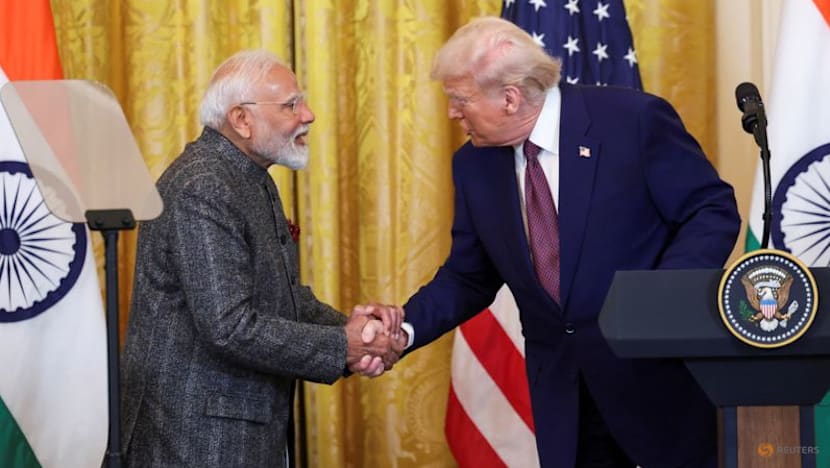
US President Donald Trump and Indian Prime Minister Narendra Modi shake hands as they attend a joint press conference at the White House in Washington, DC, US, Feb 13, 2025. (Reuters/Kevin Lamarque/File Photo)


SINGAPORE: It may not have quite dissipated like the “sea foam” it was once dismissed as by China, but the Quad is at best idling on the high seas.
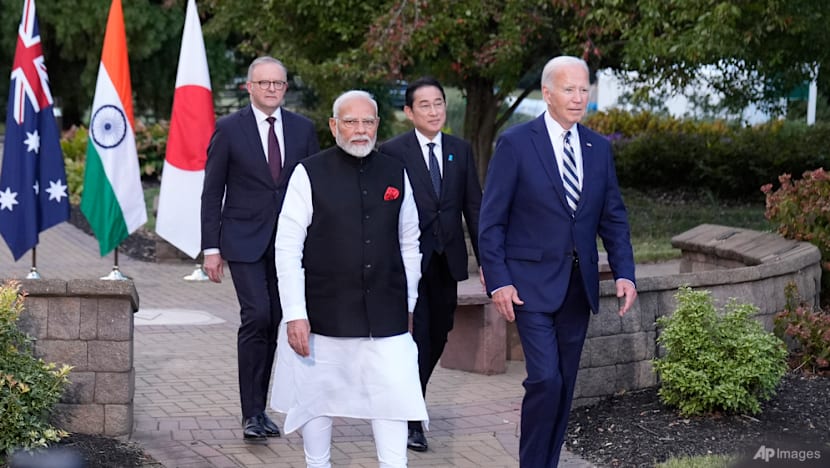
The last time leaders of the Quadrilateral Security Dialogue – India, Australia, Japan and the United States – met was in September 2024. A 2025 summit in India never materialised and there is still no sign of a top-level meeting taking place this year.
Instead, the four foreign ministers will be meeting in New Delhi in late May.
But in the absence of interest from US President Donald Trump, they may struggle to define their larger geopolitical purpose.





AN UNFORTUNATE TURN
It is an unfortunate turn for a grouping which once had the flavour of a nascent Asian counterpart to the North Atlantic Treaty Organization (NATO). Because the Quad does have compelling logic.
India does need the US – and vice versa – to counterbalance China. But the US has been disappointed that India has not stepped up as Washington thought it should: Rather than becoming a formal US ally, India has pursued a foreign policy of strategic autonomy. For instance, it maintains close relations with Russia.
As Japan’s new government takes a harder line on China amid a diplomatic crisis since last November, it may double down on the Quad to reinforce deterrence and its vision of a “free and open Indo-Pacific”.
For Australia, post the hesitant Kevin Rudd era, the Quad is significant strategically as it enables Canberra to reach beyond its traditional Anglosphere orientation to build ties and interoperability with other rising Asian powers.
NOT QUITE A SECURITY ALLIANCE
Mr Trump’s disinterest is not the only issue. Even if the underlying rationale has always been as a potential counterweight to China’s growing maritime strength and reach, the Quad has let that remain unstated.
It has instead been focusing on a non-controversial public goods agenda – disaster response and humanitarian assistance. That includes practical maritime law enforcement cooperation against piracy, drug trafficking, and illegal, unreported, and unregulated fishing.
Though they do hold joint naval exercises, including Operation Malabar hosted by India, individual Quad members have been hesitant at various times to upgrade the group into anything resembling a security alliance, mostly not to antagonise China.
India is, in one key respect, the odd one out, in that it is not a treaty ally of any of the other Quad countries. Australia and Japan are both formal allies of the US under separate mutual security agreements. In Japan’s case, the treaty commits the US to defending Japan if attacked.
India certainly has made it clear that it wants to manage its relationship with China, not pick a fight with it. And while New Delhi has been cautious not to offend the Trump administration, it also does not want to fully align with Washington, preferring to maintain agency in its foreign policy.

BUILT ON POLITICAL WILL AND PERSONAL TIES
This ambiguity has led to a stop-start trajectory for the Quad, showing how dependent it has been on political will and personal relationships, rather than institutional effort.
The grouping remained largely moribund until the first Trump administration reinvigorated it in 2017 at a senior official level, before the Biden administration elevated it to a leaders-led arrangement with regular summits.
Since 2024, it appears to be back to foreign minister-level meetings. A Congressional Research Service briefing for the US Congress earlier this month mentioned that the 2025 summit did not take place “possibly due to Trump-Modi tensions, or what one former US official called [Indian Prime Minister Narendra] Modi’s ‘obvious irritation with Trump and Trump’s apparent indifference to the group’.”
India-US relations have been rocky, with the coziness of the first Trump administration a distant memory. Only recently, in October 2025, has there been a small improvement with the two signing a new 10-year defence framework agreement designed to deepen cooperation in strategic technologies.


RISK OF INSIGNIFICANCE
But India’s Quad sceptics are not alone.
As US-China strategic competition has intensified, underlying tensions have become more obvious, with political ambiguity constraining the Quad’s development and joint projects, says Robert Manning, a distinguished fellow at the Stimson Center in Washington DC.
“Trump 2.0 casts a dark shadow over the Quad’s future as well as the perceived legitimacy of American power,” he told me. “The Quad’s current activities are a far cry from fantasies about an Asian NATO or any substantial collective security commitments. The Quad has not been able to figure out what it wants to be when it grows up.”
Mr Trump’s non-participation since his return to power in the White House in 2025 has left the Quad leaderless and degraded its geostrategic value, Derek Grossman, a professor of political scientist and at the University of Southern California, warned in an Apr 23 Foreign Policy article.
If the next Quad summit fails to materialise, the risk of the grouping’s geopolitical insignificance will deepen.


THE QUAD MUST OUTLAST INDIVIDUALS
And while the evolution and effectiveness of the Quad still depend on the level of American commitment and leadership, it is not necessarily a bad thing if the volatile and unpredictable American president skips Quad summits.
The scepticism is not unfounded, but the Quad can adapt, find direction and quietly progress and outlast the Trump administration.
To do so, however, it may need to move beyond personality-driven summitry and build a more enduring institutional architecture.
If not, it could still end up – as China’s Minister for Foreign Affairs Wang Yi famously remarked in 2018 – disappearing like “sea foam" in the vast oceans that it aims to connect.
Nirmal Ghosh, a former foreign correspondent, is an author and independent writer based in Singapore. He writes a monthly column for CNA, published every third Friday.