Commentary: Comparing the Straits of Malacca and Singapore to Hormuz is a fallacy
Comparing the Strait of Hormuz with the Straits of Malacca and Singapore is like comparing apples and oranges, say Collin Koh, Thomas Lim and Eric Ang from the S Rajaratnam School of International Studies.
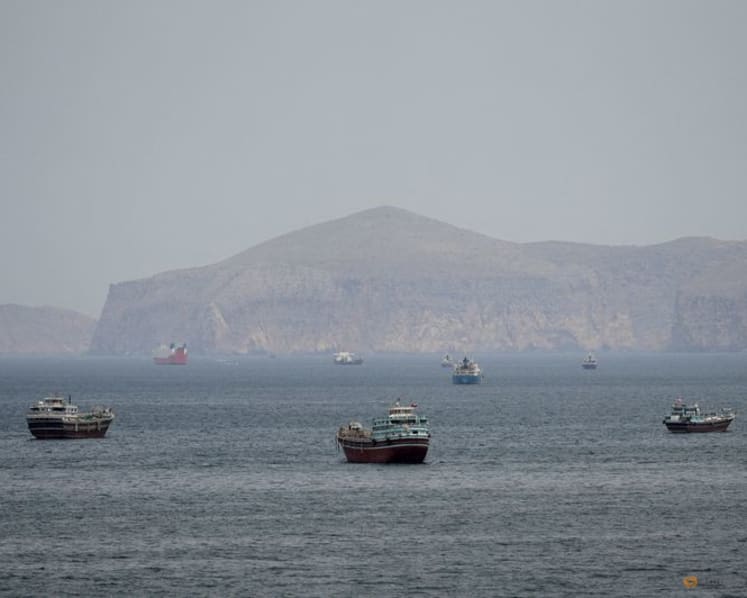
Ships and boats in the Strait of Hormuz, Musandam, Oman, Apr 22, 2026. REUTERS/Stringer/File Photo

This audio is generated by an AI tool.






SINGAPORE: When a spate of kidnap-for-ransom activities occurred in the Sulu Sea about a decade ago, a flurry of commentaries emerged to call the area between eastern Malaysia and the Philippines the “new Somalia”.
Ultimately, the Sulu Sea did not become the “new Somalia”. Instead, Indonesia, Malaysia and the Philippines established the Trilateral Cooperative Arrangement, which proved instrumental in suppressing illegal activities in the area.
Now, amid the Iran war, a commentary has emerged comparing the Strait of Hormuz with the Straits of Malacca and Singapore, noting that the Middle Eastern strait serves as a warning for the Indo-Pacific. But this comparison - like the attempt to draw parallels between the Sulu Sea and Africa’s Somalia, which are two distinctly different regions - is flawed.
DIFFERING GEOGRAPHIES
The Strait of Hormuz represents a singular outlet connecting the Persian Gulf and open waters of the northwestern Indian Ocean, primarily the Arabian Sea. Vessels prevented from transiting through the strait are practically stranded west of the waterway, without the possibility of re-routing. While land routes have been touted as potential alternatives, the logistical and political costs involved challenge their overall viability.
By contrast, the Malacca and Singapore straits, which form one continuous maritime shipping channel, are not the only waterways connecting the Indian Ocean and Pacific Ocean. In the event of a blockage, shippers can still re-route using other waterways in Southeast Asia, such as those running through the Indonesian archipelago.
Moreover, the operational frontage of any naval blockade targeting Hormuz differs from that of the Straits of Malacca and Singapore.
The first difference is that Hormuz represents a single-gate, narrow frontage. Any party seeking to block the strait would simply have to focus on this singular maritime chokepoint and sustain actions aimed at collapsing shipping activity through and around it.
By contrast, the Straits of Malacca and Singapore form part of a distributed network of maritime chokepoints that flow through Southeast Asia. An effective naval blockade attempt will, by default, have to be a much more expansive endeavour targeting these other waterways.
NO STRATEGIC LEVERAGE
In April, Indonesian Finance Minister Purbaya Yudhi Sadewa floated the idea of imposing a toll on ships passing through the Malacca Strait, adding that the idea was inspired by Iran’s plans to charge vessels through the Strait of Hormuz. But as quickly as he put forth the idea, Purbaya walked back on it, adding “if only that were possible, but that’s not the case”.
In any case, the offhand remark stirred up some controversy, prompting Indonesia’s Ministry of Foreign Affairs to reiterate the country’s adherence to the United Nations Convention on the Law of the Sea (UNCLOS) and that there is no plan to impose any toll.
The more important question is not whether littoral states of the Straits of Malacca and Singapore - chiefly Indonesia, Malaysia and Singapore - could impose restrictions, but whether they would have strategic incentives to do so.
Tehran has long viewed Hormuz as a source of strategic leverage. It has for years consistently issued open threats to block Hormuz, and it undertook militarised actions that demonstrated its resolve to that effect, long before the current conflict. Being no state party to the UNCLOS, Iran justified its action to restrict transits through Hormuz by claiming wartime-expedient coastal state controls on innocent passage through its territorial seas.
Yet, there is no Iran analogue in this region. Indonesia, Malaysia and Singapore are UNCLOS state parties, with no prior track record of issuing threats or physical acts in an attempt to control the Straits of Malacca and Singapore. All three countries derive their prosperity and legitimacy from keeping these very sea lanes open.
More importantly, even if such a policy were theoretically contemplated, enforcing it would impose enormous operational and political costs. Sustained interdiction across a roughly 900km-long corridor, either unilaterally or collaboratively, would divert significant assets and manpower from other pressing security priorities and undermine the very economic interests that the littoral states seek to protect. Unlike Iran, the littoral states of the Straits of Malacca and Singapore can ill afford the trade-offs in such maritime security reprioritisation.
GOVERNANCE DETERMINES RESILIENCE
Finally, the narrative projecting a Hormuz-like scenario on the Straits of Malacca and Singapore also fails to consider that while geography creates vulnerability, it is by no means destiny.
One key difference between Hormuz and the Straits of Malacca and Singapore lies in their governance architectures. Over the past two decades, Southeast Asian states have built layered cooperative mechanisms - including the Cooperative Mechanism, the Malacca Straits Patrols, ReCAAP, and the Information Fusion Centre - that create channels for information-sharing, coordination and deconfliction.
The Cooperative Mechanism, established in 2007 by Indonesia, Malaysia and Singapore and supported by other regional and international users, is a prime example. It envisages that the littoral states bear primary responsibility as coastal states to govern the waterway in areas such as navigational safety, while external parties provide financial and technical support.
Another initiative, the Malacca Straits Patrols, was promulgated in the wake of a scourge of piracy and armed robbery against ships in the waterway back in the early 2000s. Since then, the Malacca Straits Patrols have been instrumental in suppressing lawlessness in the waterway and demonstrated the ability of Southeast Asian countries, despite their differences, to jointly tackle a common security challenge.
The resilience of these governance architectures rests on more than formal agreements and institutional mechanisms. It is also sustained by trust networks built through decades of repeated interaction - exercises, patrols, professional exchanges, crisis coordination and routine day-by-day engagement - between naval officers, coastguard personnel, maritime administrators, diplomats, analysts and shipping stakeholders. Such relationships facilitate rapid communication during incidents and reduce the risk of miscalculation - a form of institutional capital with no parallel in the Hormuz context.
THE LESSONS THAT HOLD
Ultimately, the relevant comparison is not between two waterways, but between two governance systems shaped by different histories, incentives and patterns of cooperation.
Strategic behaviour is highly context-dependent: different legal, political and operational conditions can produce markedly different outcomes. Direct analogies between distinct maritime theatres risk obscuring the political conditions that actually shape state behaviour.
That said, this is not to suggest that developments in Hormuz hold no lessons for Southeast Asia. On the contrary, they underscore the importance of continually investing in regional mechanisms, information-sharing arrangements and cooperative frameworks that enhance resilience before a crisis emerges.
If anything, the present Hormuz crisis should serve as further impetus for Southeast Asia and its external partners to strengthen existing regional mechanisms and to overcome shared security challenges through cooperation, rather than competition.
Collin Koh is Senior Fellow at the S Rajaratnam School of International Studies (RSIS), based at Nanyang Technological University, Singapore. Thomas Lim is an Associate Research Fellow with the Military Studies Programme at RSIS. Eric Ang is a PhD student at RSIS, and a Research Fellow with the Yokosuka Council on Asia Pacific Studies.