Snap Insight: NDR 2026 - the real shift in family support goes beyond S$70,000 per child
The new measures move us toward treating child-raising as something to build and maintain collectively as a society, says Kalpana Vignehsa from the Institute of Policy Studies.


This audio is generated by an AI tool.


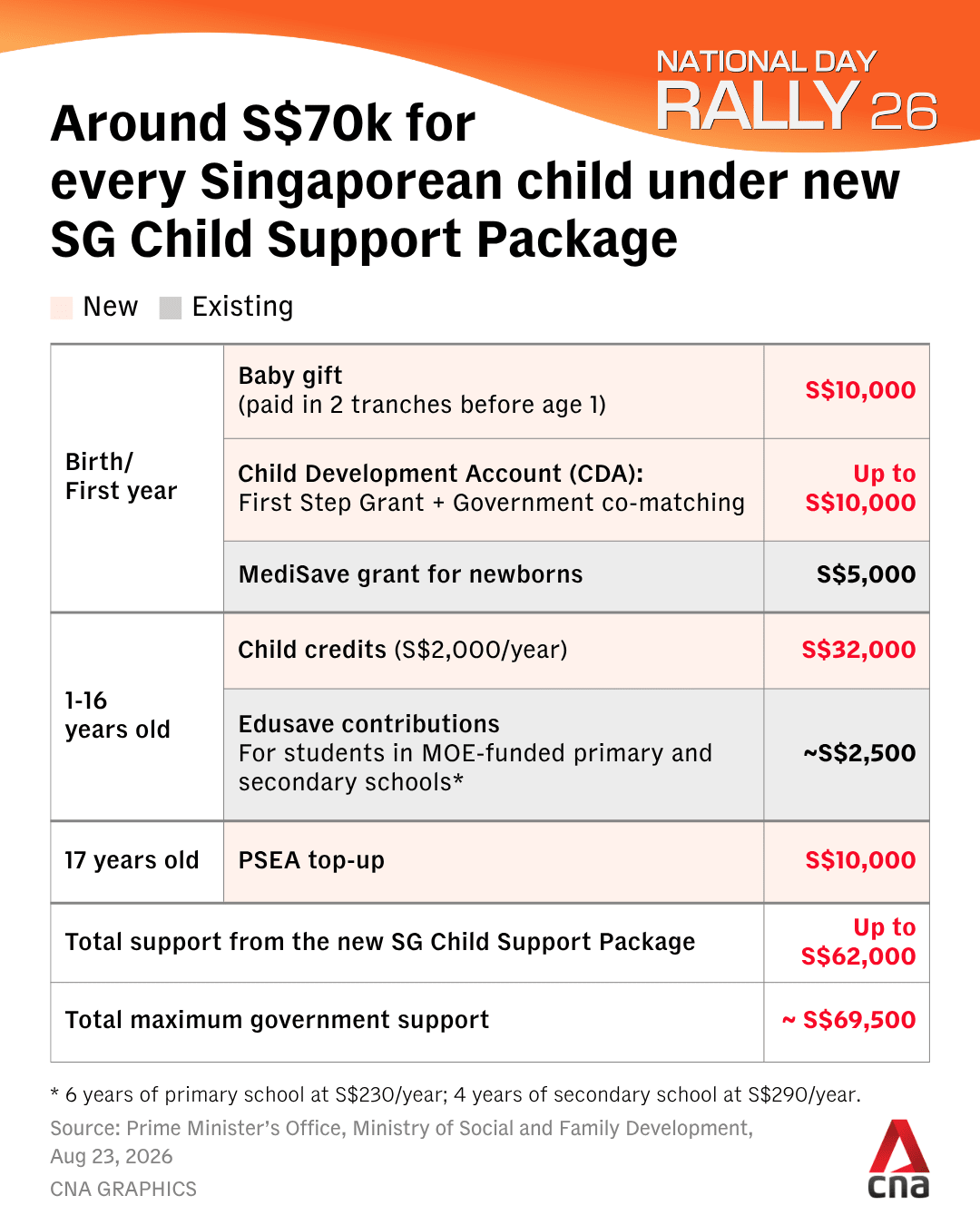
SINGAPORE: What should strike Singaporeans about the National Day Rally (NDR) is that the government is changing the logic of family support. The almost S$70,000 (US$55,140) in support for every Singaporean child is simply the most visible expression of the biggest overhaul of family policy in a generation.
On Sunday night (Aug 23), Prime Minister Lawrence Wong announced the new SG Child Support Package, including a S$10,000 Baby Gift in cash, S$2,000 a year for every child until they turn 16, subsidies that reduce the cost of childcare to S$150 a month and a post-secondary education contribution of S$10,000.
For decades, our policy stance treated child-rearing as a private undertaking. The costs of raising children were largely for parents to bear, with the state helping through grants and subsidies. That help was calibrated by birth order and concentrated around the early years.
As someone who studies how Singaporean families form and grow, I see the new measures moving us towards something different: treating the raising of children as social infrastructure - something built and maintained collectively because our whole society depends on it.





SHARING THE COST OF RAISING CHILDREN
Three shifts signal this reframing.
First, universality. Every Singapore Citizen child will now receive the same support under the new package, regardless of birth order. While the official narrative on marriage and parenthood packages has been to help families rather than address our historically low total fertility rate, it was still largely structured as an incentive ladder to encourage people to have more children.
Equalising the support while increasing the total amount does two things: It attaches the support to the child, rather than the parents’ decision to have another. And larger families will still naturally get more support overall.
Second, duration. Where support was more heavily front-loaded around birth and the early years, Child Credits now flow annually until 16, the Child Development Account runs to 16, and a further top-up arrives at 17 for post-secondary education.
With this, support becomes a more regular, predictable feature. It follows the timeline of raising children, recognising that the costs change rather than fade as children grow.
Third, who pays. All these help defray costs for parents, including the move to significantly cut fees at government-supported preschools. It is akin to how Singapore treats primary education, priced like a public utility rather than a market service.
Another significant move is to relieve employers of the costs of parenthood. The government will now reimburse all child-related leave in full, up to the cap, while childcare leave rises to between 8 and 12 days per parent, based on the number of children.
In footing the bill, the state removes employers’ excuse: If parents on childcare leave do not directly add to wage costs, an employer has fewer reasons to treat parents as costly hires, and the government rightly expects their buy-in for supporting parents in return.
THERE ARE STILL MISSING PIECES
But infrastructure is only as strong as its weakest links, and some remain unbuilt.
The first is time. Mr Wong highlighted this as something every parent wishes they had more of before announcing the increase in childcare leave.
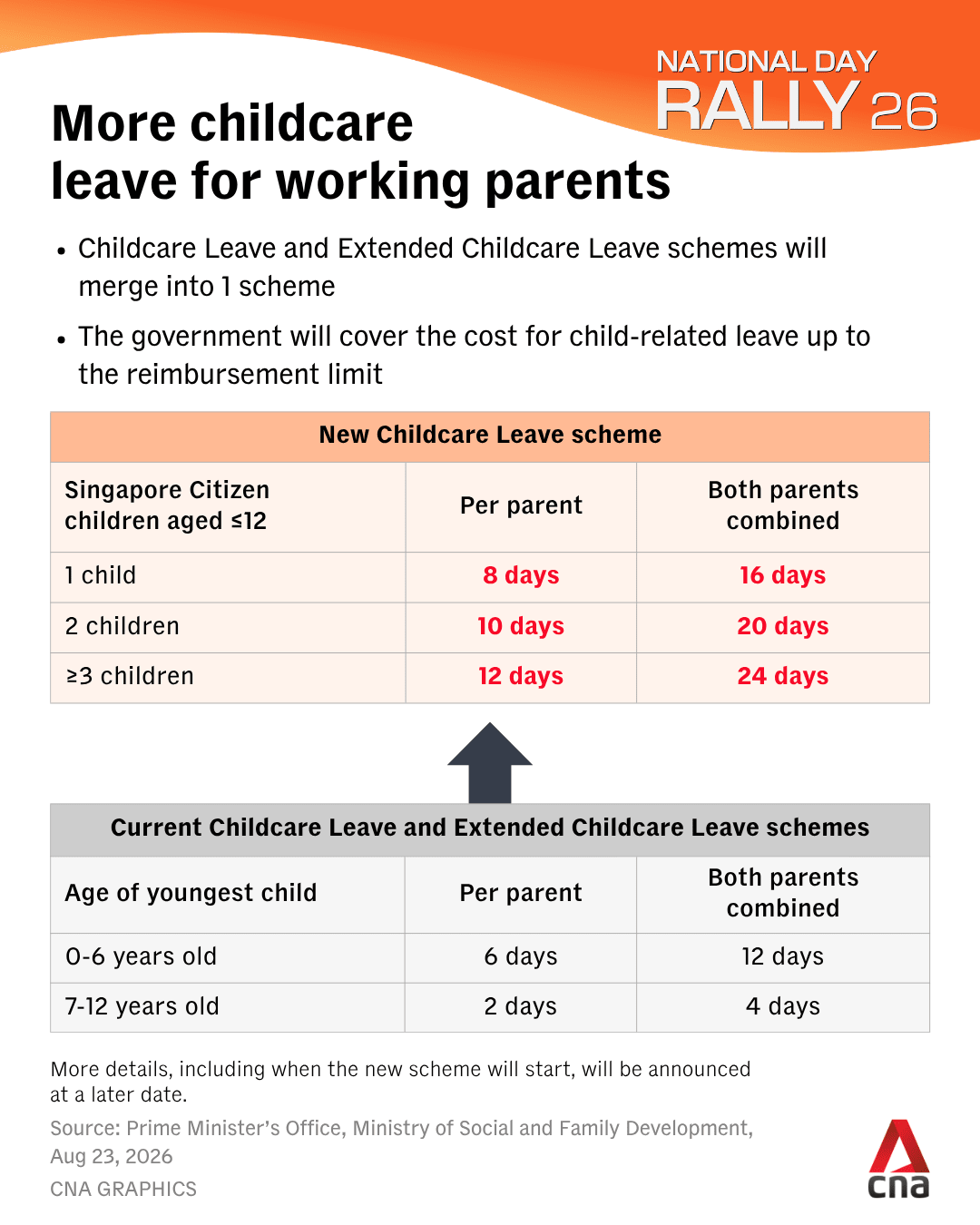
But Singaporean parents work some of the longest hours in the developed world, and raising a family demands mental bandwidth that no transfer can restore. Twelve days of childcare leave help, but the deeper determinant will still be workplace culture.
The signals there are concerning. Some employers have walked back even partial work-from-home arrangements, despite evidence that workplace flexibility boosts fertility intentions and especially matters to families with young children.
Employer practice can easily undo what policy builds; entitlements only become infrastructure when their use is unremarkable.
The second is the opportunity cost of providing care itself, which our system still treats as free. The heaviest costs of raising children in Singapore include foregone income from additional time taken out of the workforce, stalled careers and lower retirement savings, borne mostly by mothers.
Grandparents absorb the same penalty when they cut hours or retire early to cover care gaps, with little recognition beyond a modest tax relief that accrues to the working mother rather than to them. The NDR package does not touch this gap.


If child-rearing is infrastructure, the people providing the care are the ones running it - and their labour has to count.
The Marriage and Parenthood Reset Workgroup has promised fuller recommendations in early 2027. The test is whether the next tranche extends this infrastructure to time, to careers, and to the village of people beyond the nuclear household who hold up family life.
This National Day Rally laid the foundations. What matters now is what we build on them.
Kalpana Vignehsa is a senior research fellow at the Institute of Policy Studies, National University of Singapore.