Commentary: Why the central kitchen model for school meals works for my family
For Yong Qiao Qing, the new central kitchen model means that her child, who is born with multiple allergies, can finally enjoy the same food as her classmates.
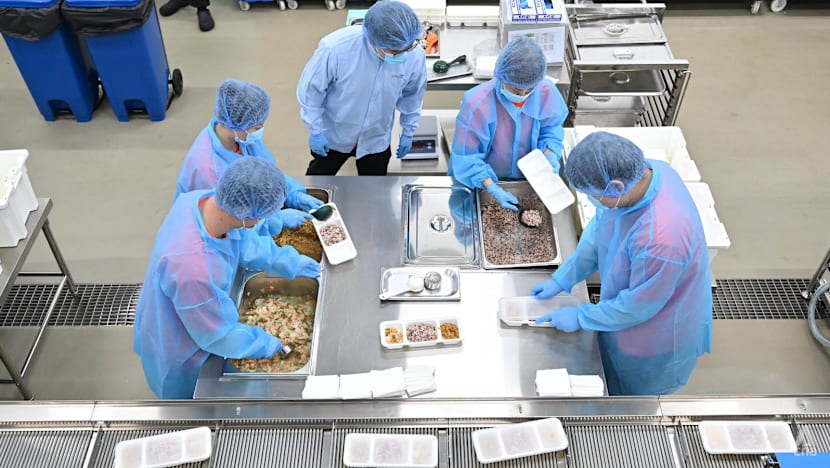
Staff at Wilmar's central kitchen packing bento meals for schools on Jan 14, 2026. (Photo: CNA/Raydza Rahman)

This audio is generated by an AI tool.


SINGAPORE: When it was announced that a new central kitchen model would be rolled out in 13 schools this year, there was a wave of dismay.
Some were unimpressed with the appearance of the catered meals and the lack of variety. Others lamented the loss of opportunities for children to learn budgeting and financial skills.
But my family was excited about the change because it meant we would finally be able to know which dishes were safe for our children.
Both my children were born with multiple allergies. Some allergens cause milder reactions like hives and eczema, but there are others that trigger severe effects such as vomiting, restricted breathing and pain along the digestive tract. To keep them safe, I have been packing all their meals – recess, snacks and lunch – every weekday since they started school.





My children are not alone. According to Dr Mohana Rajakulendran, a paediatrician who specialises in food allergies and eczema, around 5 per cent of children in Singapore have diagnosed food allergies.
This means in every class of 30 to 40 children, at least one child would have a food allergy that might not allow them to consume food from traditional canteens that do not display allergen information.
The most common food allergies among children in Singapore are milk, egg, peanut and seafood, including shellfish. “While seafood allergy is more common in older school-going children and adolescents, there has also been an increasing trend of peanut allergy locally,” Dr Rajakulendran told me.
With the new central kitchen model in place at my child’s school, I can review the menu ahead of time and decide if there is a safe option for her. I love hearing the joy in her voice when she says she can finally enjoy the same food as her classmates.
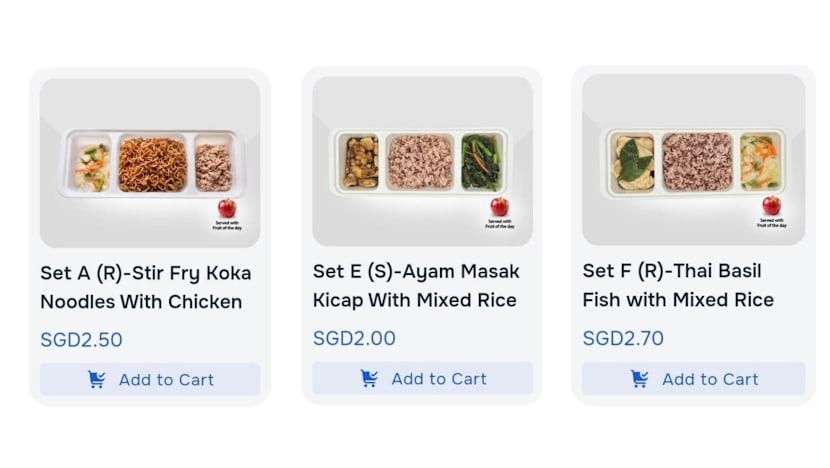
HEALTHY FOOD THAT’S VALUE FOR MONEY
When images of the canteen meals prepared by central kitchens surfaced online, some netizens had likened them to hospital meals.
So far, I’ve only seen the meals through photos on the online ordering system, and my child says the actual dishes look very much like what is shown.
My child’s main complaint is that she misses “normal” pasta and white rice, as only multi-grain versions are served. Since then, I’ve been gradually introducing brown rice and grains like quinoa and buckwheat into our family meals, so we can all get used to eating whole grains.
I also find myself hiding my delight when my child grumbles about having a large portion of vegetables. In that sense, this shift to a central kitchen model may be the start of healthier eating habits.
For a serving that includes carbohydrates, vegetables and protein, the meals – which cost S$2 for a small portion and S$2.50 to S$3 for a regular portion – are also good value for money.
Compare this with my child’s previous favourite dish – a S$1.80 tomato sauce macaroni from a stall at the school canteen, one of the few safe options available for her. Still, it was a small plate of pasta, stir-fried in tomato ketchup with a few slices of canned button mushrooms alongside three stalks of chye sim. Cheese powder was available at an extra cost. The meals she now receives definitely offer better nutritional value for what we pay.
WEIGHING THE GOOD AND THE BAD
At the start of the year, students from a primary school were reported to have gastroenteritis symptoms after having lunch provided by the school’s central kitchen meal model operator. There were also reports of teething issues, such as technical glitches that left some children without meals. Thankfully, we have not encountered such problems.
The only hiccups we’ve experienced were when we forgot to pre-order meals for the week ahead. As orders have to be placed minimally two working days in advance, last-minute orders are not possible. For example, by Sunday, we would only be able to order meals for Wednesday.
To cater to those situations, the central kitchen operator offers hot food for on-site purchases. There is also a drink stall in the canteen that still sells snacks and light bites like steamed buns, making sure that students won’t go hungry.
The only drawback is that on days when my child is unwell and unable to attend school, the meals that we have paid for would go to waste, much like fees paid for school bus and student care services.
Certainly, with an online ordering system, our children lose a valuable opportunity to learn how to count and budget. But we cannot insist our children learn skills the way we did. Instead of looking back, we must find new ways to involve them in monetary matters and teach them financial accountability. Just as how we adapt to generative artificial intelligence in our lives.
This is the same for the fond memories we have of our traditional school canteens.
The days of squirrelling away pocket money to spend on treats like the seasoned seaweed packets sold by kind aunties who called everyone “Ah Boy” and “Ah Ger” still serve as memories of the good old days, yet we need to recognise that one generation’s nostalgia has not been able to provide a sustainable business model for the changing times. Nor can it protect a child with a life-threatening allergy.
The shift towards a central kitchen model has been a step towards healthier eating habits and inclusivity for all dietary needs, and I am all for it.
Yong Qiao Qing raises two daughters with allergies and is the founder of Little Warriors, an online business that specialises in clothes for children with sensitive skin.