The Onitsuka Tiger story: From an octopus-inspired sole to a Nike link
Onitsuka Tiger's predecessor, Onitsuka Co, was founded in post-World War II Japan and produced basketball shoes as its first athletic footwear.


This audio is generated by an AI tool.


SINGAPORE: Japanese brand Asics announced on Wednesday (Jun 10) that it would spin off its nearly 80-year-old Onitsuka Tiger business amid a surge in demand for its retro-inspired sports shoes.
The Onitsuka Tiger business will be transferred to OT Group, a wholly owned subsidiary, in a company split “aimed at speeding up decision-making and boosting the brand’s global competitiveness”, Asics said.
From the origins of the iconic stripes to the eight-armed source of inspiration for Onitsuka Tiger's first-ever shoe, here are some things about the brand you may not know.
INSPIRED BY AN OCTOPUS
The Onitsuka brand started out in 1949, built on founder Kihachiro Onitsuka’s belief that “sports have the power to change people’s lives”, according to the Onitsuka Tiger website.
It was established in the post-World War II era with the aim of contributing to the development of Japan's youth and rebuilding a better future for them.
Mr Onitsuka had his eye on infiltrating the basketball shoe market, but was met with limited success initially.
The eureka moment that finally propelled Onitsuka’s breakthrough into the sports shoe market was unlikely - and delicious.





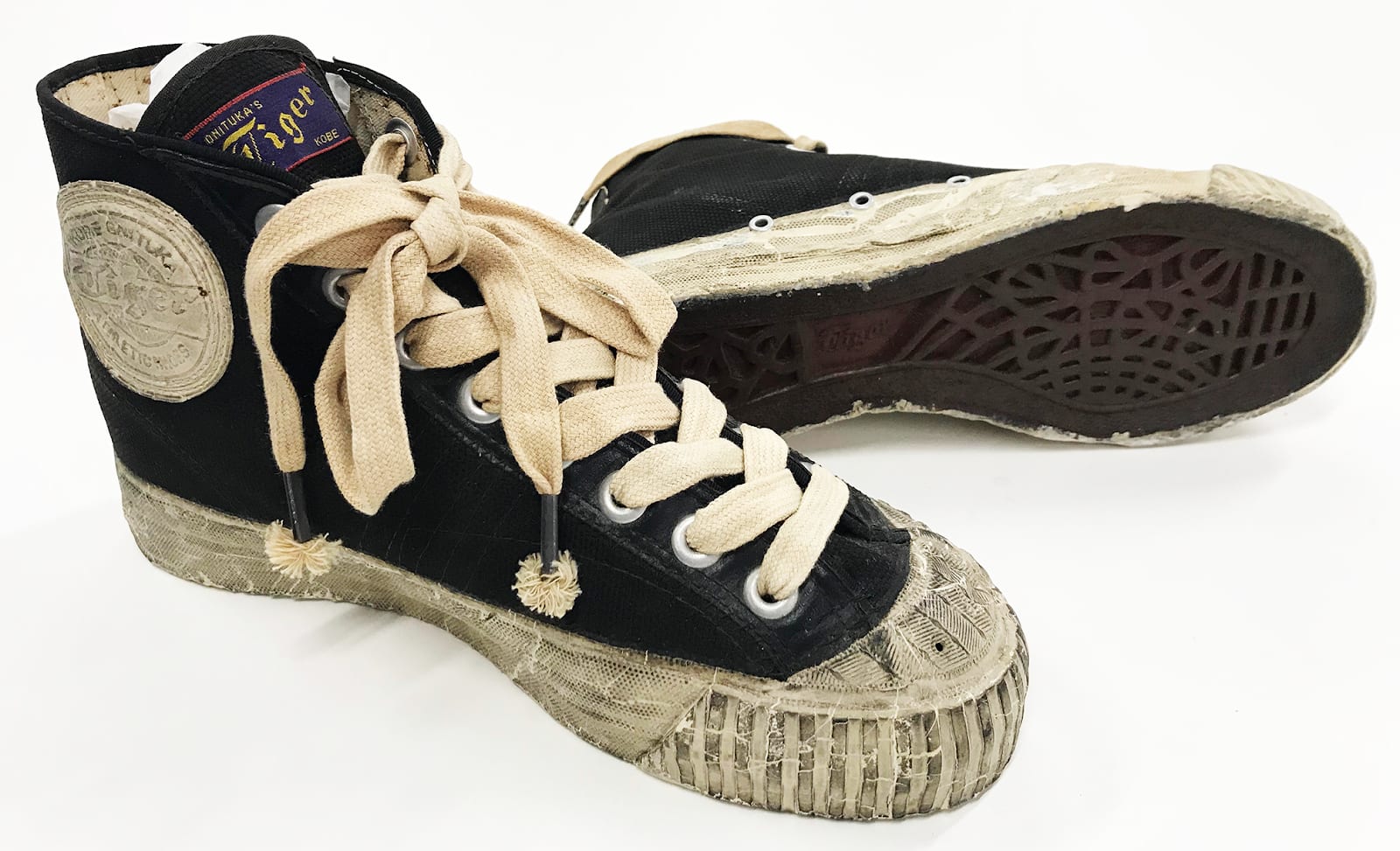
In 1951, during what was an otherwise normal meal, an octopus tentacle served to Mr Onitsuka got stuck to a salad bowl.
He realised that the suckers on the creature’s tentacles gave it a strong grip - precisely what he needed for basketball shoes, which had to allow players to stop and start, and also to change directions quickly.
That moment of inspiration led to Onitsuka’s breakthrough product: the 1951 OK basketball shoe, with octopus-inspired dimpled soles. The first high school team to adopt Mr Onitsuka’s shoes won a local championship.
THE NIKE-ONITSUKA CONNECTION
In the late 1950s, following Onitsuka shoes’ debut in international competitions, the company began gaining international attention.
American middle-distance runner Phil Knight, protege of top coach and avid shoe experimenter Bill Bowerman, travelled to Japan and contacted Onitsuka Co to convince the management that Onitsuka shoes would find a market in the US.
In 1963, Onitsuka Tiger sent its first shipment of shoes to the US. To distribute the shoes, Knight and Bowerman each invested US$500 to create Blue Ribbon Sports.
But the partnership later soured, with Knight and Bowerman severing ties with Onitsuka in the 1970s and eventually rebranding as Nike, the sportswear giant we know today.

THE ICONIC MEXICO 66
The brand’s signature cross-stripes, also known as the Tiger Stripes or Mexico line, were introduced in 1966 after an in-house design competition.
They appeared on the Limber Up Leather BK shoes, designed for Japan’s national team ahead of the 1968 Olympics in Mexico.
The stripes have since become a hallmark of Onitsuka Tiger and Asics shoes, while the model was later renamed the Mexico 66 in a nod to the year of its creation and debut at the Mexico Games.
The stripes were not just for aesthetics. They reportedly began as leather reinforcements that supported the flimsy, unstructured canvas uppers of running shoes.
The Tiger Stripes would go on to be trademarked and become synonymous with the Onitsuka Tiger brand.
IMMORTALISED ON SCREEN
Onitsuka’s striped shoes then surged in popularity after Hong Kong martial arts legend Bruce Lee wore a black-and-yellow pair resembling the Mexico 66 in his unfinished 1972 film Game of Death.
While he did not sport them on screen, Lee did wear Onitsuka Tiger shoes on set and was regularly pictured in them.

The shoes received a second boost and shot to the apex of the fashion scene in the 2000s thanks to Uma Thurman.
Starring in Quentin Tarantino’s hit film Kill Bill, Thurman appeared on screen sporting a pair of yellow Onitsuka Tiger shoes adorned with its iconic black stripes, paying homage to Lee’s Game of Death.
Following the boost in sales, Onitsuka Tiger opened 23 standalone boutiques in Japan and launched stores in Hong Kong, Seoul, Paris, Berlin and London.

ONITSUKA, ASICS AND BEYOND
In 1977, Onitsuka merged with two other companies - GTO Co and JELENK Co - to form the Asics Corporation, a general sporting goods company. As a result, the standalone Onitsuka brand was retired.
The company’s name, Asics, is an acronym of the Latin phrase “Anima Sana In Corpore Sano” by ancient Roman satirist Juvenal, meaning “a sound mind in a sound body”.
“The phrase itself is the company philosophy, and the sentiment it expresses is captured in the very name of the company,” Asics said in its company’s history archive.
Onitsuka Tiger was relaunched in 2002 amid a global vintage sneaker boom, marking the start of its expansion into the sports style market.
Models like the Mexico 66, Ultimate 81 and Nippon 60 were re-released under the brand revival.
Following the shoes, a full lineup of Onitsuka Tiger-branded apparel and accessories was also rolled out.
In recent years, Onitsuka Tiger has been a key growth driver in Asics, with sales of the brand jumping 43 per cent from a year earlier to 136.5 billion yen (US$851 million) in 2025.
In their announcement of the spin-off, Asics said, “Onitsuka Tiger has already established a solid and independent brand position and there's not much domestic competition. The spin-off is unlikely to erode Asics’ core business."