Shares and bonds surge, oil slides on Iran deal
The Federal Reserve is widely expected to leave rates at 3.50 per cent to 3.75 per cent on Wednesday at Chair Kevin Warsh's debut meeting.
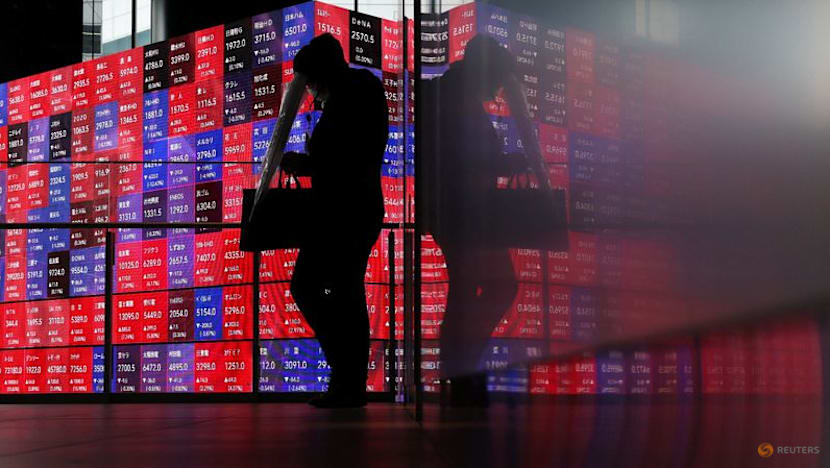
A man walks in front of an electronic screen displaying Japan's Nikkei stock prices quotation board inside a conference hall in Tokyo, Japan on Apr 27, 2026. (File photo: Reuters/Issei Kato)
SYDNEY: Share markets and bonds rallied hard on Monday (Jun 15) and oil prices tumbled 5 per cent as a framework peace deal between the United States and Iran promised to ease inflationary pressures globally and lessen the need for higher interest rates.
Europe's early optimism drove both the STOXX 600 and FTSE Eurofirst to records.
Asia's biggest markets had all leapt overnight, while futures markets pointed to gains of 1.3 per cent to 2 per cent for Wall Street later.
Early on Monday, Pakistani Prime Minister Shehbaz Sharif said on social media that an Iranian peace deal had been struck, while President Donald Trump said the agreement included opening the vital Strait of Hormuz, though without giving details.





Trump will meet with Middle Eastern leaders and attend a working session with Ukrainian President Volodymyr Zelenskyy during a G7 summit in France this week.
Iran said traffic through the strait would be regulated by it and Oman, a potential blow to the rules of free trade that suggests there might be a toll of some sort on shipping.
Saxo Bank strategist John Hardy said the peace deal was "about as supportive as you can get" for markets, especially after the excitement triggered by the recent record-breaking US$75 billion SpaceX IPO.
"What do you add on from here to get sentiment even bubblier?" he said.

The news will be a relief for the crowd of central banks meeting this week, easing some of the pressure to tighten policy to head off an energy-driven rise in inflationary expectations.
Markets had already priced in a likely deal, but the confirmation was enough to send Brent crude down 5 per cent to US$83 a barrel, well off its May peak of US$126.41, albeit still above the US$67 that it traded before the war began in late February.
"We see Brent oil futures falling to US$80 by the end of the year, assuming the strait does not close again," said Vivek Dhar, a mining and energy analyst at CBA.
"Our forecast implicitly assumes that oil and refined product exports can resume quickly through the Strait of Hormuz, but this view carries considerable uncertainty tied to the damage to oil and refinery assets."
The prospect of cheaper oil will be a boon to Japan, which is a net importer of energy.
Overnight, the Nikkei had surged 5 per cent. South Korea's red-hot market gained 5.2 per cent, and Chinese blue chips firmed 1.4 per cent.
MSCI's broadest index of Asia-Pacific shares outside Japan rose 2.4 per cent.
RELIEF FOR CENTRAL BANKS
Central banks are due to meet in the US, UK, Japan, Australia, Switzerland, Sweden, Norway and Russia this week, with Japan considered the one likely to lift rates this time.
The Federal Reserve is widely expected to leave rates at 3.50 per cent to 3.75 per cent on Wednesday at Chair Kevin Warsh's debut meeting.
The statement, economic projections and news conference will be scrutinised for any signals of the Fed dropping its easing bias as officials grow more hawkish on inflation risks.
Saxo Bank's Hardy said the change of hands was set to be the biggest at the world's most influential central bank since Ben Bernanke succeeded Alan Greenspan in early 2006.
"The whole communication strategy is going to be completely different under Warsh," he said. "They are going to hold their cards a lot closer to their chest."
Investors were quick to trim the chance of a Fed hike this year, with December futures edging up four ticks, while a move as early as October is now priced around 30 per cent.

Treasuries rallied on hopes that oil prices would now fall sustainably and lessen the upside risks for inflation.
Yields on 2-year notes dropped 6 basis points to 4.02 per cent. The equivalent two-year German yield, sensitive to European Central Bank interest rate expectations, also fell 4 basis points to a two-week low of 2.571 per cent.
The drop in yields and general improvement in risk pulled the US dollar broadly lower, with the euro rising 0.4 per cent to US$1.1617, while sterling rose 0.3 per cent to US$1.3446.
The dollar fared better on the yen at 160, which is stuck in a bear trend even though the Bank of Japan is expected to raise rates by 25 basis points to 1 per cent on Tuesday.
The Bank of England (BoE) is expected to hold rates at 3.75 per cent on Thursday and through 2026, with policymakers seen in no rush to tighten. The BoE's vote split and monetary policy report will be of interest.
Top-tier British data includes May inflation and retail sales, and April employment. Thursday's Makerfield election will also be watched, as a win for Labour Mayor Andy Burnham could set up a leadership contest against Prime Minister Keir Starmer.
In commodity markets, the drop in yields helped non-interest-paying gold climb 2.5 per cent to US$4,322 an ounce, while in the cryptomarkets, bitcoin was also 2.5 per cent higher, at US$65,633.