With world leaders’ ‘abysmal failure’ to uphold global order, ASEAN holds lessons: Timor-Leste president
President José Ramos-Horta also called on the Southeast Asian grouping to have the “audacity to declare the South China Sea a zone of peace” in a special address at the Shangri-La Dialogue on May 30.
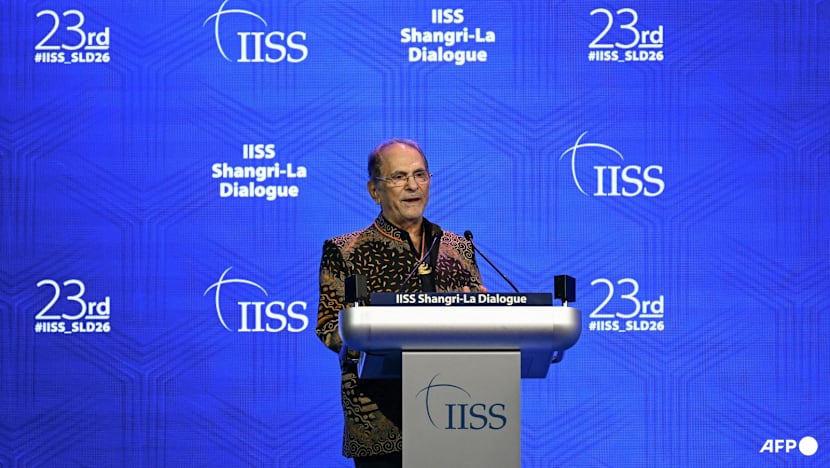
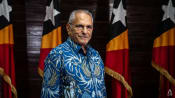
Timor-Leste President José Ramos-Horta delivers a special address during the 23rd Shangri-La Dialogue in Singapore on May 30, 2026. (Photo: AFP/Jam Sta Rosa)

This audio is generated by an AI tool.


SINGAPORE: Amid a fraying global security order, the Association of the Southeast Asian Nations (ASEAN) offers a model on how “patient practical diplomacy” can transform conflict into cooperation, said Timor-Leste President José Ramos-Horta in a special address at this year’s Shangri-La Dialogue on Saturday (May 30).
“In a world where bridges are burned faster than they are built, ASEAN provides lessons on how sustained dialogues (and) engagement can safeguard against conflict and deliver shared benefits,” he said.
“These are the thoughts of despair and hope that came to me as I watched the abysmal failure of global leadership resulting in devastating wars in Ukraine, Gaza, Lebanon, Iran … consequences of which reverberate across the world.”
Speaking to an audience of defence ministers, military leaders and senior officials from more than 40 countries, Ramos-Horta described the United Nations (UN) Security Council - a major global body for maintaining international peace and security - as “moribund” and “irrelevant”.
“It is a sad mirror of the state of the world today,” he added.
Expanding the council’s membership or curbing the veto powers of its five permanent members - namely China, France, Russia, the United States and the United Kingdom - still falls short of rendering it as an “effective, credible guardian of international security”, he added.
“We require much more than that … We all routinely speak of preserving the rules-based order but rules do not survive because they are printed in charters. They survive because states show restraint, consistency, and dialogues to resolve grievances,” he said.
UN Secretary-General António Guterres has previously called for reform of the UN Security Council, including expanding the number of permanent members.





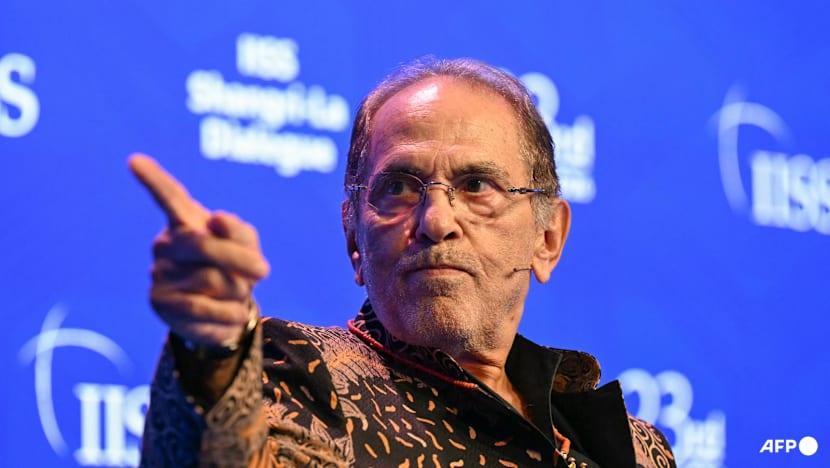
Sustained security cannot be built through coercion and fear, Ramos-Horta said on Saturday, warning that if the most vulnerable people in the country suffer harm, confidence in the international laws and institutions designed to prevent and resolve wars would be eroded.
“When rules appear to protect some and not others, small states begin to wonder whether the language of order is really only the language of power,” he said in his 15-minute address.
“HISTORY MUST NOT IMPRISON NATIONS”
Drawing on his country’s own experience, Ramos-Horta said that Timor-Leste’s independence from Indonesia in 2002 was built through “years of patient and practical diplomacy” involving multiple actors, including the UN and Indonesia, which “gradually turned all wounds into new bonds”.
Timor-Leste - previously known as East Timor - was a Portuguese colony for over 400 years before briefly declaring independence in November 1975.
Nine days later, Indonesia, whose East Nusa Tenggara province makes up the western half of Timor island, invaded and occupied the territory.
That sparked a decades-long resistance movement in East Timor, and an inquiry later estimated that 102,800 people died between 1974 and 1999 during the conflict.
It was only when BJ Habibie became Indonesia’s president that a referendum for Timor-Leste’s self-determination was held in August 1999, in which the majority of Timorese voted for independence.
“We show that history need not imprison our hearts and minds. History must not imprison nations,” he said, adding that the close ties between Timor-Leste and Indonesia today is “a model of reconciliation and partnership”.
“Wise leadership and dialogue can turn conflict into coexistence, coexistence into friendship and trust,” he said.
He added that ASEAN offers a “good example”, having emerged from a region marked by colonial scars, wars among Indochina countries and past Cold War rivalries, rather than a “tranquil epoch”.
Both the experiences of Timor-Leste and ASEAN, Ramos-Horta said, hold key lessons for “patient, practical and effective diplomacy”.
“ASEAN’s achievement in this respect is not that it made all countries seem alike. It has not erased differences … it created habits of cooperation despite those differences,” said the Nobel Peace Prize laureate.
Ramos-Horta highlighted ASEAN’s Treaty of Amity and Cooperation which affirmed principles which he said “sound simple but were revolutionary when practised”.
Core principles in the legally-binding treaty on inter-state relations include mutual respect for the independence and sovereignty of all nations, settlement of disputes by peaceful means and a renunciation of threats or the use of force.
“The resulting trust between ASEAN nations has delivered vast mutual benefits,” he said.


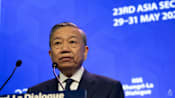
Through various meetings and agreements, the Timor-Leste president said ASEAN has shown that it can be constructive.
“It has shown that dialogue can become trade, trade can become interdependence, interdependence can become a shared interest in peace,” he added.
“It planted a banyan tree and under its foliage, leaders gathered and plotted the end of wars.”
ASEAN “NOT HEAVEN ON EARTH”
However, Ramos-Horta acknowledged that ASEAN is “not heaven on earth”, referring to the Myanmar conflict and tensions in the South China Sea due to overlapping territorial claims by numerous ASEAN countries and China.
“Achieving consensus is frustratingly slow, diplomacy can disappoint. Disillusionment can produce cynicism,” he said.
On the South China Sea, Ramos-Horta said that apart from a code of conduct being negotiated by ASEAN and China, “someone must have the audacity” to declare it “a zone of peace”.
“Not necessarily that everyone (member states) has to abandon their legitimate historical legal claims, but do not allow these claims to freeze initiative that would, in fact, gain for everybody more confidence, and then lessen tensions.” Ramos-Horta added.
ASEAN member states and China are currently engaged in negotiations of the Code of Conduct in the South China Sea (COC), which commenced in March 2018.

Ramos-Horta also described the Myanmar civil war as a “stain on ASEAN’s otherwise impressive catalogue of successes”.
In response to questions from forum delegates later on Saturday, he described ASEAN’s Five-Point Consensus as a “solid principle” but said different parties must come together to have a “substantive conversation” on how to improve the humanitarian situation.
The 76-year-old Timor-Leste president noted that it “seems like no one is going to win in the battlefront”.
The five points, agreed during a meeting between ASEAN leaders in April 2021, include the immediate cessation of violence and the commencement of constructive dialogue among all parties.
“It is a war of exhaustion, ruining the whole country, economy and people,” he said during the question-and-answer segment.
“Could they come together, all of them - the Tatmadaw (armed forces) and all leaders of the ethnic armies and democratic opposition - under a tent? No preconditions, no agenda, just meet as human beings.”
Myanmar has been in turmoil since its military overthrew an elected civilian government and triggered pro-democracy protests in early 2021 that morphed into a widening rebellion and conflict.
Ramos-Horta’s address came less than a year after Timor-Leste was formally admitted as ASEAN’s 11th member at the bloc’s summit last October, after more than a decade of efforts to join.
The region’s youngest nation formally applied to join ASEAN in 2011 during Ramos-Horta’s first presidency from 2007 to 2012.
It was only in November 2022 during the ASEAN chairmanship of Cambodia - and months after Ramos-Horta began his second term as president in May 2022 - that the 10 ASEAN countries agreed in principle for Timor-Leste to join and granted it observer status.
In an exclusive interview with CNA last year, Ramos-Horta had said the country hoped to contribute to strengthening the grouping’s mechanisms, including those for conflict prevention.
Established in 2002, the Shangri-La Dialogue is the premier defence and security conference in the Asia-Pacific region.
More than 550 delegates attended the three-day security summit at Shangri-La Hotel.