Singapore ‘increasingly’ seeing people from ‘different parts of Malaysian society’ wanting to intervene in its politics, policies: Shanmugam
Malaysian activist Fadiah Nadwa Fikri – who was refused entry to Singapore on Mar 22 – had “incited” activists in Singapore to break the law and use violence, said Singapore’s Coordinating Minister for National Security K Shanmugam.

This audio is generated by an AI tool.
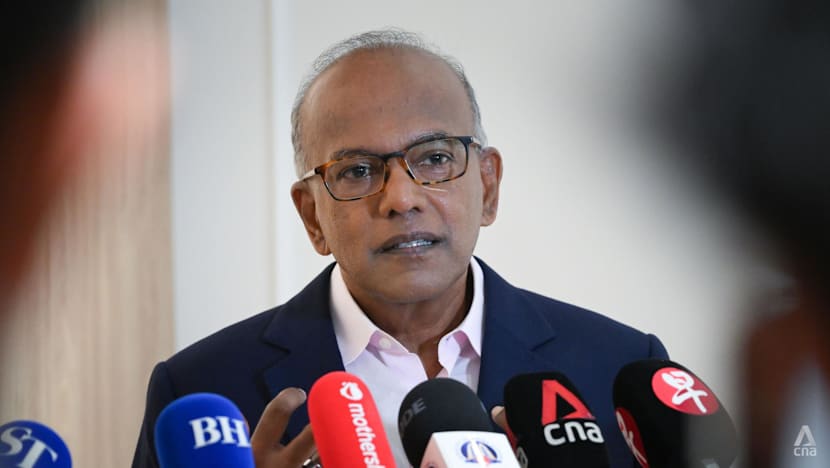
SINGAPORE: Malaysian activist Fadiah Nadwa Fikri, who was denied entry to Singapore, had incited local activists to break the law and use violence, Home Affairs Minister K Shanmugam said on Saturday (Mar 28).
He added that Singapore is increasingly seeing people from Malaysian society wanting to intervene in the country’s politics and policies.
“Increasingly, we are seeing persons from different parts of Malaysian society wanting to intervene. In our politics. And in our policies - the penalties we impose for some criminal offences, our foreign policy, and in some of the ways Singapore organises itself,” Mr Shanmugam said in a Facebook post.
“Singapore’s position on this has been consistent since 1965 - such interference is unacceptable. It is an absolute no,” he added.
“That position has not changed - and it will be firmly enforced.”
His comments came a day after the Ministry of Home Affairs confirmed that Ms Fadiah was refused entry to Singapore earlier this month, calling her an “undesirable visitor”.
She was a PhD student at the National University of Singapore’s Southeast Asian Studies department and was awarded her doctorate in January.
Mr Shanmugam said Ms Fadiah used to visit Singapore regularly.
“She encouraged local activists to adopt her brand of radical advocacy. Incited them to break the law and use violence,” he said.
“When people attempt to interfere in this manner, we will act decisively. It does not matter whether the instigator is Singaporean, Malaysian, or any other foreign national.”






Ms Fadiah said she was stopped at the Woodlands immigration checkpoint on Mar 22. According to her Instagram post, she had been invited by her former supervisor to deliver a guest lecture on her PhD thesis.
She described her scholarly work as examining the intellectual history of decolonisation and anti-imperialism.
After failing to pass through the automated gate, she was told she was not allowed to enter the country and would be deported.
ICA’s purported notice of refusal of entry, which she posted online, stated she was “ineligible for the issue of a pass under current immigration policies”.
In a response on Friday evening to MHA’s statement earlier that day on refusing her entry to Singapore, Ms Fadiah had said the MHA’s statement was “malicious, false and defamatory”.
She added that Singapore’s MHA had “provided no evidence to support these allegations”.
At NUS, she received two graduate teaching awards and presented her scholarly work at academic institutions within Southeast Asia and beyond, as well as on various public platforms, Ms Fadiah added.
In the final year of her candidature, she was awarded a teaching fellowship by the College of Humanities and Sciences, NUS.
“The only plausible explanation for these acts of repression is that I, as a scholar of Southeast Asian Studies whose work examines the intellectual history of decolonisation and anti-imperialism in Malaya/Malaysia, Singapore, and the broader region, am being targeted for my role and responsibility as a scholar,” she stated.
MALAYSIAN PARTY IN SPOTLIGHT PREVIOUSLY
In a speech on the politicisation of race and religion in Parliament last October, Mr Shanmugam said Malaysian politicians from the Islamist Parti Islam Se-Malaysia’s (PAS) had urged Singaporeans to vote along racial and religious lines in the country’s general election last May.
In the lead-up to the May 3 polls, MHA and the Elections Department said the authorities had identified a number of foreigners trying to influence the election, and blocked access to several Facebook posts.
The posts were by PAS national treasurer Iskandar Abdul Samad and its Selangor Youth chief Mohamed Sukri Omar, Mr Shanmugam said.
The posts had expressed support for Singapore’s Workers’ Party candidate Muhamad Faisal Abdul Manap, who contested in Tampines group representation constituency, and claimed the ruling People’s Action Party’s Malay-Muslim Members of Parliament could not be trusted.
In response to Mr Shanmugam’s remarks, PAS rejected what it called an attempt to cast it as “a convenient bogeyman to advance domestic political agendas in Singapore”.
“Do not manufacture enemies where none exist,” said PAS secretary-general Takiyuddin Hassan in a statement on Oct 15.
The next day, MHA quoted extracts of Mr Iskandar’s comments and noted Mr Mohamed Sukri had re-posted a social media post which stated that PAP’s Malay-Muslim Members of Parliament could not be trusted.
“This was a serious interference in Singapore’s elections,” MHA said.
“We recognise that foreigners may have views and are entitled to comment on Singapore’s policies and politics. The foreign media do so regularly,” it said.
“But the Singapore Government will not stand by if a foreign actor attempts to influence Singaporeans for its own purposes, especially by rousing racial and religious sentiments and during elections.”