Rescuers race to reach trapped victims after powerful quake in southern Philippines
Officials are hoping that the death toll will not rise further as search-and-rescue operations continue, with more than 400 people injured and four still missing.
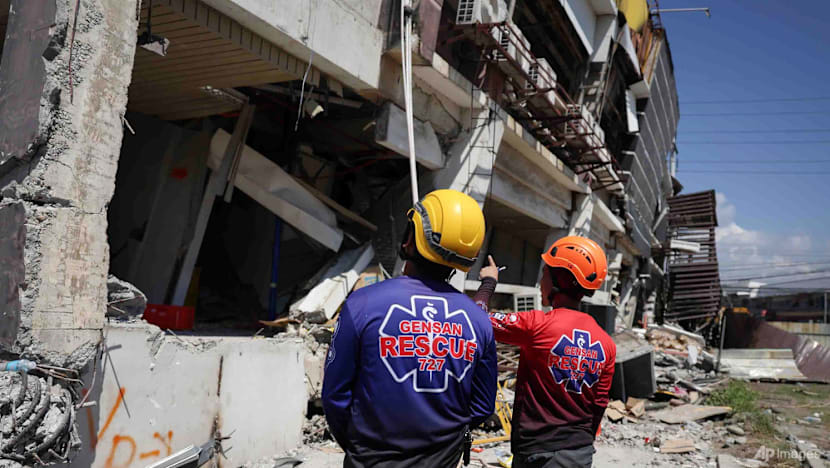
Rescuers inspecting a damaged building after an earthquake in General Santos, the Philippines, on Jun 9, 2026. (Photo: AP/Basilio Sepe)
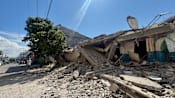
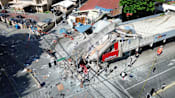
GENERAL SANTOS, Philippines: Rescuers searched the rubble on Tuesday (Jun 9) of a collapsed building in the southern Philippine city of General Santos, the worst hit by a powerful earthquake that has killed at least 37 people and injured hundreds, to reach two people still believed to be trapped inside.
Regional fire officer Edgar Tanawan, who is leading the operation, told Reuters that two people had been pulled out alive from the commercial building, housing a grocery store and other businesses, but a third was found dead.
Scanners have so far detected no signs of life from the remaining two, he added.
"It’s difficult to accept, as a mother, that my son is still trapped there," Dioslinda Deluvio said, distraught as she waited outside the building for news of her son. "I don’t know … it's very hard to accept.





"My only call is to have him retrieved today so we can be at peace," the 65-year-old mother added.
The 7.8-magnitude quake, which triggered tsunami warnings across several countries, struck early on Monday morning about 20km off the coast of Sarangani province, with tremors felt strongly across Mindanao and as far as the city of Manado, 420km away on the Indonesian island of Sulawesi.
Officials said they hoped the death toll would not rise further as search-and-rescue operations continued, with more than 400 people injured and four still missing.
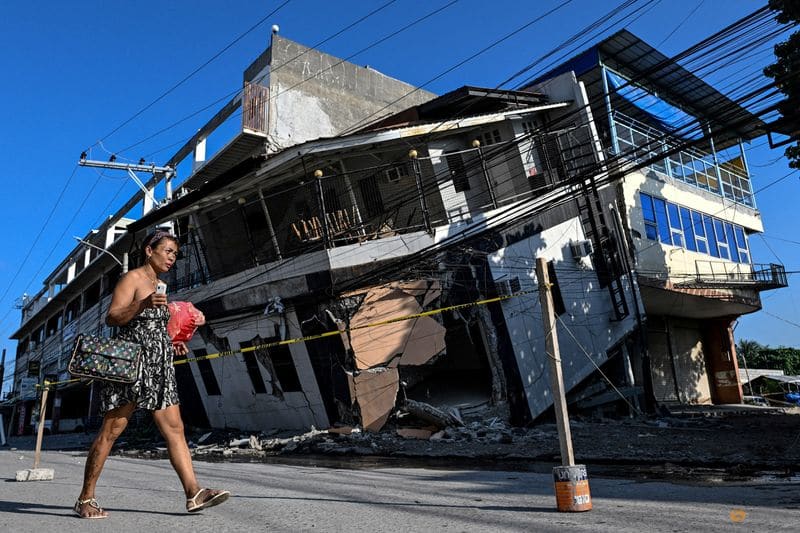
Scenes of devastation were visible in parts of General Santos, which is home to more than 700,000 people and now under a state of calamity, with several buildings collapsed and debris strewn across streets beneath a tangle of toppled power lines and utility posts.
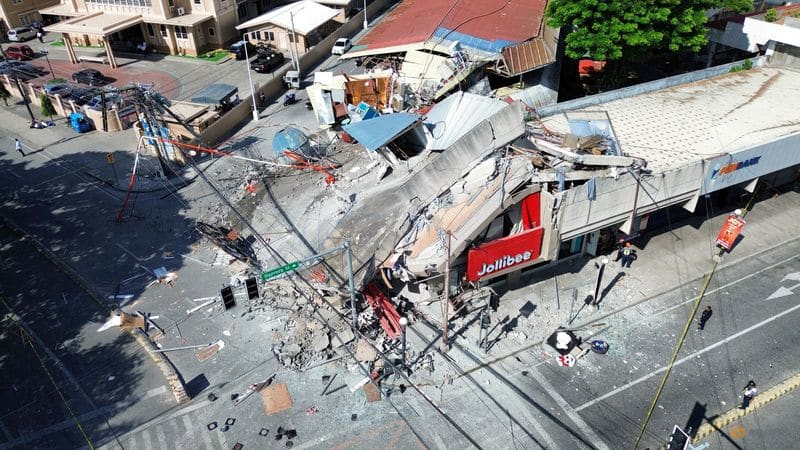
Philippine disaster officials scoured damaged buildings to assess damage and worked to restore power and water for the thousands of residents affected by the disaster.
The quake came eight months after the country suffered its deadliest tremor in 12 years, when a shallow 6.9 magnitude quake hit off the central island of Cebu, killing 79 people.
DAMAGE TO SCHOOLS, HOSPITALS
The Philippines experiences hundreds of quakes each year and sits on tectonically complex parts of the Pacific "Ring of Fire", a seismically active belt stretching from South America to the Russian Far East.
Rafaelito Alejandro, head of the office of civil defence, told DZBB radio that schools, which had just reopened on Monday after a long break, remained closed as the authorities checked the condition of school buildings, thousands of which sustained minor to severe damage.
A video shared by one school of the moment the quake struck showed a large group of children sitting on a floor swaying violently from side to side, some hugging teachers, before they fled en masse as a makeshift shelter collapsed behind them.
The Philippine Institute of Volcanology and Seismology recorded 23 strong aftershocks, with the strongest measuring magnitude 6.7, forcing some residents to spend the night in evacuation centres and tents.
In General Santos and Sarangani, patients were treated in makeshift tents as officials worked to ensure hospitals were safe, Health Secretary Teodoro Herbosa told DZBB, adding that the restoration of power was critical as outages limited access to sensitive and sophisticated treatments needed by patients.