Norway confirms decision to revoke missile licences for Malaysia, cites stricter export controls
The Norwegian foreign ministry said its decision was shaped by evolving security conditions in Europe and around the world
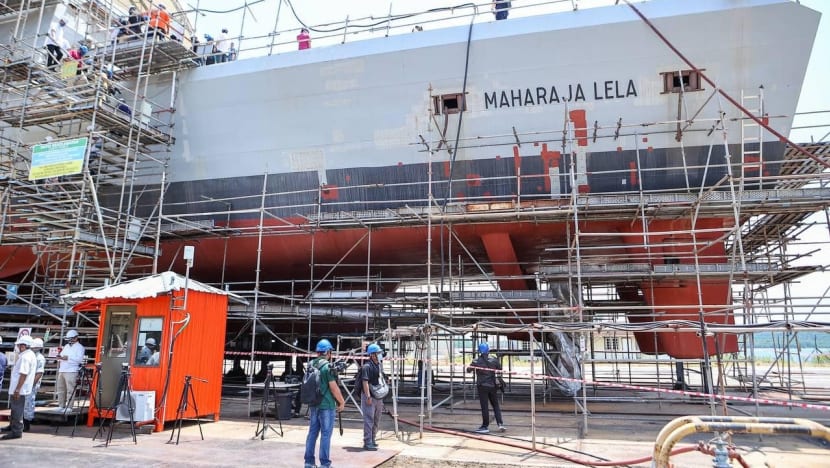
A littoral combat ship under construction at the Boustead naval shipyard in Lumut, Perak. (File Photo: Facebook/Hishammuddin Hussein)
KUALA LUMPUR: Norway has revoked export licences linked to a naval strike missile system intended for Malaysia, citing tighter restrictions on some of its most sensitive defence technologies amid a shifting global security landscape, its foreign ministry confirmed.
“The Ministry of Foreign Affairs can confirm that certain licenses related to the export of specific defence technology to Malaysia have been revoked,” the Norwegian Foreign Ministry said, as quoted by media reports on Thursday (May 14) and Friday.
“This is solely due to Norway’s application of the export control regulations and it is regrettable that this affects Malaysia.”
This comes as Malaysia Prime Minister Anwar Ibrahim earlier voiced his “vehement objection” to what he described as Norway’s "unilateral and unacceptable decision” to revoke the export approvals during a telephone conversation with his Norwegian counterpart Jonas Gahr Stoere.
"Malaysia has honoured every obligation under this contract since 2018: scrupulously, faithfully and without equivocation," Anwar wrote on Facebook.
"Norway, it appears, has not felt compelled to extend us the same courtesy and demonstration of good faith."
Anwar added that he had told Stoere that Norway’s move would have grave consequences for Malaysia's defence operational readiness and its littoral combat ship (LCS) modernisation programme and would "carry broader ramifications for the regional balance".
"Signed contracts are solemn instruments. They are not confetti to be scattered in so capricious a manner," said Anwar.
"If European defence suppliers reserve the right to renege with impunity, their value as strategic partners flies out the window."







Norway said its decision was shaped by evolving security conditions in Europe and around the world, prompting the government to strengthen oversight on domestically developed defence technologies.
“Exports of some of the most sensitive Norwegian-developed defence technologies will be limited to our allies and closest partners,” said the statement from the Norwegian foreign ministry, cited by local media platform, the New Straits Times on Friday.
It added that Oslo valued its relationship with Malaysia and looked forward to a constructive dialogue.
News agency AFP also reported the statement from Norway's foreign ministry.
Earlier, Malaysia’s Defence Minister Mohamed Khaled Nordin said there was no indication that the Norwegian government would reverse its decision.
“So far negative,” he told the New Straits Times on Thursday when asked if there had been any early signs Malaysia could still expect delivery of the missiles as previously agreed.
He gave the same response when asked if Kongsberg Defence and Aerospace (KDA), the developer of the naval strike missile system, would refund payments already made should the delivery fail to proceed.
According to the New Straits Times, Khaled added that Malaysia’s defence ministry had formed a special committee to assess the full scope of legal action against KDA, as the Malaysian government had already paid nearly 95 per cent of the total contract value, amounting to more than RM500 million (US$127 million).
"We are doing the computation right now - we would not only claim the amount that we have paid, but also the damages arising from the breach of contract," he told reporters, according to a recording of his remarks provided by the ministry to Reuters.
The defence ministry is also exploring alternatives to the naval strike missiles system, although Khaled acknowledged the challenges involved.
"But this is not easy. It is not like buying a car where the item is already available. These systems have to be ordered according to specifications, and they must be able to connect and communicate with other systems on the ship," he said at a press conference on Thursday, as quoted by the New Straits Times.
"However, we are looking for options that can be expedited. We must make the right and best choice for the country.”
Khaled said that the first indication of issues with the procurement of the naval strike missile system emerged when the delivery was not fulfilled in March.
The New Straits Times reported that Khaled had said that he would meet his Norwegian counterpart in Singapore later this month to seek clarification over Norway’s sudden decision to block the export licence for the missile system to Malaysia.
The defence arm of Norwegian group Kongsberg said in 2018 it had agreed a 124 million euros (US$145.23 million) contract with the Royal Malaysian Navy to supply naval strike missiles for six LCS.