Why is the Indonesian rupiah falling, and could confidence be cracking?
Despite the market volatility, analysts insist the current situation bears little resemblance to the 1998 Asian Financial Crisis, when the rupiah collapsed.
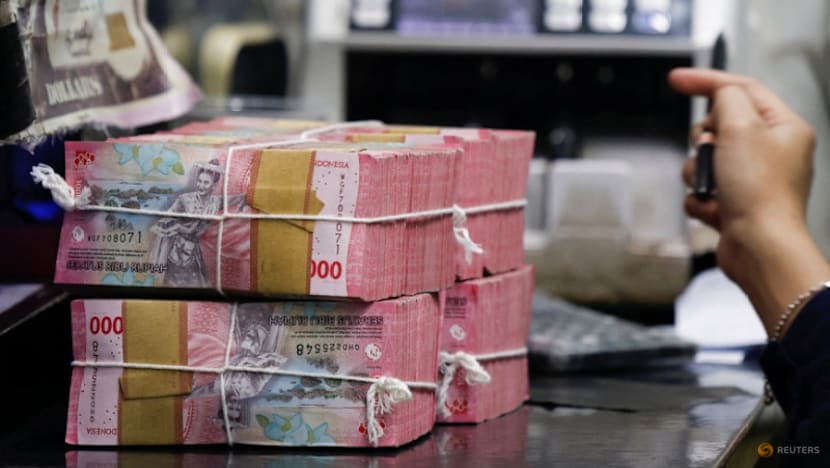
A teller prepares rupiah bank notes at a money changer in Jakarta, Indonesia, January 20, 2026. REUTERS/Ajeng Dinar Ulfiana

This audio is generated by an AI tool.




SINGAPORE: The Indonesian rupiah is facing renewed pressure, sinking to record lows against the US dollar amid growing investor concerns over the country’s fiscal outlook.
The currency has weakened to around 17,600 rupiah against the greenback, crossing the symbolic 17,000 level that markets have long regarded as a psychological threshold.
Many Indonesians associate this level with the 1998 Asian Financial Crisis, when the rupiah collapsed, inflation surged, banks failed and widespread unrest eventually brought an end to former president Suharto’s three-decade rule.
The rupiah has depreciated by about 5 per cent so far this year, making it one of the worst-performing currencies in Asia.





RUPIAH’S SLIDE FUELS INVESTOR CONCERNS
While analysts stress that Indonesia’s economy is far stronger than it was during the late 1990s crisis, the sharp decline has still unsettled investors and reignited concerns over inflation and policy direction.
“The increasing oil prices are certainly unfavourable, and this leads to some concerns on the inflation front,” said Roman Ziruk, a senior market analyst at fintech firm Ebury.
“With regards to domestic factors, investors have worried about the fiscal situation, and central bank independence.”
Economists note that Indonesia’s economic fundamentals today are considerably stronger than in the past.
Banks are better capitalised, foreign reserves are healthier and economic growth remains above 5 per cent.
But markets are increasingly questioning Indonesia’s fiscal outlook, particularly as higher global oil prices threaten to raise fuel subsidy costs and place additional strain on government finances.
“The deeper issue is that Indonesia’s risk premium is being repriced,” said Josua Pardede, chief economist at Permata Bank.
“Investors are worried that higher oil prices will increase subsidy and compensation costs, weaken fiscal credibility, push bond yields higher, and limit Bank Indonesia’s room to ease policy.”
Those worries are rippling across financial markets.
Indonesian stocks have fallen sharply, while the rupiah’s decline has prompted repeated intervention by the central bank to stabilise the currency.
Investors are also scrutinising the government’s broader economic direction, including concerns over policy credibility and the growing role of the state in business.
In response, Indonesia’s finance ministry recently urged Indonesians to bring offshore assets home within six months, even without offering a formal tax amnesty.
Analysts believe the move could help improve domestic liquidity, though it may also heighten unease about capital flight.
This measure alone “is not enough to support confidence”, said Charu Chanana, chief investment strategist at Saxo.
“On one hand, it's actually quite positive because it supports domestic liquidity, and potentially that could ease some pressure on the rupiah. It also sends a message that the government wants to strengthen compliance,” she added.
“But if markets see this as a sign that authorities are becoming worried about capital flight or dollar shortages, then sentiment could again be hit.”


ANALYSTS DOWNPLAY CRISIS COMPARISONS
Despite the market volatility, analysts insist the current situation bears little resemblance to the 1998 crisis.
“There is no comparison with the 1998 crisis,” said Ziruk. “Indonesia’s economy looks much healthier. Inflation is quite contained. The banking system is much stronger.
“There are much more regulations, and the political situation is also not comparable.”
He added that Indonesia’s external debt burden is far lower relative to gross domestic product, while unhedged corporate foreign debt is no longer viewed as a major systemic risk.
Seasonal demand for US dollars during the second quarter is also putting additional pressure on the rupiah, as companies make dividend payments, service debt and pay for imports.
That could keep the currency volatile even if broader global market sentiment improves.
“Because investors are charging Indonesia a higher uncertainty discount ... the policy response should therefore go beyond intervention,” said Pardede.
“Bank Indonesia can smooth volatility, but the government must strengthen the confidence story through clear fiscal discipline.”
A weaker rupiah could still provide some benefits.
Exporters earning revenue in foreign currencies may become more competitive, tourism could receive a boost, and households receiving remittances from abroad may gain more value from every dollar sent home, observers said.
However, analysts believe the downsides are likely to outweigh the benefits.
For most Indonesians, the impact of a weaker rupiah is likely to be felt most directly through rising everyday costs.
“I think the costs of a weaker currency are really much broader,” said Chanana.
“(There is) imported inflation because of higher fuel and food costs. Also from a more government perspective, the added cost of servicing the foreign debt,” she added.
“Those negatives really have bigger weight compared to the positives, and particularly also because of the pace at which the rupiah has declined.”